


Trimethylamine N-oxide in atrial fibrillation progression
- PMID: 32885030
- PMCID: PMC7452421
- DOI: 10.1016/j.ijcha.2020.100554
Trimethylamine N-oxide in atrial fibrillation progression
Erratum in
-
Erratum regarding missing Declaration of Competing Interest statements in previously published articles.Int J Cardiol Heart Vasc. 2020 Nov 18;31:100676. doi: 10.1016/j.ijcha.2020.100676. eCollection 2020 Dec. Int J Cardiol Heart Vasc. 2020. PMID: 33364333 Free PMC article.
Abstract
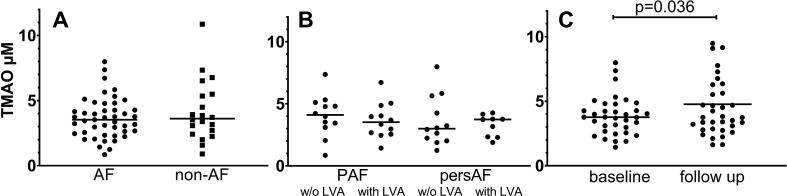
The human gut microbiome and its metabolite Trimethylamine N-oxide (TMAO) are sensitive to the human diet and are involved in the complex pathomechanisms that underpin diabetes, obesity, and cardiovascular diseases. A potential involvement of increased TMAO in atrial fibrillation (AF) manifestation and progression is not clear. We measured TMAO in peripheral blood of 45 AF patients and 20 non-AF individuals (matched for age, sex, BMI, prevalence of hypertension and diabetes). TMAO levels in AF (median [IQR] 3.5 µM [2.51-4.53]) were comparable with those in non-AF individuals (3.62 µM [2.49-5.46]) (p = 0.629). There was no association between TMAO and AF progression phenotypes (p = 0.588). In 35 AF patients, TMAO was additionally measured 12-18 months after AF catheter ablation. TMAO levels at baseline and follow-up were correlated (r = 0.481, p = 0.003), and TMAO was increased independent from the success (restoration of sinus rhythm) of the ablation procedure. The data of this pilot study indicate that TMAO is not generally higher in AF and is not associated with AF progression phenotypes. The observed TMAO increase 12-18 months after AF catheter ablation needs further investigation in a larger cohort.
Keywords: Atrial fibrillation; Atrial fibrillation progression; Recurrences; Trimethylamine N-oxide.
© 2020 The Authors.
Figures
References
-
- Büttner P., Schumacher K., Dinov B., Zeynalova S., Sommer P., Bollmann A., Husser D., Hindricks G., Kornej J. Role of NT-proANP and NT-proBNP in patients with atrial fibrillation: association with atrial fibrillation progression phenotypes. Heart Rhythm. 2018:1132–1137. doi: 10.1016/j.hrthm.2018.03.021. - DOI - PubMed
-
- Yu L., Meng G., Huang B., Zhou X., Stavrakis S., Wang M., Li X., Zhou L., Wang Y., Wang M., Wang Z., Deng J., Po S.S., Jiang H. A potential relationship between gut microbes and atrial fibrillation: Trimethylamine N-oxide, a gut microbe-derived metabolite, facilitates the progression of atrial fibrillation. Int. J. Cardiol. 2018;255:92–98. doi: 10.1016/j.ijcard.2017.11.071. - DOI - PubMed
LinkOut - more resources
Full Text Sources
