


COVID-19 and possible links with Parkinson's disease and parkinsonism: from bench to bedside
- PMID: 32885037
- PMCID: PMC7441399
- DOI: 10.1038/s41531-020-00123-0
COVID-19 and possible links with Parkinson's disease and parkinsonism: from bench to bedside
Abstract
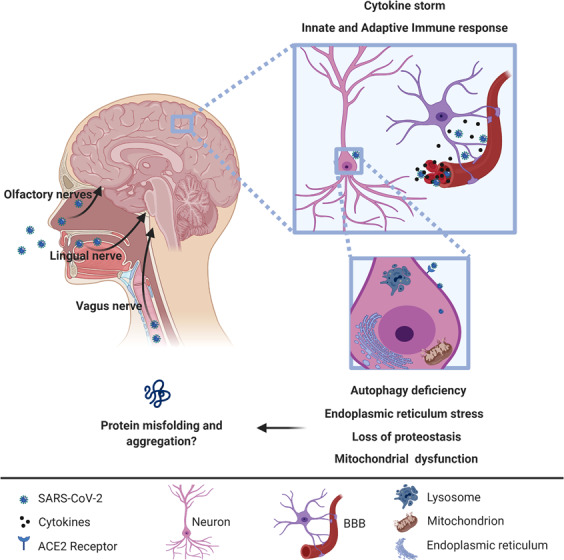
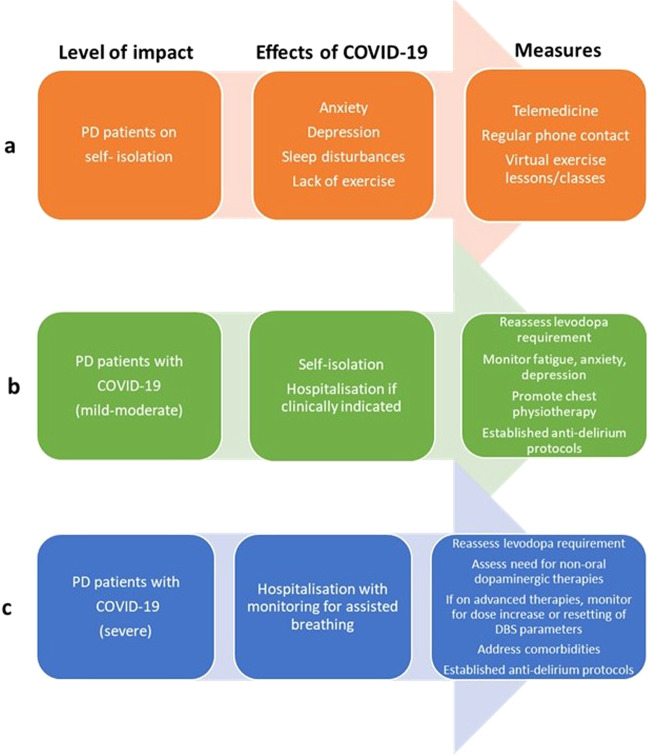
This Viewpoint discusses insights from basic science and clinical perspectives on coronavirus disease 2019 (COVID-19)/severe acute respiratory syndrome-coronavirus-2 (SARS-CoV-2) infection in the brain, with a particular focus on Parkinson's disease. Major points include that neuropathology studies have not answered the central issue of whether the virus enters central nervous system neurons, astrocytes or microglia, and the brain vascular cell types that express virus have not yet been identified. Currently, there is no clear evidence for human neuronal or astrocyte expression of angiotensin-converting enzyme 2 (ACE2), the major receptor for viral entry, but ACE2 expression may be activated by inflammation, and a comparison of healthy and infected brains is important. In contrast to the 1918 influenza pandemic and avian flu, reports of encephalopathy in COVID-19 have been slow to emerge, and there are so far no documented reports of parkinsonism apart from a single case report. We recommend consensus guidelines for the clinical treatment of Parkinson's patients with COVID-19. While a role for the virus in causing or exacerbating Parkinson's disease appears unlikely at this time, aggravation of specific motor and non-motor symptoms has been reported, and it will be important to monitor subjects after recovery, particularly for those with persisting hyposmia.
Keywords: Translational research.
© The Author(s) 2020.
Conflict of interest statement
Competing interestsD.S. and K.R.C. are Editors in Chief for npj Parkinson’s Disease. E.M. is Associate Editor for npj Parkinson’s Disease. A.A has received compensation for consultancy and speaker related activities from UCB, Boehringer Ingelheim, AbbVie, Zambon, Bial, Ever Pharma, Neuroderm, Theravance Biopharma, Biogen, outside the submitted work; he receives research support from Chiesi Pharmaceuticals, Lundbeck, Horizon 2020 - PD_Pal Grant 825785, Ministry of Education University and Research (MIUR) Grant ARS01_01081, Cariparo Foundation, outside the submitted work. He serves as consultant for Boehringer–Ingelheim for legal cases on pathological gambling, outside the submitted work. V.L., A.N., R.J.S., J.E.G., O.A., L.Z., A.S., L.B., O.M., A.S.H., Y.X., and S.F. declare that there are no competing interests.
Figures
References
-
- Reperant LA, Kuiken T, Osterhaus AD, Webby RJ, Webster RG. Influenza viruses: from birds to humans. Emergence of influenza A viruses. Hum. Vaccin. Immunother. 2012;8:7–16. - PubMed
Publication types
Grants and funding
LinkOut - more resources
Full Text Sources
Miscellaneous
