


Developing a delivery science for artificial intelligence in healthcare
- PMID: 32885053
- PMCID: PMC7443141
- DOI: 10.1038/s41746-020-00318-y
Developing a delivery science for artificial intelligence in healthcare
Abstract
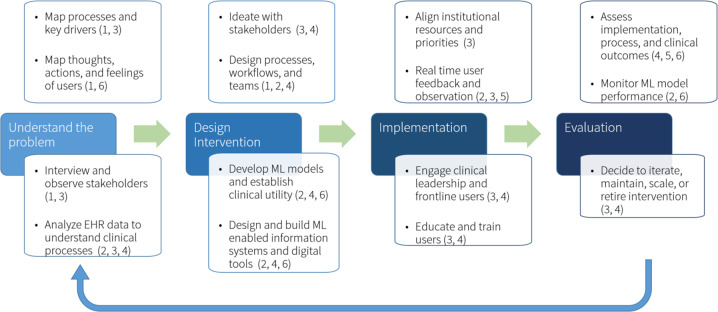
Artificial Intelligence (AI) has generated a large amount of excitement in healthcare, mostly driven by the emergence of increasingly accurate machine learning models. However, the promise of AI delivering scalable and sustained value for patient care in the real world setting has yet to be realized. In order to safely and effectively bring AI into use in healthcare, there needs to be a concerted effort around not just the creation, but also the delivery of AI. This AI "delivery science" will require a broader set of tools, such as design thinking, process improvement, and implementation science, as well as a broader definition of what AI will look like in practice, which includes not just machine learning models and their predictions, but also the new systems for care delivery that they enable. The careful design, implementation, and evaluation of these AI enabled systems will be important in the effort to understand how AI can improve healthcare.
Keywords: Health services; Translational research.
© The Author(s) 2020.
Conflict of interest statement
Competing interestsThe authors declare no competing interests.
Figures
References
-
- Fihn, S. D. et al. Deploying AI in Clinical Settings. In Artificial Intelligence in Health Care: The Hope, the Hype, the Promise, the Peril (eds Matheny, M., Thadaney-Israni, S., Ahmed, M. & Whicher, D.) (National Academy of Medicine, 2019).
LinkOut - more resources
Full Text Sources
