


Modeling the spread of COVID-19 in Germany: Early assessment and possible scenarios
- PMID: 32886696
- PMCID: PMC7473552
- DOI: 10.1371/journal.pone.0238559
Modeling the spread of COVID-19 in Germany: Early assessment and possible scenarios
Abstract
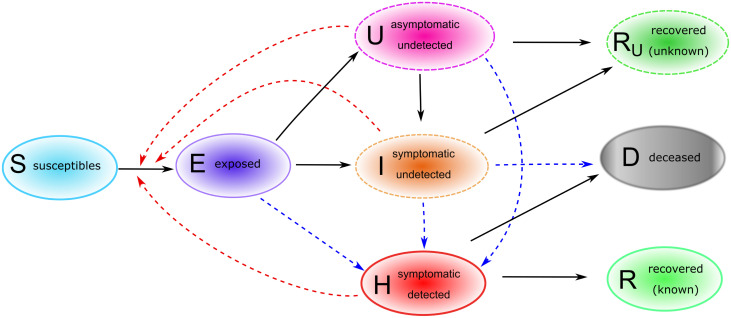
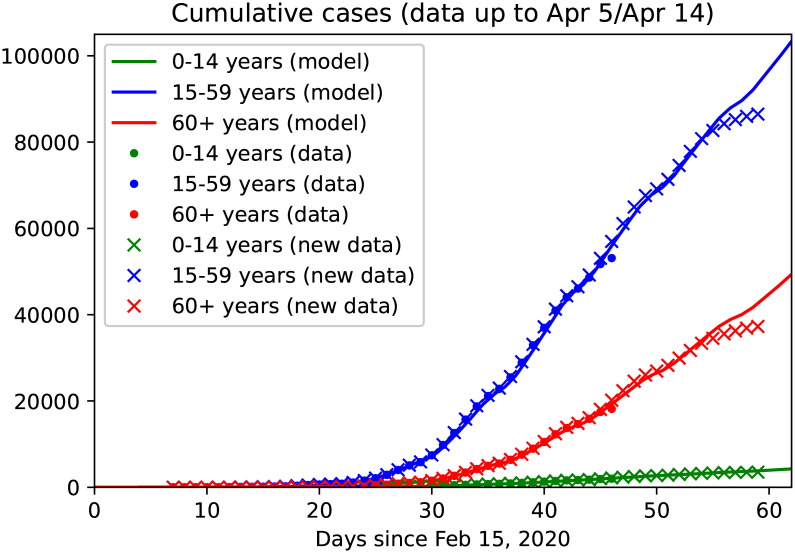
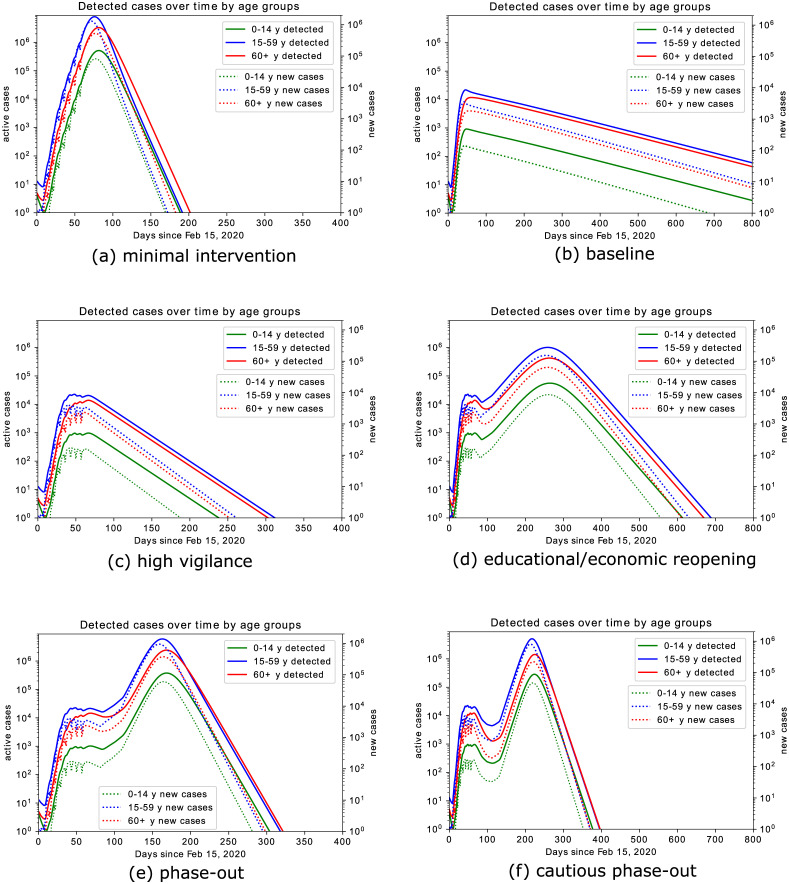
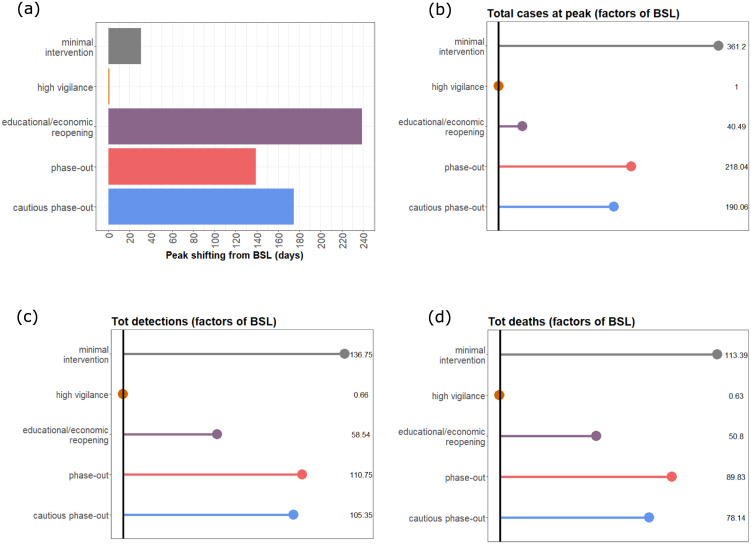
The novel coronavirus (SARS-CoV-2), identified in China at the end of December 2019 and causing the disease COVID-19, has meanwhile led to outbreaks all over the globe with about 2.2 million confirmed cases and more than 150,000 deaths as of April 17, 2020. In this work, mathematical models are used to reproduce data of the early evolution of the COVID-19 outbreak in Germany, taking into account the effect of actual and hypothetical non-pharmaceutical interventions. Systems of differential equations of SEIR type are extended to account for undetected infections, stages of infection, and age groups. The models are calibrated on data until April 5. Data from April 6 to 14 are used for model validation. We simulate different possible strategies for the mitigation of the current outbreak, slowing down the spread of the virus and thus reducing the peak in daily diagnosed cases, the demand for hospitalization or intensive care units admissions, and eventually the number of fatalities. Our results suggest that a partial (and gradual) lifting of introduced control measures could soon be possible if accompanied by further increased testing activity, strict isolation of detected cases, and reduced contact to risk groups.
Conflict of interest statement
The authors have declared that no competing interests exist. The affiliation of some of the authors with the Forschungszentrum Jülich GmbH does not alter our adherence to PLOS ONE policies on sharing data and materials.
Figures

References
-
- ECDC COVID-19 European Center for Disease Prevention and Control 2020. Available online: https://www.ecdc.europa.eu/en/covid-19-pandemic (last accessed on April 2, 2020)
-
- WHO Coronavirus disease 2019 (COVID-19) Situation Report—73 World Health Organisation 2020. Available online: https://www.who.int/docs/default-source/coronaviruse/situation-reports/2...
-
- Johns Hopkins University Coronavirus Resouce Center. Johns Hopkins Center for Systems Science and Engineering 2020. Available online: https://coronavirus.jhu.edu/#covid-19-basics (last accessed on April 2, 2020)
-
- RKI Coronavirus SARS-CoV-2—dedicated homepage of the Robert Koch-Institute, Berlin, Germany 2020. Available online: https://www.rki.de/DE/Content/InfAZ/N/Neuartiges_Coronavirus/nCoV_node.html (last accessed on April 2, 2020)
-
- WHO Team Modes of transmission of virus causing COVID-19:implications for IPC precaution recommendations World Health Organisation—Department of Communication 2020. Available online: WHO Reference Number: WHO/2019-nCoV/Sci_Brief/Transmission_modes/2020.2 (last accessed on April 2, 2020)
Publication types
MeSH terms
LinkOut - more resources
Full Text Sources
Miscellaneous
