. 2020 Sep 4;21(1):109.
doi: 10.1186/s10194-020-01177-4.

Improvements across a range of patient-reported domains with fremanezumab treatment: results from a patient survey study

Affiliations

Improvements across a range of patient-reported domains with fremanezumab treatment: results from a patient survey study

Dawn C Buse et al. J Headache Pain. .

Abstract

Background: The long-term safety and efficacy of fremanezumab were evaluated in a 52-week extension study (NCT02638103). Patient satisfaction with fremanezumab, dosing preferences, and patient-reported outcomes were assessed in a subpopulation who completed the extension study and consented to a follow-up questionnaire.

Methods: In the extension study (N = 1842), adults with migraine were randomized to quarterly or monthly fremanezumab. After completing active treatment, patients answered a survey evaluating patient satisfaction, treatment and dosing preferences, and changes in patient-reported outcomes.

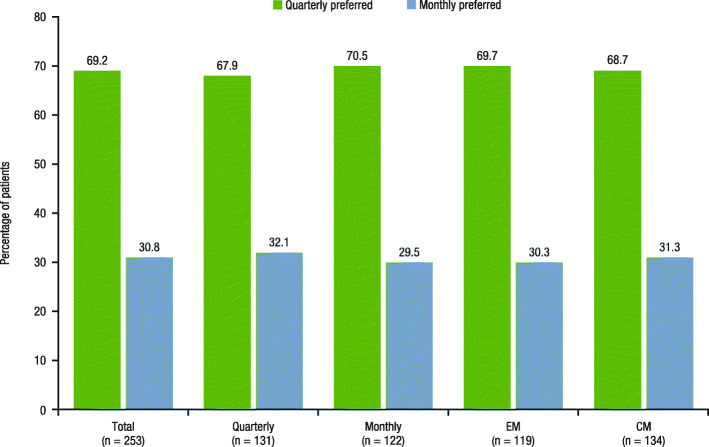
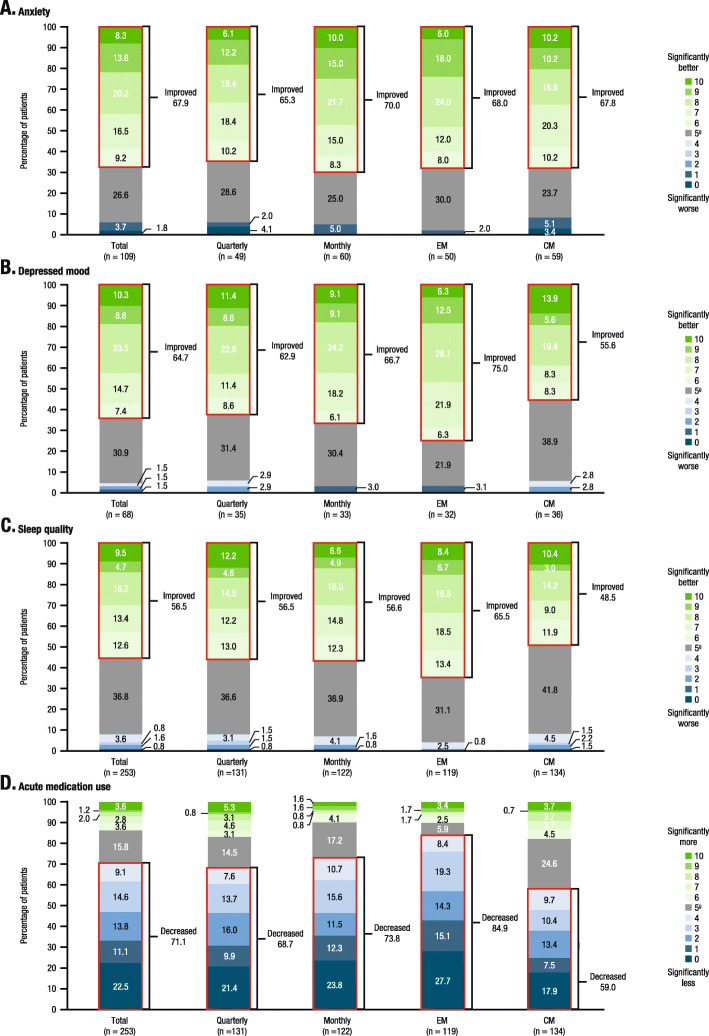
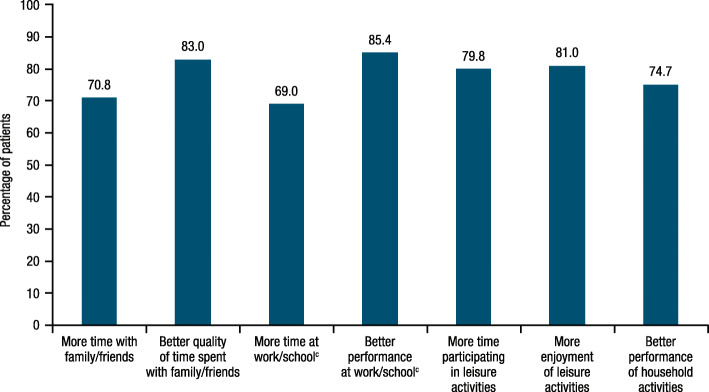
Results: Of the 557 patients who could have been contacted upon completing the extension study, 302 consented and 253 completed the survey. The mean (standard deviation) satisfaction rating for fremanezumab was 6.1 (1.4; 1 = "extremely dissatisfied" to 7 = "extremely satisfied"). Most patients (175 [69.2%]) preferred quarterly over monthly fremanezumab dosing. Among patients taking antiepileptics (most common class of prior preventive medication; n = 130), 91.5% preferred fremanezumab. Patients reported improvements in anxiety (74 [67.9%]), sleep quality (143 [56.5%]), and quality of time spent with others (210 [83.0%]) with fremanezumab.

Conclusion: In this study, treatment satisfaction with fremanezumab was high, most patients preferred quarterly fremanezumab dosing, and fremanezumab was generally preferred to prior preventive medications.

Trial registration: ClinicalTrials.gov NCT02638103 (HALO LTS), registered December 22, 2015.

Keywords: Anxiety; Migraine; Prevention; Satisfaction; Sleep; Treatment preference.


Conflict of interest statement

DCB has received grant support and honoraria from Allergan, Amgen, Avanir, Biohaven, Lilly, Promius, and Teva Pharmaceuticals. She is on the editorial board of Current Pain and Headache Reports. RPC has received consulting fees and honoraria from Teva Pharmaceuticals, Amgen, Alder, and Lilly. SKG, JMC, VR-C, and RY are employees of Teva Pharmaceuticals. BC had no conflicts of interest to report.

Figures

Fig. 1
Fig. 1
Patient satisfaction with efficacy dimensions of fremanezumaba. CM, chronic migraine; EM, episodic migraine. aPatients responded to the following question: “Thinking specifically of the experimental medicine’s ability to prevent migraine, with which dimension of your migraine relief were you satisfied? Select all that apply.” This question had the following response options: “reducing attack frequency,” “reducing migraine pain intensity,” “reducing attack duration,” “reducing migraine-associated symptoms (like nausea, light & sound sensitivity),” “reducing migraine associated disability (ability to work and participate in activities),” and “none of the above”
Fig. 2
Fig. 2
Patient-reported preference for quarterly or monthly fremanezumab dosing regimena. CM, chronic migraine; EM, episodic migraine. aPatients responded to the following question: “If the effectiveness was similar no matter which option you choose, would you rather take the injectable migraine medicine once a month, or once every 3 months?” This question had the following response options: “monthly” or “once every 3 months”
Fig. 3
Fig. 3
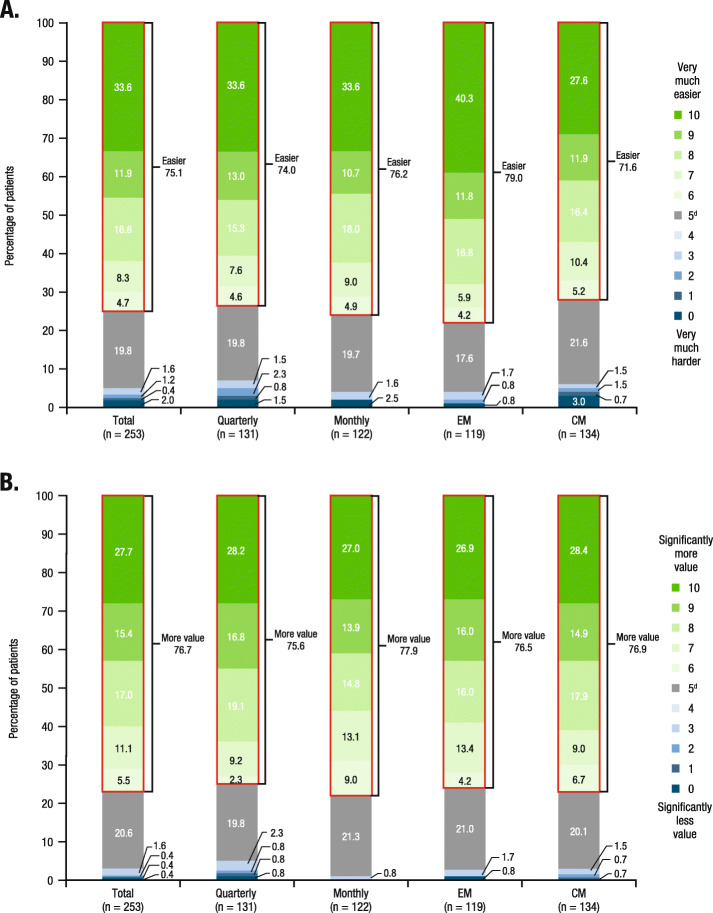
Patient perceptions of dosing flexibility: a impact on ease of usea; b valueb,c. CM, chronic migraine; EM, episodic migraine. aFor patient perceptions of the impact of dosing flexibility on the ease of taking a migraine preventive treatment as prescribed, patients responded to the following question: “We want to learn from you the importance of having a choice of dosing frequency for this migraine medicine. The dosing frequencies are either monthly or every-3-months. On a scale of 0 to 10, where 0 is ‘very much harder’ and 10 is ‘very much easier,’ how much harder or easier would it be to take your medicine regularly, as prescribed by your doctor, if you had the flexibility to select either monthly or every-3-month injections, based on your preference after discussion with your doctor?” bFor patient perceptions on the value of having dosing flexibility to allow taking the injection quarterly or monthly, patients responded to the following question: “On a scale of 0 to 10, where 0 is ‘significantly less value’ and 10 is ‘much more value,’ how much more valuable to you is the flexibility of taking your injection either once a month or once every 3 months after consulting with your doctor?” cPercentages may not total 100%. dNo difference
Fig. 4
Fig. 4
Patient perceptionsa; a anxietyb,c; b depressed moodb,d; c sleep qualityb; d acute medication use changese,f. CM, chronic migraine; EM, episodic migraine. aChanges from baseline; 3-month baseline period before the first injection during fremanezumab treatment. bFor the changes in anxiety, depressed mood, and sleep quality, patients responded to the following questions: “Compared to the 3-month baseline period before the first injection, on a scale of 0 to 10, where 0 is ‘significantly worse’ and 10 is ‘significantly better’…” “…how much change in anxiety level did you feel while you were taking the study medicine?” “…how much change in depressed mood did you feel while you were taking the study medicine?” “…how much worse or better was your sleep quality while you were taking the study medicine compared to the 3-month baseline period before the first injection?”. cImpact of fremanezumab treatment on anxiety was only evaluated for patients with self-reported anxiety during the 3-month baseline period (n = 109). dDue to a data anomaly, the baseline depression question was re-validated among survey participants. The results here are in a sub-sample of patients with self-reported depressed mood during the baseline period (n = 68). eFor the changes in acute medication use, patients responded to the following question: “Compared to the 3-month baseline period before the first injection, on a scale of 0 to 10, where 0 is ‘significantly less’ and 10 is ‘much more,’ how much did you rely on rescue or abortive medicines that stop migraine symptoms (ex: sumatriptan, naratriptan, rizatriptan) and over-the-counter medicines while you were taking the study medicine?” fPercentages may not total 100% due to rounding. gNo difference
Fig. 5
Fig. 5
Proportion of patients overall who reported improvements in psychosocial and quality-of-life domains (n = 253)a,b. aFor time with family/friends, quality of time with family/friends, time at work/school, time participating in leisure activities, and enjoyment of leisure activities, patients responded to the following questions: “Compared to the 3-month baseline period before the first injection, on a scale of 0 to 10, where 0 is ‘significantly less’ and 10 is ‘significantly more,’…” “…how much less or more time did you spend with friends and family while you were taking the study medicine?” “…how much change did you experience in the quality of time you spent with your friends and family while you were taking the study medicine?” “…how much less or more were you able to attend work or school while you were taking the study medicine?” “…how much less or more could you participate in leisure and personal activities (i.e., hobbies) while you were taking the study medicine?” “…how much less or more were you able to enjoy leisure and personal activities while you were taking the study medicine?” bFor performance at work/school and performance of household activities, patients responded to the following questions: “Compared to the 3-month baseline period before the first injection, on a scale of 0 to 10, where 0 is ‘significantly worse’ and 10 is ‘significantly better,’…” “…how did your work or school performance change while you were taking the study medicine?” “…how much did your ability to perform household activities and chores change while you were taking the study medicine?” cn = 213

References

    1. Pringsheim T, Davenport W, Mackie G, Worthington I, Aube M, Christie SN et al (2012) Canadian Headache Society guideline for migraine prophylaxis. Can J Neurol Sci 39(2 Suppl 2):S1–S59 - PubMed
    1. Diamond S, Bigal ME, Silberstein S, Loder E, Reed M, Lipton RB. Patterns of diagnosis and acute and preventive treatment for migraine in the United States: results from the American Migraine Prevalence and Prevention study. Headache. 2007;47(3):355–363. - PubMed
    1. Antonaci F, Dumitrache C, De Cillis I, Allena M. A review of current European treatment guidelines for migraine. J Headache Pain. 2010;11(1):13–19. doi: 10.1007/s10194-009-0179-2. - DOI - PMC - PubMed
    1. American Headache Society (2019) The Amercan Headache Society position statement on integrating new migraine treatments into clinical practice. Headache. 59(1):1–18 - PubMed
    1. Lipton RB, Munjal S, Alam A, Buse DC, Fanning KM, Reed ML, et al. Migraine in America Symptoms and Treatment (MAST) study: baseline study methods, treatment patterns, and gender differences. Headache. 2018;58(9):1408–1426. doi: 10.1111/head.13407. - DOI - PubMed

Associated data