


A group-based mental health intervention for young people living with HIV in Tanzania: results of a pilot individually randomized group treatment trial
- PMID: 32887558
- PMCID: PMC7487650
- DOI: 10.1186/s12889-020-09380-3
A group-based mental health intervention for young people living with HIV in Tanzania: results of a pilot individually randomized group treatment trial
Abstract
Background: Increasing numbers of young people living with HIV (YPLWH) have unaddressed mental health challenges. Such challenges are associated with poor antiretroviral therapy (ART) adherence and high mortality. Few evidence-based mental health interventions exist to improve HIV outcomes among YPLWH.
Methods: This pilot group treatment trial individually randomized YPLWH from two clinical sites in Tanzania, evaluated acceptability, feasibility, and preliminary effectiveness of a mental health intervention, Sauti ya Vijana (SYV; The Voice of Youth), was compared to the local standard-of-care (SOC) for improving ART adherence and virologic suppression. Enrolled YPLWH were 12-24 years of age and responded to mental health and stigma questionnaires, self-reported adherence, objective adherence measures (ART concentration in hair), and HIV RNA at baseline and 6-months (post-intervention). Feasibility and acceptability were evaluated, and potential effectiveness was assessed by comparing outcomes between arms using mixed effects modeling.
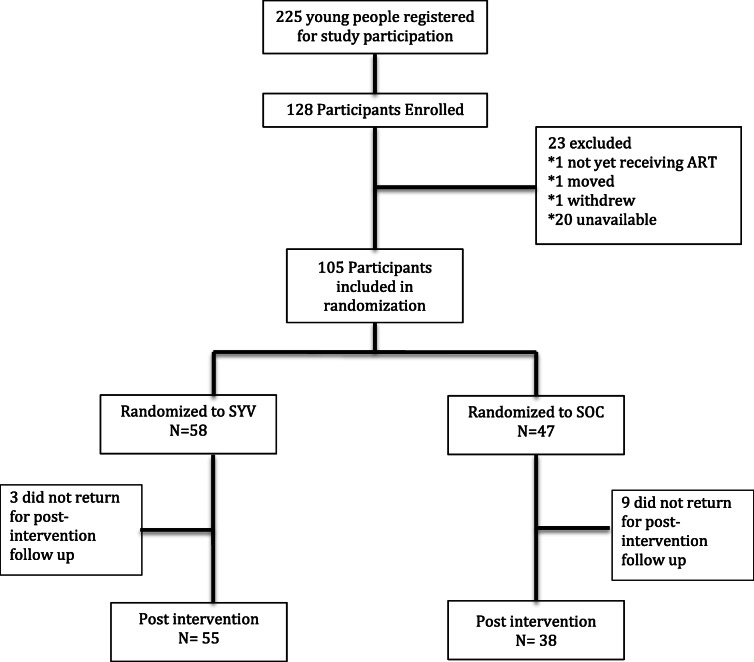
Results: Between June 2016 and July 2017, 128 YPLWH enrolled; 105 were randomized and 93 (55 in SYV) followed-up at 6-months and were thereby included in this analysis. Mean age was 18.1 years; 51% were female; and 84% were HIV-infected perinatally. Attendance to intervention sessions was 86%; 6-month follow-up was 88%, and fidelity to the protocol approached 100%. Exploratory analyses of effectiveness demonstrated self-reported adherence improved by 7.3 percentage points (95% CI: 2.2, 12.3); and the pooled standard deviation for all ART concentration values increased by 0.17 units (95% CI: - 0.52, 0.85) in the SYV arm compared to SOC. Virologic suppression rates (HIV RNA < 400 copies/mL) at baseline were 65% in both arms but increased to 75% in the SYV arm while staying the same in the SOC arm (RR 1.13; 95% CI: 0.94, 1.36).
Conclusions: YPLWH often have poor HIV outcomes, making interventions to improve outcomes in this population critical. This pilot trial of the Tanzania-based SYV intervention demonstrated trends towards improvement in ART adherence and virologic outcomes among YPLWH, supporting efforts to scale the intervention into a fully-powered effectiveness trial.
Trial registration: ClinicalTrials.gov Identifier: NCT02888288 . Registered August 9, 2016. Retrospectively registered as first participant enrolled June 16, 2016.
Keywords: ART adherence; Adolescent; Africa; HIV; HIV RNA; Intervention; Mental health; Tanzania; Viral load; Young people.
Conflict of interest statement
Authors have no conflict of interest to declare.
Figures
References
-
- UNAIDS. Youth and HIV. Accessed on 17 August 2018. Accessed at http://www.unaids.org/en/resources/documents/2018/youth-and-hiv. 2018.
-
- Bernays S, Jarrett P, Kranzer K, Ferrand RA. Children growing up with HIV infection: the responsibility of success. Lancet. 2014;383(9925):1355–1357. - PubMed
-
- The Joint United Nations Programme on HIV/AIDS (UNAIDS). The Youth Bulge and HIV. 2018. Available at www.unaids.org/en/resources/documents/2018/the-youth-bulge-and-hiv. Last accessed 12 May 2020.
