. 2020 Sep 4;20(1):1348.
doi: 10.1186/s12889-020-09401-1.

Bayesian spatial analysis of socio-demographic factors influencing pregnancy termination and its residual geographic variation among ever-married women of reproductive age in Bangladesh

Affiliations

Bayesian spatial analysis of socio-demographic factors influencing pregnancy termination and its residual geographic variation among ever-married women of reproductive age in Bangladesh

Rifat Zahan et al. BMC Public Health. .

Abstract

Background: Unsafe pregnancy termination is a major public health concern among reproductive-aged women in many developing countries. This study evaluated the socio-demographic characteristics, as well as residual spatial correlation in pregnancy termination among Bangladeshi women.

Methods: Secondary data was obtained from the Bangladesh Demographic and Health Survey for the survey year 2014. Data included 17,863 samples of ever-married women between the ages of 15-49 years, which is a national representative sample in Bangladesh. Bayesian spatial logistic regression was used to assess the associations between socio-demographic characteristics and pregnancy termination. We flexibly modeled the non-linear effects of the continuous covariates while accounting for residual spatial correlation at the district level.

Results: Our findings revealed that about 19% of the respondents in Bangladesh reported ever had a pregnancy terminated. The risk of pregnancy termination was higher among women who had been working, had a higher wealth index, were in a conjugal relationship, had no children, were older and started their cohabitation earlier. Residual spatial patterns revealed the areas at a higher risk of pregnancy termination, including Panchagarh, Habiganj, and Sylhet after adjusting for covariates.

Conclusions: Prevalence of pregnancy termination remains considerably high in Bangladesh. The study revealed significant associations of women's age at survey time, age at first cohabitation, occupational status, socio-economic status, marital status and the total number of children ever born with reporting having a history of terminated pregnancy among Bangladeshi ever-married women. The identified socio-demographic characteristics and districts at an increased likelihood of pregnancy termination can inform localized intervention and prevention strategies to improve the reproductive healthcare of women in Bangladesh.

Keywords: Bangladesh; Bayesian logistic regression; Pregnancy termination; Reproductive health; Spatial analysis.


Conflict of interest statement

The authors declare that they have no competing interest.

Figures

Fig. 1
Fig. 1
Partial effects of age at survey time (left panel) and age at first cohabitation (right panel) based on the best fitting model, i.e. CAR model adjusting all the covariates presented in Table 3. The blue points are the posterior mean estimates of the random effects for the age variables and the black vertical lines are the 95% point-wise confidence intervals. R [32] package ggplot2 [34] was used to generate the graphs
Fig. 2
Fig. 2
Posterior mean (left) and standard deviation (right) of the district-level random effect for the best fitting model, i.e. CAR model adjusting for all the covariates presented in Table 3. The shape file of Bangladesh administrative level 2 (i.e., district-level) was downloaded from the link: https://gadm.org/download_country_v3.html, which is freely available for academic use and other non-commercial use. R [32] package rgdal [33] was used to read the shape file, and R package ggplot2 [34] was used to generate the maps
Fig. 3
Fig. 3
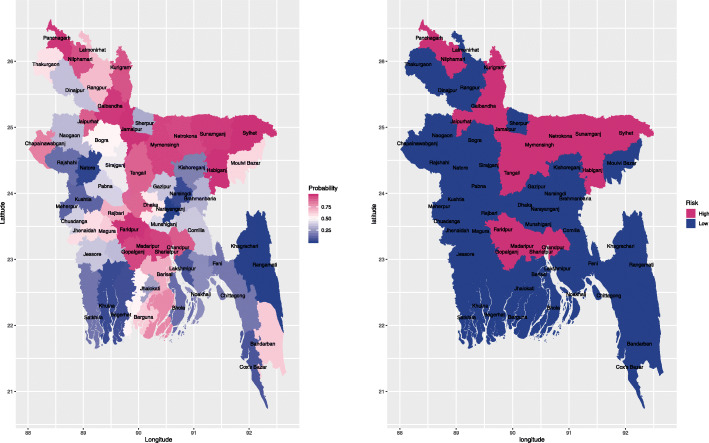
Posterior estimate of exceedance probabilities, defined as qi=pebi>1 (left) and districts with significantly elevated risk of reporting pregnancy termination [exceedance probability >0.90] (right), based on the best fitting model, i.e., CAR model adjusting for all the covariates presented in Table 3. The shape file of Bangladesh administrative level 2 (i.e., district-level) was downloaded from the link: https://gadm.org/download_country_v3.html, which is freely available for academic use and other non-commercial use. R [32] package rgdal [33] was used to read the shape file, and R package ggplot2 [34] was used to generate the maps
Fig. 4
Fig. 4
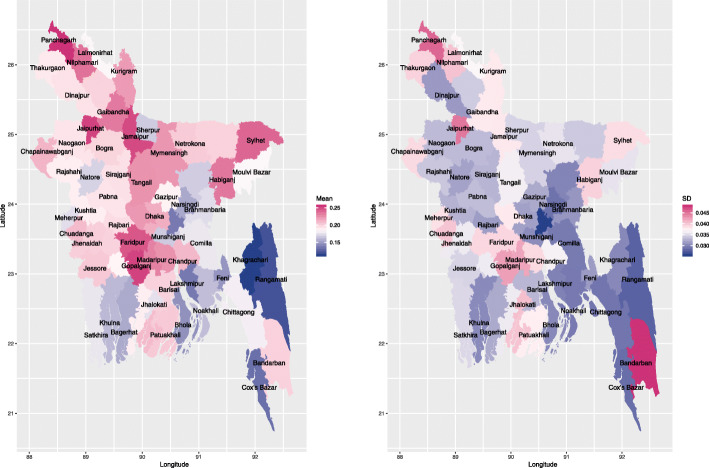
The left and right panels display the maps of the average and standard deviation of the posterior predicted probabilities of reporting pregnancy termination at each district, respectively, based on the best fitting model, i.e., CAR model adjusting for all the covariates presented in Table 3. The shape file of Bangladesh administrative level 2 (i.e., district-level) was downloaded from the link: https://gadm.org/download_country_v3.html, which is freely available for academic use and other non-commercial use. R [32] package rgdal [33] was used to read the shape file, and R package ggplot2 [34] was used to generate the maps
Fig. 5
Fig. 5
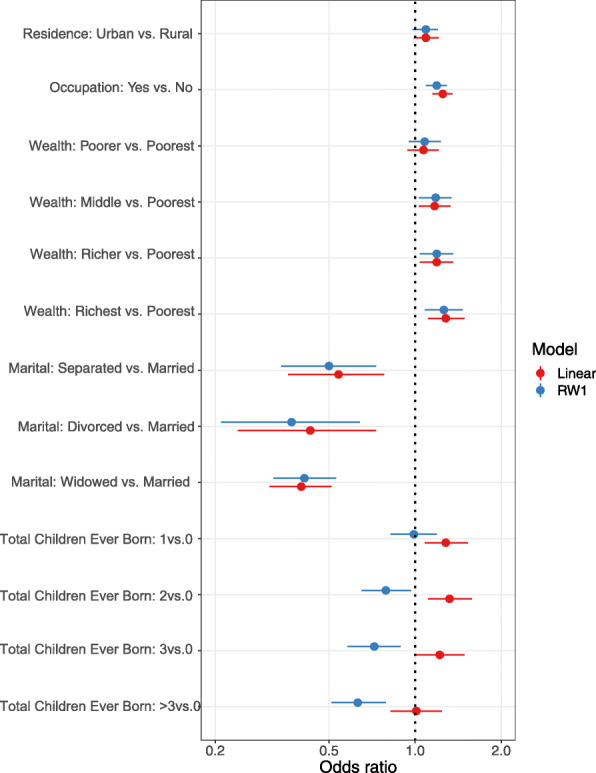
Comparison of adjusted odds ratios and 95% credible intervals of the fixed covariate effects based on the CAR models with linear versus non-linear (RW1) effects of age of women at survey time and age at first cohabitation
Fig. 6
Fig. 6
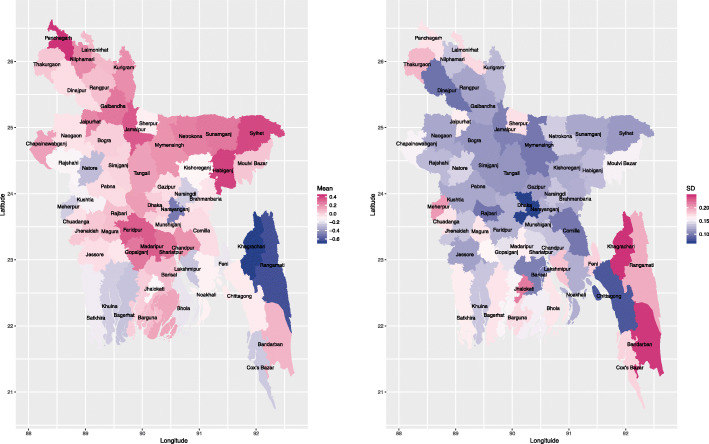
Posterior mean (left) and standard deviation (right) of the district-level random effect for the CAR model without any covariates. The shape file of Bangladesh administrative level 2 (i.e., district-level) was downloaded from the link: https://gadm.org/download_country_v3.html, which is freely available for academic use and other non-commercial use. R [32] package rgdal [33] was used to read the shape file, and R package ggplot2 [34] was used to generate the maps

References

    1. Bongaarts J. Trends in unwanted childbearing in the developing world. Stud Fam Plan. 1997;28(4):267–77. - PubMed
    1. Ganatra B, Gerdts C, Rossier C, Johnson Jr BR, Tunçalp Ö, Assifi A, Sedgh G, Singh S, Bankole A, Popinchalk A, et al. Global, regional, and subregional classification of abortions by safety, 2010–14: estimates from a Bayesian hierarchical model. Lancet. 2017;390(10110):2372–81. - PMC - PubMed
    1. Blencowe H, Cousens S, Jassir FB, Say L, Chou D, Mathers C, Hogan D, Shiekh S, Qureshi ZU, You D, et al. National, regional, and worldwide estimates of stillbirth rates in 2015, with trends from 2000: a systematic analysis. Lancet Glob Health. 2016;4(2):98–108. - PubMed
    1. Rana J, Sen KK, Sultana T, Hossain MB, Islam RM. Prevalence and determinants of menstrual regulation among ever-married women in Bangladesh: evidence from a national survey. Reprod Health. 2019;16(1):123. - PMC - PubMed
    1. Hossain A, Maddow-Zimet I, Ingerick M, Bhuiyan HU, Vlassoff M, Singh S. Access to and quality of menstrual regulation and postabortion care in bangladesh: evidence from a survey of health facilities, 2014. New York: Guttmacher Institute; 2017.