. 2020 Oct 7;40(41):7980-7994.
doi: 10.1523/JNEUROSCI.1367-20.2020. Epub 2020 Sep 4.

SYNGAP1 Controls the Maturation of Dendrites, Synaptic Function, and Network Activity in Developing Human Neurons

Affiliations

SYNGAP1 Controls the Maturation of Dendrites, Synaptic Function, and Network Activity in Developing Human Neurons

Nerea Llamosas et al. J Neurosci. .

Abstract

SYNGAP1 is a major genetic risk factor for global developmental delay, autism spectrum disorder, and epileptic encephalopathy. De novo loss-of-function variants in this gene cause a neurodevelopmental disorder defined by cognitive impairment, social-communication disorder, and early-onset seizures. Cell biological studies in mouse and rat neurons have shown that Syngap1 regulates developing excitatory synapse structure and function, with loss-of-function variants driving formation of larger dendritic spines and stronger glutamatergic transmission. However, studies to date have been limited to mouse and rat neurons. Therefore, it remains unknown how SYNGAP1 loss of function impacts the development and function of human neurons. To address this, we used CRISPR/Cas9 technology to ablate SYNGAP1 protein expression in neurons derived from a commercially available induced pluripotent stem cell line (hiPSC) obtained from a human female donor. Reducing SynGAP protein expression in developing hiPSC-derived neurons enhanced dendritic morphogenesis, leading to larger neurons compared with those derived from isogenic controls. Consistent with larger dendritic fields, we also observed a greater number of morphologically defined excitatory synapses in cultures containing these neurons. Moreover, neurons with reduced SynGAP protein had stronger excitatory synapses and expressed synaptic activity earlier in development. Finally, distributed network spiking activity appeared earlier, was substantially elevated, and exhibited greater bursting behavior in SYNGAP1 null neurons. We conclude that SYNGAP1 regulates the postmitotic maturation of human neurons made from hiPSCs, which influences how activity develops within nascent neural networks. Alterations to this fundamental neurodevelopmental process may contribute to the etiology of SYNGAP1-related disorders.SIGNIFICANCE STATEMENTSYNGAP1 is a major genetic risk factor for global developmental delay, autism spectrum disorder, and epileptic encephalopathy. While this gene is well studied in rodent neurons, its function in human neurons remains unknown. We used CRISPR/Cas9 technology to disrupt SYNGAP1 protein expression in neurons derived from an induced pluripotent stem cell line. We found that induced neurons lacking SynGAP expression exhibited accelerated dendritic morphogenesis, increased accumulation of postsynaptic markers, early expression of synapse activity, enhanced excitatory synaptic strength, and early onset of neural network activity. We conclude that SYNGAP1 regulates the postmitotic differentiation rate of developing human neurons and disrupting this process impacts the function of nascent neural networks. These altered developmental processes may contribute to the etiology of SYNGAP1 disorders.

Keywords: SYNGAP1; autism; development; epilepsy; iPSC; synapse.


Figures

Figure 1.
Figure 1.
Development of isogenic SYNGAP1 KO hiPSCs. A, Diagram represents CRISPR targeting within exon 7 (complete coding sequence) of the SYNGAP1 gene. Blue sequence represents the sgRNA. Red sequence represents the PAM site. B, Sanger sequencing for two WT and two SYNGAP1 mutant clones derived from the CRISPR experiment. C, Individual WES paired-end reads from clone #4 near the CRISPR targeted region within SYNGAP1. D, Normalized mapped reads for the same samples around the Cas9 target sequence. E, Genomic PCR to amplify DNA sequence flanking the CRISPR target site. F, Normalized mapped reads from the entire coding sequence of the SYNGAP1 gene in the four clone hiPSCs. Red arrow indicates predicted Cas9 cut site. Numbers indicate clonal reads relative to Cas9 hiPSC reads. G, Indels from each clone identified from WES analysis. Indels were identified by clonal sequence differences from the original Cas9 hiPSCs (reference sequence). Indel threshold was determined by at least 50% of the reads differing from the reference sequence with a minimum of at least 10 reads. Indels with frequency >0.8 were used to determine frequency of homozygous variants. *(in clone #4) indicates the compound heterozygous deletion of neighboring base pairs on each copy of SYNGAP1 within exon 7 (B, C). *(in clone #38) indicates the 8 bp deletion present in one copy of SYNGAP1. The other copy contains a large deletion encompassing the entirety of exons 6 and 7. H, Whole-genome view of iNeurons from WT#6, WT#30, KO#4, and KO#38 clones represents a copy number value of 2 cross all chromosomes (except for the Y-chromosome, which is not detected), revealing normal (female) karyotype with no chromosomal aberrations. Pink, green, and yellow represent the raw signal for each individual chromosome probe. Blue signal represents the normalized probe signal that is used to identify copy number and aberrations (if any).
Figure 2.
Figure 2.
Nominal SynGAP protein expression in clones #4 and #38. A, B, Model, based on evidence from Sanger traces and WES, of how targeted CRISPR mutations impacted each copy of SYNGAP1 in the two “KO” clones. Predicted impact on coding sequences is also included. C, Western blots demonstrating SynGAP protein expression from iNeuron or hiPSC homogenate. Total refers to signal from an antibody that detects all splice variants, and α2 refers to signal from an antibody that detects only a specific C-terminal splice variant. D, Quantification of relative intensity of bands normalized to total protein signal. In box-and-whisker plots, the middle, boxes, and whiskers represent the median, interquartile range, and min to max, respectively. *p < 0.05.
Figure 3.
Figure 3.
Increased dendrite length in iNeurons derived from KO iPSC clones. A, Representative images of eGFP-expressing iNeurons from the four different clones at DIV45. Scale bars: Inset, 200 µm. B–E, Histograms represent average length per cell of total (B), primary (C), secondary (D), and tertiary dendrites (E) of the four clones. F–I, Graphs represent average number of dendrites per cell of total (F), primary (G), secondary (H), and tertiary (I) dendrites of the four clones. In box-and-whisker plots, the middle, boxes, and whiskers represent the median, interquartile range, and min to max, respectively. *p < 0.05, **p < 0.01, ***p < 0.001, ****p < 0.0001.
Figure 4.
Figure 4.
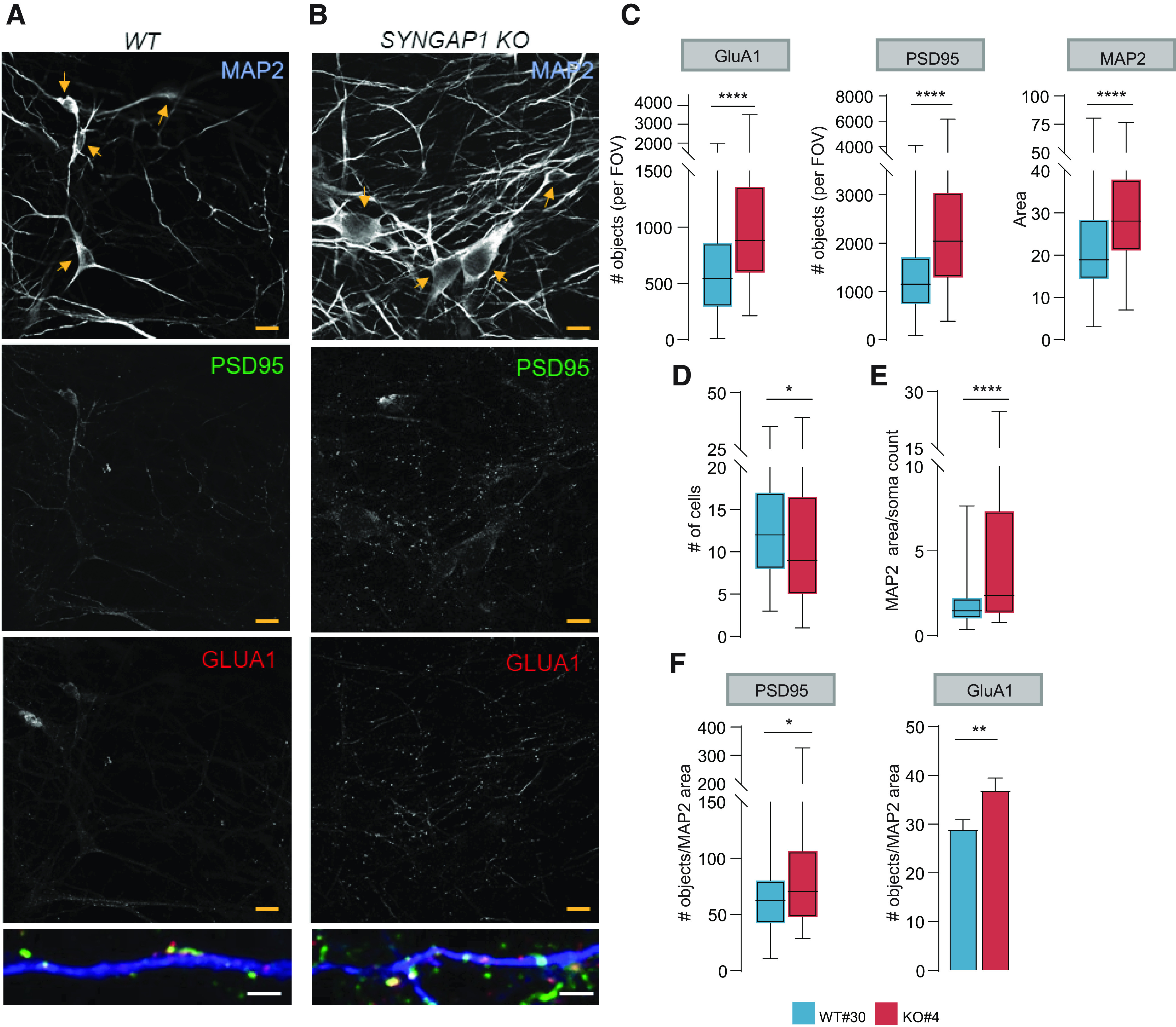
Increased dendritic area and more numerous postsynaptic structures in SYNGAP1 KO iNeurons. A, B, Representative images showing MAP2 labeling (top), PSD95 labeling (middle), and GluA1 labeling (middle bottom), and merge of MAP2, PSD95, and GLUA1 (bottom) of iNeurons from WT#30 (A) and KO#4 (B) at DIV45. Yellow arrows indicate cell bodies. Scale bars: yellow, 10 µm; white, 2 µm. C, Graphs represent MAP2 area and number of PSD95 and GluA1 objects (punctate labeling) per FOV in WT#30 and KO#4. D, Number of MAP2-postive somas detected per image FOV. E, MAP2 signal normalized to MAP2 = positive somas per image FOV. F, Graphs represent quantification of PSD95 and GluA1 expression in WT#30 and KO#4 normalized to MAP2 area. In box-and-whisker plots, the middle, boxes, and whiskers represent the median, interquartile range, and min to max, respectively. Bar graph represents mean ± SEM. *p < 0.05, **p < 0.01, ****p < 0.0001.
Figure 5.
Figure 5.
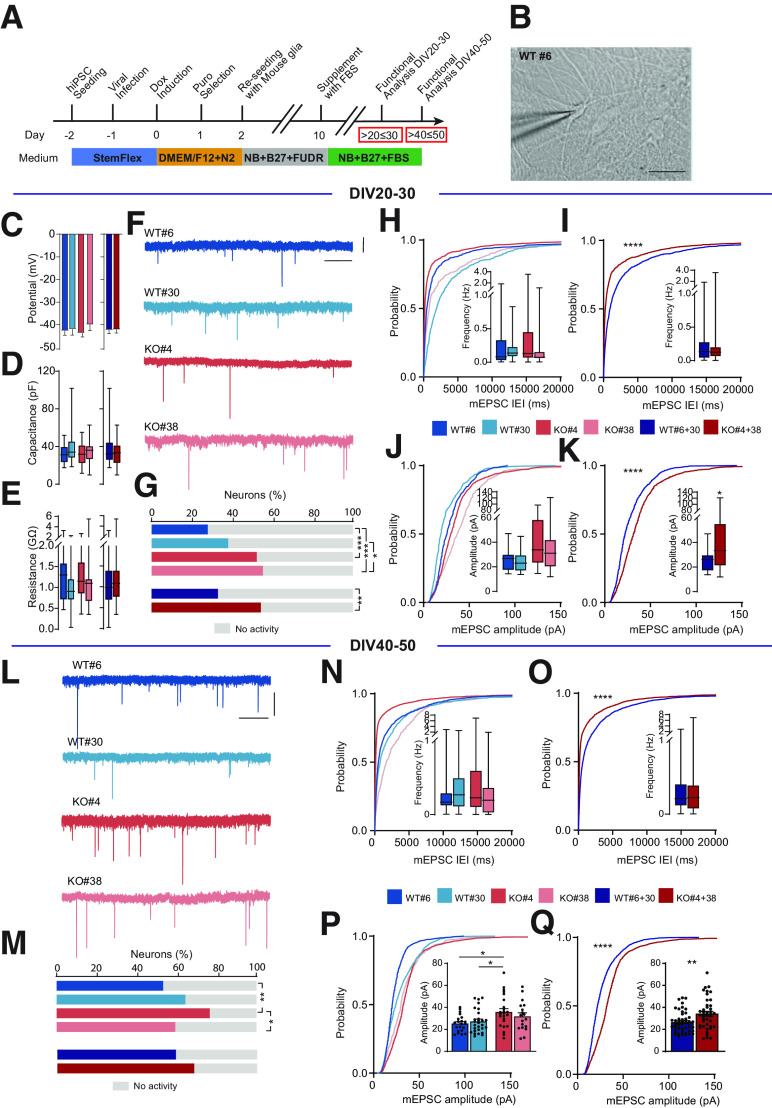
SYNGAP1 expression in human iNeurons regulates excitatory synapse function. A, Flow diagram of iNeuron generation from WT and SYNGAP1 KO iPSCs for whole-cell electrophysiological experiments (recording days within red boxes). B, Representative DIC image of patched iNeurons cells from WT#6. C–E, Bar graphs represent intrinsic membrane properties measured at DIV20-DIV30 as resting membrane potential (C), capacitance (D), and input resistance (E) from the four clones. F, Representative traces of mEPSCs of iNeurons from WT and KO clones at DIV20-DIV30. Calibration: 2 s, 20 pA. G, Percentage of successful observations of mEPSCs in iNeurons from the four clones at DIV20-DIV30. H, I, Cumulative plots of mEPSC interevent interval and frequency (inset) of the different clones individually (H) and grouped by genotype (I) at DIV20-DIV30. J, K, Cumulative probability plots of mEPSC amplitude of the different clones individually (J) and grouped by genotype (K) at DIV20-DIV30. L, Representative traces of mEPSCs of iNeurons from WT and KO clones at DIV40-DIV50. Calibration: 2 s, 20 pA. M, Percentage of successful observations of mEPSCs in iNeurons from the four clones at DIV40-DIV50. N, O, Cumulative probability plots of mEPSC interevent interval (IEI) and frequency (inset) of the different clones individually (N) and grouped by genotype (O) at DIV40-DIV50. P, Q, Cumulative probability plots of mEPSC amplitude of the different clones individually (P) and grouped by genotype (Q) at DIV40-DIV50. In box-and-whisker plots, the middle, boxes, and whiskers represent the median, interquartile range, and min to max, respectively. Bar graphs represent mean ± SEM. *p < 0.05, **p < 0.01, ***p < 0.001, ****p < 0.0001.
Figure 6.
Figure 6.
Reproducibility of SYNGAP1-mediated effects on iNeuron excitatory synapse function. A–C, Graphs represent resting membrane potential (A), capacitance (B), and input resistance (C) from the four clones at DIV40-DIV50. D, E, Cumulative plots of mEPSC interevent interval (IEI) and frequency (inset) of the different clones individually (D) and grouped by genotype (E) at DIV40-DIV50. F, G, Cumulative probability plots of mEPSC amplitude of the different clones individually (F) and grouped by genotype (G) at DIV40-DIV50. In box-and-whisker plots, the middle, boxes, and whiskers represent the median, interquartile range, and min to max, respectively. Bar graphs represent mean ± SEM. *p < 0.05, ****p < 0.0001.
Figure 7.
Figure 7.
Earlier onset and elevated levels of network activity in SYNGAP1 KO iNeurons. A, Representative bright-field image of 1-week-old iNeurons differentiated from iPSC-derived NPCs plated on a 16-electrode array of an MEA well. Spontaneous action potentials were recorded from the homozygous SYNGAP1 null (KO#4 and #38) and control (WT#6 and #30) neurons. B, Representative waveforms of spiking behavior from a single electrode for each Homo and WT neuronal culture. C, Representative temporal raster plots of KO iNeurons (KO#4 and #38) and WT isogenic control iNeurons (WT#6 and #30) over 5 min of continuous recording during culture week 3. D, E, Cumulative plots of mean firing rates for all four clones individually (D) and grouped together by genotype (E), along a developmental timeline. F, G, Cumulative plots of average number of bursts for individual clones (F) and grouped together by genotype (G). H, I, Cumulative plots of average number of network bursts for all clone individually (H) and grouped together by genotype (I). KO neurons display synaptic connections as early as week 3 of maturation compared with the WT controls. For each clone, four replicates of iNeurons were plated and differentiated concurrently. Graphs represent mean ± SEM.

References

    1. Aceti M, Creson TK, Vaissiere T, Rojas C, Huang WC, Wang YX, Petralia RS, Page DT, Miller CA, Rumbaugh G (2015) Syngap1 haploinsufficiency damages a postnatal critical period of pyramidal cell structural maturation linked to cortical circuit assembly. Biol Psychiatry 77:805–815. 10.1016/j.biopsych.2014.08.001 - DOI - PMC - PubMed
    1. Berryer MH, Hamdan FF, Klitten LL, Møller RS, Carmant L, Schwartzentruber J, Patry L, Dobrzeniecka S, Rochefort D, Neugnot-Cerioli M, Lacaille JC, Niu Z, Eng CM, Yang Y, Palardy S, Belhumeur C, Rouleau GA, Tommerup N, Immken L, Beauchamp MH, et al. (2013) Mutations in SYNGAP1 cause intellectual disability, autism, and a specific form of epilepsy by inducing haploinsufficiency. Hum Mutat 34:385–394. 10.1002/humu.22248 - DOI - PubMed
    1. Carvill GL, Heavin SB, Yendle SC, McMahon JM, O'Roak BJ, Cook J, Khan A, Dorschner MO, Weaver M, Calvert S, Malone S, Wallace G, Stanley T, Bye AM, Bleasel A, Howell KB, Kivity S, Mackay MT, Rodriguez-Casero V, Webster R, et al. (2013) Targeted resequencing in epileptic encephalopathies identifies de novo mutations in CHD2 and SYNGAP1. Nat Genet 45:825–830. 10.1038/ng.2646 - DOI - PMC - PubMed
    1. Charrier C, Joshi K, Coutinho-Budd J, Kim JE, Lambert N, de Marchena J, Jin WL, Vanderhaeghen P, Ghosh A, Sassa T, Polleux F (2012) Inhibition of SRGAP2 function by its human-specific paralogs induces neoteny during spine maturation. Cell 149:923–935. 10.1016/j.cell.2012.03.034 - DOI - PMC - PubMed
    1. Clement JP, Aceti M, Creson TK, Ozkan ED, Shi Y, Reish NJ, Almonte AG, Miller BH, Wiltgen BJ, Miller CA, Xu X, Rumbaugh G (2012) Pathogenic SYNGAP1 mutations impair cognitive development by disrupting maturation of dendritic spine synapses. Cell 151:709–723. 10.1016/j.cell.2012.08.045 - DOI - PMC - PubMed

Publication types

Substances

LinkOut - more resources