


Propolis and its potential against SARS-CoV-2 infection mechanisms and COVID-19 disease: Running title: Propolis against SARS-CoV-2 infection and COVID-19
- PMID: 32890967
- PMCID: PMC7430291
- DOI: 10.1016/j.biopha.2020.110622
Propolis and its potential against SARS-CoV-2 infection mechanisms and COVID-19 disease: Running title: Propolis against SARS-CoV-2 infection and COVID-19
Abstract
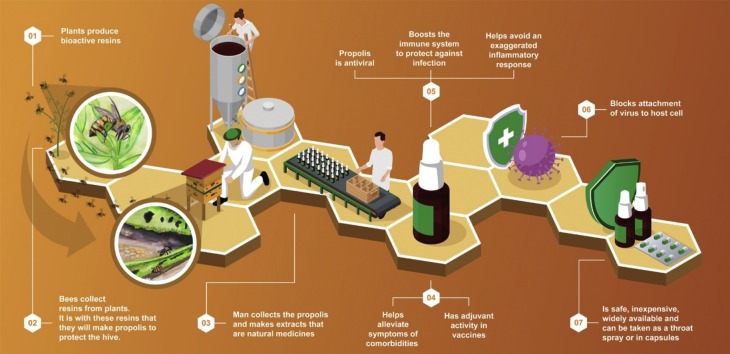
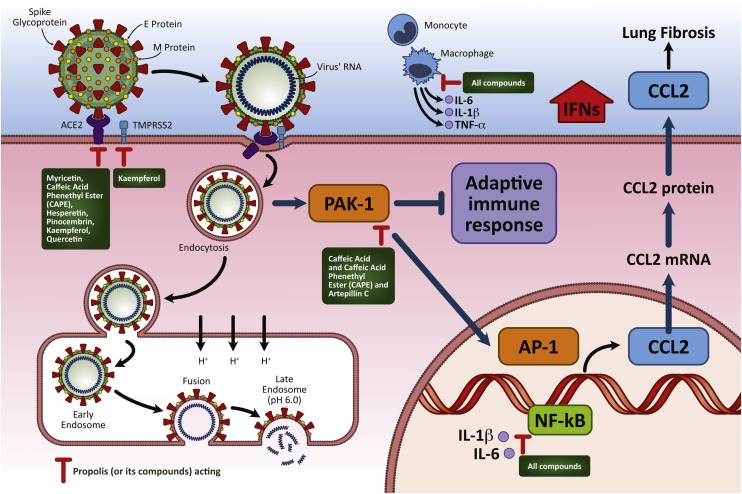
Propolis, a resinous material produced by honey bees from plant exudates, has long been used in traditional herbal medicine and is widely consumed as a health aid and immune system booster. The COVID-19 pandemic has renewed interest in propolis products worldwide; fortunately, various aspects of the SARS-CoV-2 infection mechanism are potential targets for propolis compounds. SARS-CoV-2 entry into host cells is characterized by viral spike protein interaction with cellular angiotensin-converting enzyme 2 (ACE2) and serine protease TMPRSS2. This mechanism involves PAK1 overexpression, which is a kinase that mediates coronavirus-induced lung inflammation, fibrosis, and immune system suppression. Propolis components have inhibitory effects on the ACE2, TMPRSS2 and PAK1 signaling pathways; in addition, antiviral activity has been proven in vitro and in vivo. In pre-clinical studies, propolis promoted immunoregulation of pro-inflammatory cytokines, including reduction in IL-6, IL-1 beta and TNF-α. This immunoregulation involves monocytes and macrophages, as well as Jak2/STAT3, NF-kB, and inflammasome pathways, reducing the risk of cytokine storm syndrome, a major mortality factor in advanced COVID-19 disease. Propolis has also shown promise as an aid in the treatment of various of the comorbidities that are particularly dangerous in COVID-19 patients, including respiratory diseases, hypertension, diabetes, and cancer. Standardized propolis products with consistent bioactive properties are now available. Given the current emergency caused by the COVID-19 pandemic and limited therapeutic options, propolis is presented as a promising and relevant therapeutic option that is safe, easy to administrate orally and is readily available as a natural supplement and functional food.
Keywords: Anti-inflammatory; Antiviral; COVID-19; PAK1 blocker; Propolis; SARS-CoV-2.
Copyright © 2020 The Author(s). Published by Elsevier Masson SAS.. All rights reserved.
Conflict of interest statement
The authors declare no conflict of interest.
Figures
References
-
- Corburn J., Vlahov D., Mberu B., Riley L., Caiaffa W.T., Rashid S.F., Ko A., Patel S., Jukur S., Martínez-Herrera E., Jayasinghe S., Agarwal S., Nguendo-Yongsi B., Weru J., Ouma S., Edmundo K., Oni T., Ayad H., Health Slum. Arresting COVID-19 and Improving Well-Being in Urban Informal Settlements. J Urban Health. 2020;97:348–357. doi: 10.1007/s11524-020-00438-6. - DOI - PMC - PubMed
Publication types
MeSH terms
Substances
LinkOut - more resources
Full Text Sources
Other Literature Sources
Medical
Research Materials
Miscellaneous
