


Linear predictive coding distinguishes spectral EEG features of Parkinson's disease
- PMID: 32891924
- PMCID: PMC7900258
- DOI: 10.1016/j.parkreldis.2020.08.001
Linear predictive coding distinguishes spectral EEG features of Parkinson's disease
Abstract
Objective: We have developed and validated a novel EEG-based signal processing approach to distinguish PD and control patients: Linear-predictive-coding EEG Algorithm for PD (LEAPD). This method efficiently encodes EEG time series into features that can detect PD in a computationally fast manner amenable to real time applications.
Methods: We included a total of 41 PD patients and 41 demographically-matched controls from New Mexico and Iowa. Data for all participants from New Mexico (27 PD patients and 27 controls) were used to evaluate in-sample LEAPD performance, with extensive cross-validation. Participants from Iowa (14 PD patients and 14 controls) were used for out-of-sample tests. Our method utilized data from six EEG leads which were as little as 2 min long.
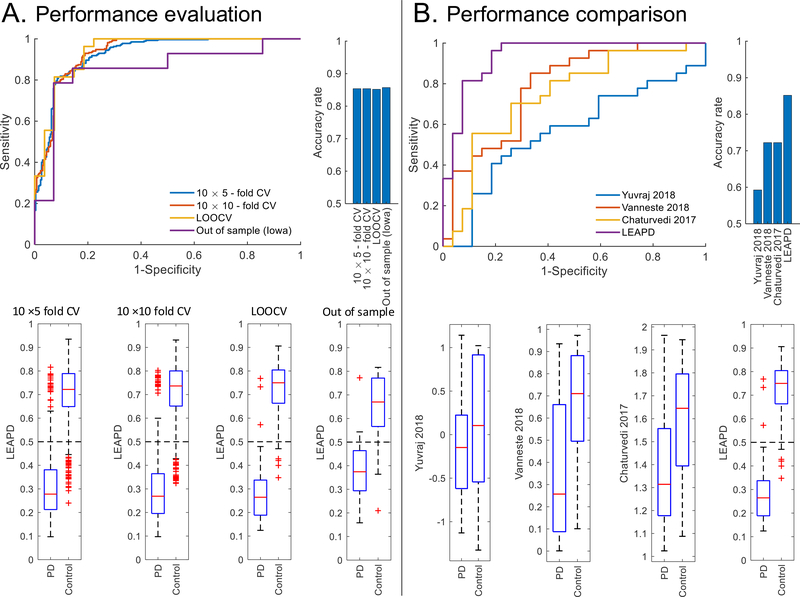
Results: For the in-sample dataset, LEAPD differentiated PD patients from controls with 85.3 ± 0.1% diagnostic accuracy, 93.3 ± 0.5% area under the receiver operating characteristics curve (AUC), 87.9 ± 0.9% sensitivity, and 82.7 ± 1.1% specificity, with multiple cross-validations. After head-to-head comparison with state-of-the-art methods using our dataset, LEAPD showed a 13% increase in accuracy and a 15.5% increase in AUC. When the trained classifier was applied to a distinct out-of-sample dataset, LEAPD showed reliable performance with 85.7% diagnostic accuracy, 85.2% AUC, 85.7% sensitivity, and 85.7% specificity. No statistically significant effect of levodopa-ON and levodopa-OFF sessions were found.
Conclusion: We describe LEAPD, an efficient algorithm that is suitable for real time application and captures spectral EEG features using few parameters and reliably differentiates PD patients from demographically-matched controls.
Keywords: Classifier; Diagnosis; EEG; Parkinson's disease.
Copyright © 2020 Elsevier Ltd. All rights reserved.
Conflict of interest statement
Declarations of interest:
None
Figures
References
-
- Fahn S, The history of dopamine and levodopa in the treatment of Parkinson’s disease, 23(S3) (2008) S497–S508. - PubMed
-
- Chaudhuri KR, Schapira AHV, Non-motor symptoms of Parkinson’s disease: dopaminergic pathophysiology and treatment, The Lancet Neurology 8(5) (2009) 464–474. - PubMed
-
- Rizzo G, Copetti M, Arcuti S, Martino D, Fontana A, Logroscino G, Accuracy of clinical diagnosis of Parkinson disease, A systematic review and meta-analysis 86(6) (2016) 566–576. - PubMed
Publication types
MeSH terms
Grants and funding
LinkOut - more resources
Full Text Sources
Other Literature Sources
Medical
