


First trimester anomaly scan using virtual reality (VR FETUS study): study protocol for a randomized clinical trial
- PMID: 32894073
- PMCID: PMC7487721
- DOI: 10.1186/s12884-020-03180-8
First trimester anomaly scan using virtual reality (VR FETUS study): study protocol for a randomized clinical trial
Abstract
Background: In recent years it has become clear that fetal anomalies can already be detected at the end of the first trimester of pregnancy by two-dimensional (2D) ultrasound. This is why increasingly in developed countries the first trimester anomaly scan is being offered as part of standard care. We have developed a Virtual Reality (VR) approach to improve the diagnostic abilities of 2D ultrasound. Three-dimensional (3D) ultrasound datasets are used in VR assessment, enabling real depth perception and unique interaction. The aim of this study is to investigate whether first trimester 3D VR ultrasound is of additional value in terms of diagnostic accuracy for the detection of fetal anomalies. Health-related quality of life, cost-effectiveness and also the perspective of both patient and ultrasonographer on the 3D VR modality will be studied.
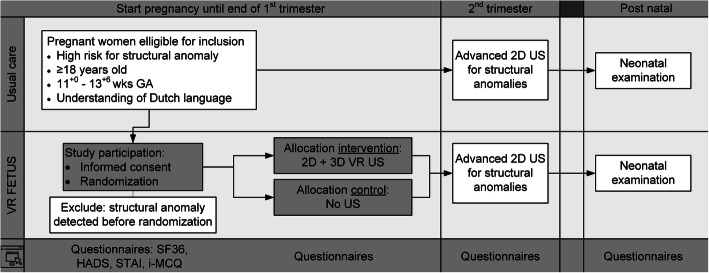
Methods: Women in the first trimester of a high risk pregnancy for a fetus with a congenital anomaly are eligible for inclusion. This is a randomized controlled trial with two intervention arms. The control group receives 'care as usual': a second trimester 2D advanced ultrasound examination. The intervention group will undergo an additional first trimester 2D and 3D VR ultrasound examination. Following each examination participants will fill in validated questionnaires evaluating their quality of life and healthcare related expenses. Participants' and ultrasonographers' perspectives on the 3D VR ultrasound will be surveyed. The primary outcome will be the detection of fetal anomalies. The additional first trimester 3D VR ultrasound examination will be compared to 'care as usual'. Neonatal or histopathological examinations are considered the gold standard for the detection of congenital anomalies. To reach statistical significance and 80% power with a detection rate of 65% for second trimester ultrasound examination and 70% for the combined detection of first trimester 3D VR and second trimester ultrasound examination, a sample size of 2800 participants is needed.
Discussion: First trimester 3D VR detection of fetal anomalies may improve patients' quality of life through reassurance or earlier identification of malformations. Results of this study will provide policymakers and healthcare professionals with the highest level of evidence for cost-effectiveness of first trimester ultrasound using a 3D VR approach.
Trial registration: Dutch Trial Registration number NTR6309 , date of registration 26 January 2017.
Keywords: Detection rate; Fetal anomalies; First trimester; Two-dimensional ultrasound, three-dimensional ultrasound; Virtual reality.
Conflict of interest statement
The authors declare that they have no competing interests.
Figures


References
-
- EURO-PERISTAT Project with SCPE and EUROCAT: European Perinatal Health Report. The health and care of pregnant women and babies in Europe in 2010. In.; 2013. www.europeristat.com. Accessed 5 Sept 2018.
-
- Dolk H, Loane M, Garne E. The prevalence of congenital anomalies in Europe. Adv Exp Med Biol. 2010;686:349–364. - PubMed
-
- Committee on Practice B-O, the American Institute of Ultrasound in M Practice Bulletin No. 175: Ultrasound in Pregnancy. Obstet Gynecol. 2016;128(6):e241–e256. - PubMed
-
- Excellence NIfHaC . Antenatal care for uncomplicated pregnancies. NICE guideline (CG62) 2008. - PubMed
-
- Nederlandse Vereniging voor Obstetrie & Gynaecologie . Indicaties voor Prenatale Diagnostiek. 1999.
Publication types
MeSH terms
Grants and funding
LinkOut - more resources
Full Text Sources
