Review
. 2020 Aug 4;20(4):e30.
doi: 10.4110/in.2020.20.e30. eCollection 2020 Aug.

The Link between Fusobacteria and Colon Cancer: a Fulminant Example and Review of the Evidence

Affiliations
Review

The Link between Fusobacteria and Colon Cancer: a Fulminant Example and Review of the Evidence

Martina King et al. Immune Netw. .

Abstract

Systemic infections due to Fusobacterium may originate in the tonsillar/internal jugular veins or from the abdomen. We encountered a patient who presented with bacteremia, fulminant septic shock, and extensive soft tissue pyogenic infection due to Fusobacterium necrophorum. In addition, there was widespread metastatic colon cancer with the unique finding of pre-mortem co-localization of F. necrophorum and cancer cells at a site distant from the colon. We reviewed the literature of the association of F. necrophorum and colon cancer, and discuss the evidence of how each of these 2 distinct entities may mutually augment the development or progression of the other.

Keywords: Anaerobes; Bacteremia; Lemierre's disease; Malignancy; Microbiome.


Conflict of interest statement

Conflicts of Interest: The authors declare no potential conflicts of interest.

Figures
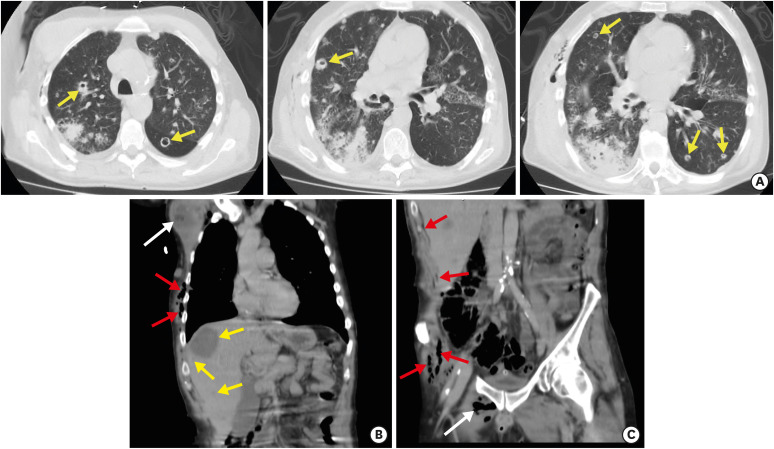
Figure 1
Figure 1. (A) Three panel axial chest CT demonstrating multiple lung nodules—with several that were cavitary (yellow arrows)—with patchy areas of ground-glass opacities and consolidation. Based on histopathology, the lung nodules are more likely to be colon cancer metastases rather than septic emboli. (B) Coronal image of the chest and abdominal CT showing a large right axillary mass with central necrosis (white arrow) with subcutaneous gas tracking inferiorly along chest wall (red arrows). In the liver, there were numerous small hypoattenuating lesions and a large hypodense lesion consistent with an abscess (yellow arrows). (C) Coronal image of the lower abdomen and pelvic CT showing a complicated perirectal collection containing gas and fluid, concerning for abscess (white arrow). Also seen are pockets of soft tissue gas that tracked from the pelvis to anterior thigh and inferior abdominal wall (red arrows).
Figure 2
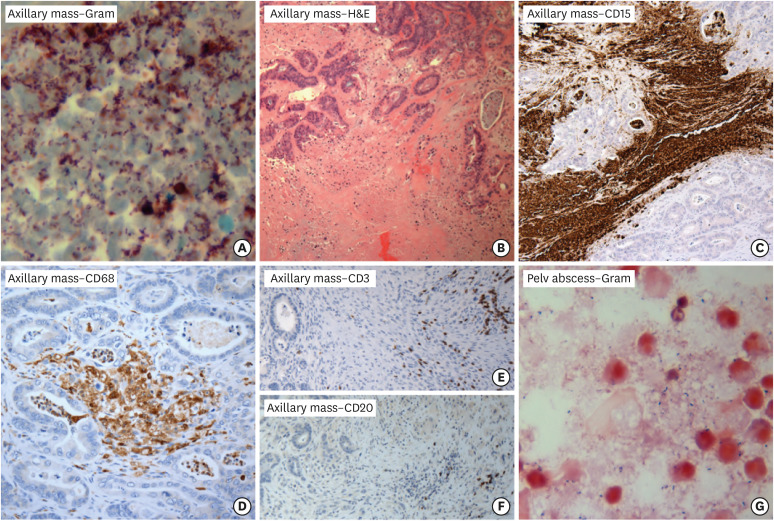
Figure 2. Surgically resected axillary mass and pelvic abscess drainage. (A) Gram stain of the surgically removed axillary mass revealed abundant pleiomorphic, gram-variable bacteria (1,000×). (B) Histopathology of the right axillary mass on the day-of-admission demonstrated infiltration by well-differentiated adenocarcinoma with adjacent necrotic debris (H&E stain, 100×). (C) Tissue of axillary mass immunostained with anti-CD15 antibody revealed abundant neutrophils (100×). (D) Tissue of axillary mass immunostained with anti-CD68 antibody demonstrated macrophages within malignant glands (200×). Axillary mass tissue stained for CD3 revealed few T lymphocytes (E) and rare CD20-positive B lymphocytes (F) adjacent to the malignant glands. (G) Gram stain of pelvic abscess drainage demonstrated gram-negative bacilli and gram-positive cocci (1,000×).
Figure 3
Figure 3. Colonic and lung tissues at autopsy. (A) Histopathology of rectal mass at autopsy demonstrated well-differentiated colorectal adenocarcinoma in the rectal muscularis propria invading into the perirectal adipose tissue (H&E, 100×). (B) Histopathology of rectal mass at autopsy showing mucinous features of the adenocarcinoma (H&E, 100×). (C) Lung tissue (left lower lobe) at autopsy showed well-differentiated adenocarcinoma (arrow) with adjacent necrotic debris (N) (H&E, 100×).
Figure 4
Figure 4. Diagram of the hypothesized, mutual synergism between Fusobacterium and colon cancer. (1) With regard to possible direct oncogenic effect of Fusobacterium, the FadA adhesin molecule of Fusobacterium binds to E-cadherin molecule on the colonic epithelium to trigger the Wnt/β-catenin oncogenic pathway. More indirect oncogenic effects of Fusobacterium include the following hypothesized sequence of events: (2) Fusobacterium recruits TMC to the intestinal submucosa, (3a) TMC inhibition of T effector cell and (3b) Fusobacterium inhibition of T cell proliferation and induction of T cell apoptosis, (4) loss of inhibition of T effector cells on any premalignant cells that begin to transform into cancer cells, (5) transformation and growth of pre-cancerous lesion to colon cancer, (6) infiltration by immunosuppressive TAM and TAN, (7) immunosuppression caused by TAM and TAN allows Fusobacteria to invade the submucosa and enter the blood stream, and (8) spread of both Fusobacterium and cancer cells to regional or distant lymph nodes may occur independently or the Fusobacteria may be transported inside cancer cells. Within the lymph node, induction of immunosuppressive TAM, TMC, and TAN by the cancer cells and induction of T effector cell apoptosis by Fusobacterium may lead to a mutual synergism between cancer cells and Fusobacteria. Inset: Diagram showing the purported molecular mechanisms by which Fusobacteria, via induction of NF-κB in tumor-infiltrating myeloid cells, may facilitate tumorigenesis.

References

    1. Afra K, Laupland K, Leal J, Lloyd T, Gregson D. Incidence, risk factors, and outcomes of Fusobacterium species bacteremia. BMC Infect Dis. 2013;13:264. - PMC - PubMed
    1. Chan ED, Hermanoff MA, Connick E. Lemierre's postanginal sepsis in an “older” patient: case report and review of the English literature over the past twenty-five years. Clin Pulm Med. 1999;6:333–338.
    1. Hagelskjaer Kristensen L, Prag J. Lemierre's syndrome and other disseminated Fusobacterium necrophorum infections in Denmark: a prospective epidemiological and clinical survey. Eur J Clin Microbiol Infect Dis. 2008;27:779–789. - PMC - PubMed
    1. Lemierre A. On certain septicaemias due to anaerobic organisms. Lancet. 1936;227:701–703.
    1. Kostic AD, Chun E, Robertson L, Glickman JN, Gallini CA, Michaud M, Clancy TE, Chung DC, Lochhead P, Hold GL, et al. Fusobacterium nucleatum potentiates intestinal tumorigenesis and modulates the tumor-immune microenvironment. Cell Host Microbe. 2013;14:207–215. - PMC - PubMed