


Genomic characterization of SARS-CoV-2 identified in a reemerging COVID-19 outbreak in Beijing's Xinfadi market in 2020
- PMID: 32895643
- PMCID: PMC7467064
- DOI: 10.1016/j.bsheal.2020.08.006
Genomic characterization of SARS-CoV-2 identified in a reemerging COVID-19 outbreak in Beijing's Xinfadi market in 2020
Abstract
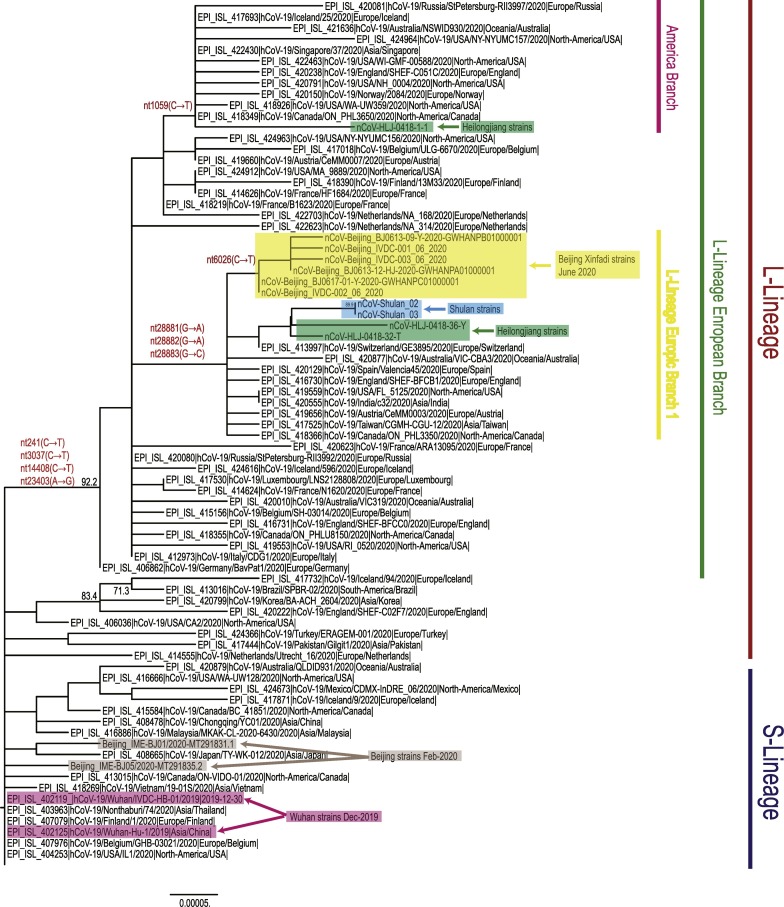
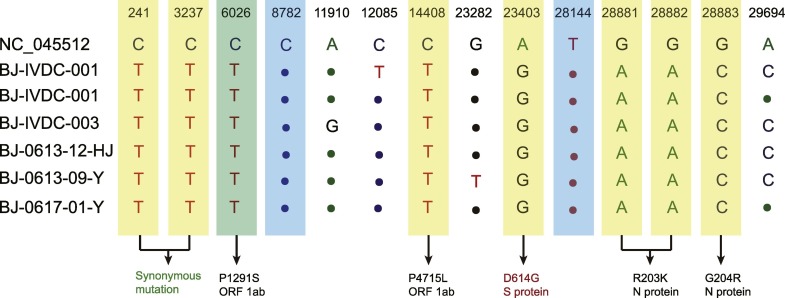
After 56 days without coronavirus disease 2019 (COVID-19) cases, reemergent cases were reported in Beijing, China on June 11, 2020. Here, we report the genetic characteristics of severe acute respiratory syndrome coronavirus 2 (SARS-CoV-2) sequenced from the clinical specimens of 4 human cases and 2 environmental samples. The nucleotide similarity among six SARS-CoV-2 genomes ranged from 99.98% to 99.99%. Compared with the reference strain of SARS-CoV-2 (GenBank No. NC_045512), all six genome sequences shared the same substitutions at nt241 (C → T), nt3037 (C → T), nt14408 (C → T), nt23403 (A → G), nt28881 (G → A), nt28882 (G → A), and nt28883 (G → C), which are the characteristic nucleotide substitutions of L-lineage European branch I. This was also proved by the maximum likelihood phylogenetic tree based on the full-length genome of SARS-CoV-2. They also have a unique shared nucleotide substitution, nt6026 (C → T), which is the characteristic nucleotide substitution of SARS-CoV-2 in Beijing's Xinfadi outbreak. It is noteworthy that there is an amino acid D614G mutation caused by nt23403 substitution in all six genomes, which may enhance the virus's infectivity in humans and help it become the leading strain of the virus to spread around the world today. It is necessary to continuously monitor the genetic variation of SARS-CoV-2, focusing on the influence of key mutation sites of SARS-CoV-2 on viral transmission, clinical manifestations, severity, and course of disease.
Keywords: COVID-19; D614G mutation; Genomic epidemiology; L-lineage European branch I; SARS-CoV-2.
© 2020 Chinese Medical Association Publishing House. Published by Elsevier B.V.
Figures
References
-
- Tan W., Niu P., Zhao X., Pan Y., Zhang Y., Chen L., Zhao L., Wang Y., Wang D., Han J., Gao G.F., Huang C., Xu W., Wu G. Reemergent cases of COVID-19 — Xinfadi wholesales market, Beijing municipality, China, June 11, 2020. China CDC Weekly. 2020;2:502–504. doi: 10.46234/ccdcw2020.132. - DOI - PMC - PubMed
-
- Korber B., Fischer W.M., Gnanakaran S., Yoon H., Theiler J., Abfalterer W., Hengartner N., Giorgi E.E., Bhattacharya T., Foley B., Hastie K.M., Parker M.D., Partridge D.G., Evans C.M., Freeman T.M., Silva T.I.D., McDanal C., Perez L.G., Tang H., Moon-Walker A., Whelan S.P., LaBranche C.C., Saphire E.O., Montefiori D.C. Tracking changes in SARS-CoV-2 Spike: evidence that D614G increases infectivity of the COVID-19 virus. Cell. 2020;182:812–827. doi: 10.1016/j.cell.2020.06.043. - DOI - PMC - PubMed
-
- Lu J., du Plessis L., Liu Z., Hill V., Kang M., Lin H., Sun J., Francois S., Kraemer M.U.G., Faria N.R., McCrone J.T., Peng J., Xiong Q., Yuan R., Zeng L., Zhou P., Liang C., Yi L., Liu J., Xiao J., Hu J., Liu T., Ma W., Li W., Su J., Zheng H., Peng B., Fang S., Su W., Li K., Sun R., Bai R., Tang X., Liang M., Quick J., Song T., Rambaut A., Loman N., Raghwani J., Pybus O.G., Ke C. Genomic epidemiology of SARS-CoV-2 in Guangdong Province, China. Cell. 2020;181:997–1003. doi: 10.1016/j.cell.2020.04.023. - DOI - PMC - PubMed
LinkOut - more resources
Full Text Sources
Miscellaneous
