. 2020 Sep 8;324(10):1000-1003.
doi: 10.1001/jama.2020.14978.

Allocation of COVID-19 Relief Funding to Disproportionately Black Counties

Affiliations

Allocation of COVID-19 Relief Funding to Disproportionately Black Counties

Pragya Kakani et al. JAMA. .

Abstract

This study describes correlations between the dollar amount of relief funding authorized by the US Congress to fund prevention, diagnosis, and treatment of coronavirus disease 2019 (COVID-19) and to reimburse health care entities for lost revenues, and county-level Black population fraction accounting for county COVID-19 burden, comorbidity, and hospital financial health.


Conflict of interest statement

Conflict of Interest Disclosures: Dr Chandra reported serving on the Congressional Budget Office’s Panel of Health Advisors as well as serving as an advisor to SmithRx, Kyruus, and Health Engine and being an academic affiliate of Analysis Group. Dr Obermeyer reported having equity interest in Berkeley Data Ventures, a consultancy that applies machine learning to health care problems, including ways to expand testing for severe acute respiratory syndrome coronavirus 2. No other disclosures were reported.

Figures

Figure.
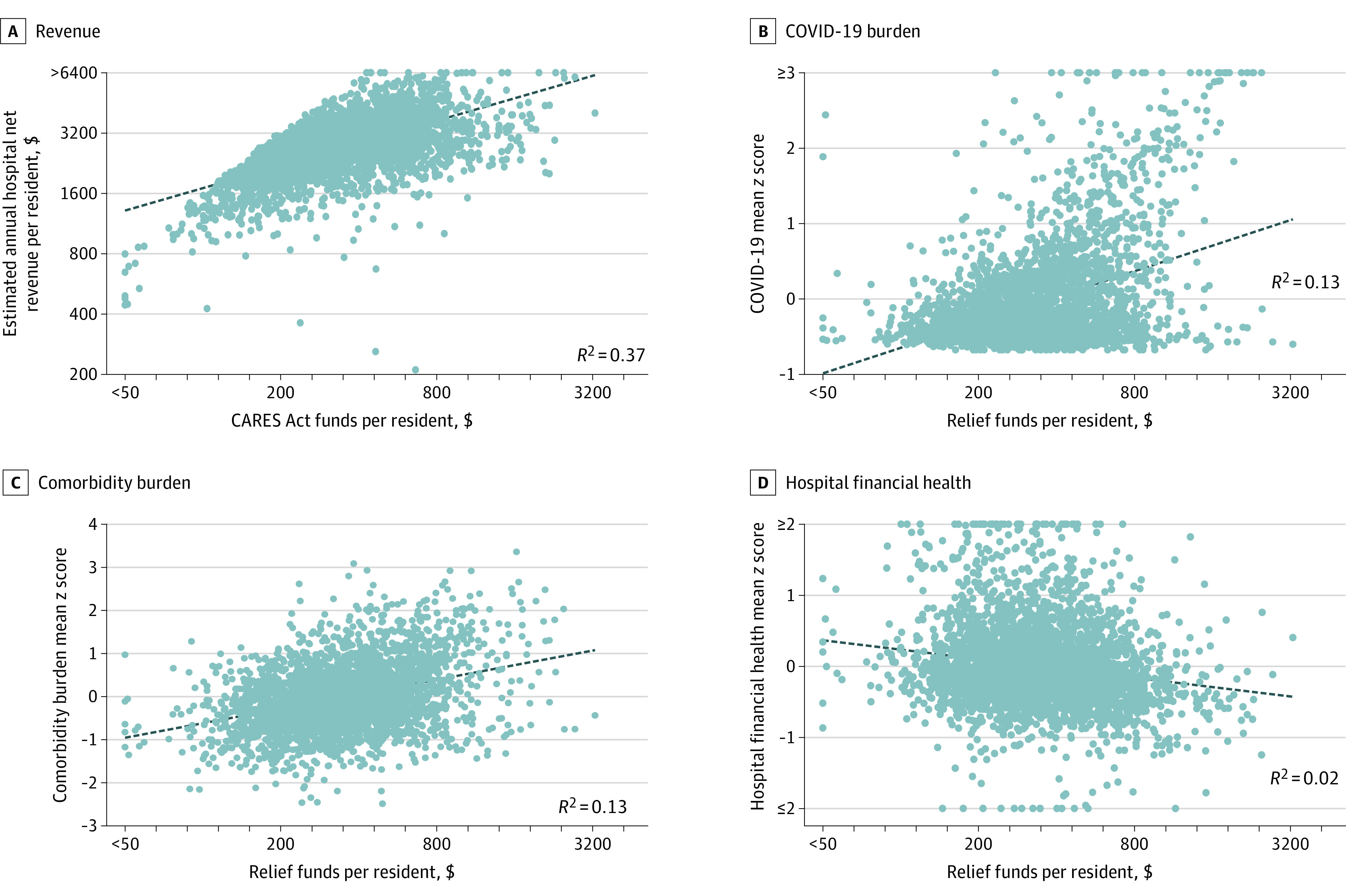
Figure.. Correlation Between County Measures of Health and Financial Need and Relief Funding
Net revenue per resident refers to the estimated annual net revenue across all hospitals. Z scores are calculated by subtracting the mean and dividing by the standard deviation for a given metric. The coronavirus disease 2019 (COVID-19) mean z score is estimated as the mean of z scores for the following outcomes: cumulative COVID-19 deaths per 100 000, cumulative COVID-19 cases per 100 000, non–COVID-19 deaths per 100 000, and severe acute respiratory syndrome coronavirus 2 (SARS-CoV-2) case-to-test ratio. Higher COVID-19 mean z scores indicate higher burden of COVID-19 (higher COVID-19 cases, higher COVID-19 and non–COVID-19 deaths, higher positive SARS-CoV-2 case-to-test ratio). The mean comorbidity burden z score is the mean of the z scores among the following comorbidities, estimated using population-based data on prevalence: end-stage kidney disease, diabetes, hypertension, obesity, and smoking. Higher mean comorbidity z scores indicate poorer health. The mean hospital finance z score includes the following metrics: mean hospital operating margin and days of cash on hand across Medicare fee-for-service admissions within the county. Higher mean hospital finance z scores indicate better financial health. Best fit lines were fitted linearly for all panels. For each panel, more than 95% of counties are within the bounds of the axes. The remaining counties are top or bottom coded for scatterplot visualization only. The dots indicate counties and the dashed lines indicate the best fit line across all counties.

References

    1. Coronavirus Aid, Relief, and Economic Security (CARES) Act, Pub L No. 116-136.
    1. Schwartz K, Damico A Distribution of CARES Act funding among providers. Kaiser Family Foundation. Published May 13, 2020. Accessed July 5, 2020. https://www.kff.org/coronavirus-covid-19/issue-brief/distribution-of-car...
    1. Institute of Medicine Unequal Treatment: Confronting Racial and Ethnic Disparities in Health Care. Washington, DC: National Academies Press; 2003. - PubMed

    1. Lillie-Blanton M, Hoffman C. The role of health insurance coverage in reducing racial/ethnic disparities in health care. Health Aff (Millwood). 2005;24(2):398-408. doi:10.1377/hlthaff.24.2.398 - DOI - PubMed
    1. Dowling MK, Kelly RL. Policy solutions for reversing the color-blind public health response to COVID-19 in the US. JAMA. 2020;324(3):229-230. doi:10.1001/jama.2020.10531 - DOI - PubMed

Publication types