


Review
doi: 10.3390/genes11091045.
Regulation of mTORC2 Signaling
Affiliations
- PMID: 32899613
- PMCID: PMC7564249
- DOI: 10.3390/genes11091045
Item in Clipboard
Review
Regulation of mTORC2 Signaling
Genes (Basel).
.
Abstract
Mammalian target of rapamycin (mTOR), a serine/threonine protein kinase and a master regulator of cell growth and metabolism, forms two structurally and functionally distinct complexes, mTOR complex 1 (mTORC1) and mTORC2. While mTORC1 signaling is well characterized, mTORC2 is relatively poorly understood. mTORC2 appears to exist in functionally distinct pools, but few mTORC2 effectors/substrates have been identified. Here, we review recent advances in our understanding of mTORC2 signaling, with particular emphasis on factors that control mTORC2 activity.
Keywords: Akt; mTOR; mTORC2 signaling; signaling crosstalk.
Conflict of interest statement
The authors declare no conflict of interest.
Figures
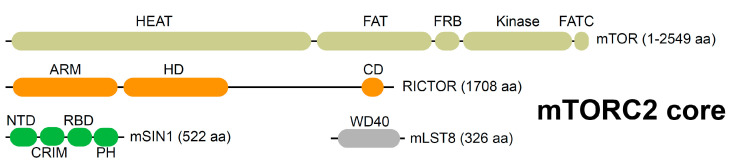
Composition of mTORC2 core. mTORC2 is composed of four core subunits (mTOR, RICTOR, mSIN1, and mLST8). mTOR is composed of several domains, including the HEAT (huntingtin, elongation factor 3, a subunit of protein phosphatase 2A, TOR1; a tandemly repeated motif with helical structure), FAT (FRAP, ATM, TRRAP; α helices arranged as repeats), FRB (FKBP12–rapamycin binding), kinase, and FATC (FRAP, ATM, TRRAP, C-terminal; an α-helix and a disulfide-bonded loop) domains. RICTOR has armadillo (ARM; two curved layers of α-helix) repeats, a HEAT-like domain (HD), and a C-terminal domain (CD), and all three regions likely interact with mSIN1. A flexible region between HD and CD contains most of the identified RICTOR phosphorylation sites. mSIN1 is composed of NTD (N-terminal domain), CRIM (conserved region in the middle; substrate recruitment), RBD (Ras binding domain), and PH (pleckstrin homology; has membrane targeting capacity) domains. NTD and CRIM regions of mSIN1 have direct contact with RICTOR and mLST8. mLST8 is composed mainly of WD40 repeats and interacts with the kinase domain of mTOR.
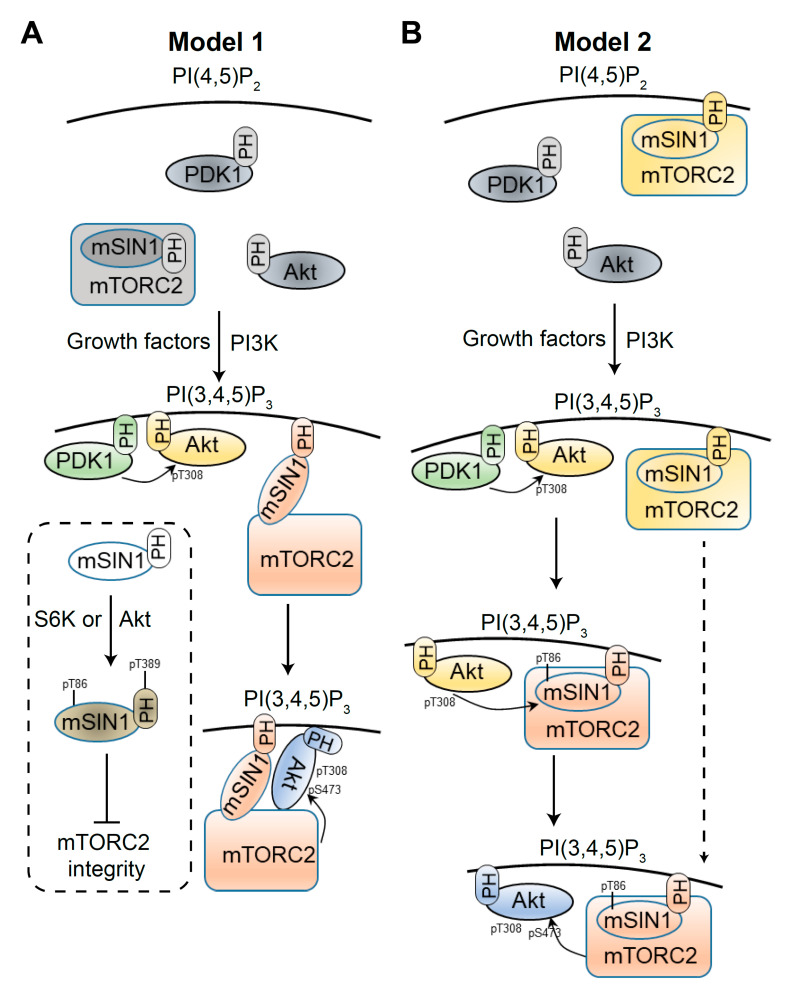
Growth factors induce Akt Ser473 phosphorylation via mTORC2. In both models, in the absence of growth factors, PDK1 and Akt are localized at the cytoplasm. Upon growth factor stimulation, PI(4,5)P2 is converted to PI(3,4,5)P3 via PI3K at the plasma membrane, and PDK1 and Akt are recruited to the plasma membrane via their pleckstrin homology (PH) domains, leading to phosphorylation of Akt Thr308 by PDK1. In model 1 (A), PI(3,4,5)P3 recruits mTORC2 to the plasma membrane and directly activates mTORC2 toward Akt Ser473 via the release of an inhibitory conformation. In the box, S6K or Akt leads to dual phosphorylation of mSIN1 at Thr86 and Thr389 to inhibit mTORC2. In model 2 (B), mTORC2 permanently resides at the plasma membrane. Akt-pThr308 phosphorylates mSIN1 Thr86 within mTORC2, which in turn boosts mTORC2 activity. mTORC2 then phosphorylates Akt Ser473, leading to full activation of Akt. The contribution of mTORC2 containing Thr86-nonphosphorylated mSIN1 to Akt Ser473 phosphorylation is not very clear.
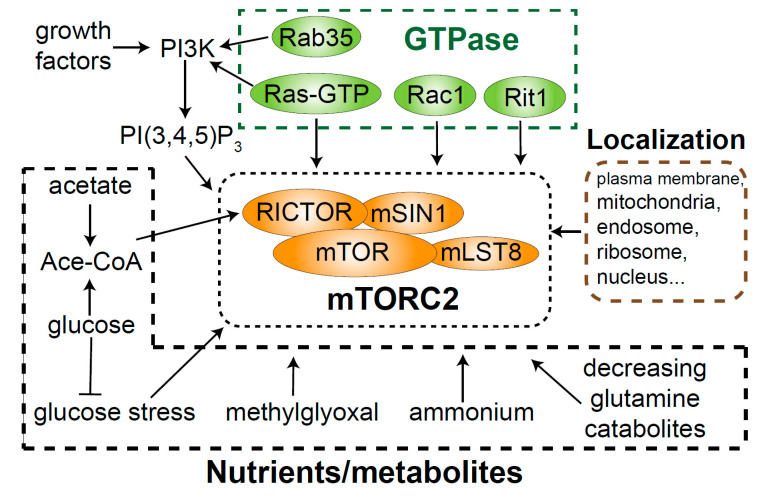
Upstream of mTORC2 signaling. Besides canonical PI3K-mediated mTORC2 activation, mTORC2 activity is controlled by its localization to different subcellular compartments, small GTPases, nutrients, and metabolites.
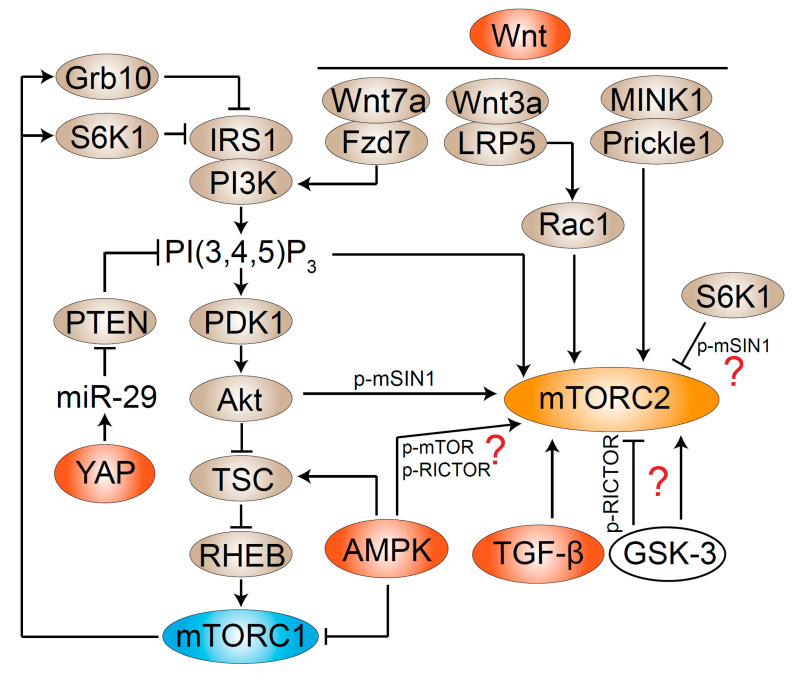
Regulation of mTORC2 activity by signaling crosstalk. AMPK, Wnt, YAP, and TGF-β (depicted in red) positively regulate mTORC2 activity. mTORC1 (depicted in blue) negatively regulates mTORC2 activity.
References
-
- Dos D.S., Ali S.M., Kim D.H., Guertin D.A., Latek R.R., Erdjument-Bromage H., Tempst P., Sabatini D.M. Rictor, a novel binding partner of mTOR, defines a rapamycin-insensitive and raptor-independent pathway that regulates the cytoskeleton. Curr. Biol. 2004;14:1296–1302. - PubMed
Publication types
MeSH terms
Substances
LinkOut - more resources
Full Text Sources
Miscellaneous
