


Mycoplasmas-Host Interaction: Mechanisms of Inflammation and Association with Cellular Transformation
- PMID: 32899663
- PMCID: PMC7565387
- DOI: 10.3390/microorganisms8091351
Mycoplasmas-Host Interaction: Mechanisms of Inflammation and Association with Cellular Transformation
Abstract
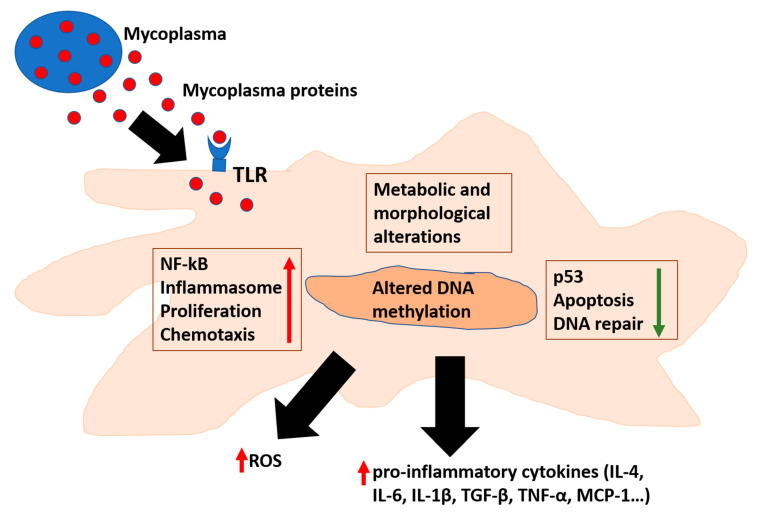
Mycoplasmas are the smallest and simplest self-replicating prokaryotes. Located everywhere in nature, they are widespread as parasites of humans, mammals, reptiles, fish, arthropods, and plants. They usually exhibiting organ and tissue specificity. Mycoplasmas belong to the class named Mollicutes (mollis = soft and cutis = skin, in Latin), and their small size and absence of a cell wall contribute to distinguish them from other bacteria. Mycoplasma species are found both outside the cells as membrane surface parasites and inside the cells, where they become intracellular residents as "silent parasites". In humans, some Mycoplasma species are found as commensal inhabitants, while others have a significant impact on the cellular metabolism and physiology. Mollicutes lack typical bacterial PAMPs (e.g., lipoteichoic acid, flagellin, and some lipopolysaccharides) and consequently the exact molecular mechanisms of Mycoplasmas' recognition by the cells of the immune system is the subjects of several researches for its pathogenic implications. It is well known that several strains of Mycoplasma suppress the transcriptional activity of p53, resulting in reduced apoptosis of damaged cells. In addition, some Mycoplasmas were reported to have oncogenic potential since they demonstrated not just accumulation of abnormalities but also phenotypic changes of the cells. Aim of this review is to provide an update of the current literature that implicates Mycoplasmas in triggering inflammation and altering critical cellular pathways, thus providing a better insight into potential mechanisms of cellular transformation.
Keywords: Mycoplasma; PARP; cancer; inflammation; molecular pathways; p53.
Conflict of interest statement
The authors declare no conflict of interest.
Figures
References
Publication types
LinkOut - more resources
Full Text Sources
Research Materials
Miscellaneous
