Review
. 2020 Sep 4;25(18):4049.
doi: 10.3390/molecules25184049.

The Potential of Algal Biotechnology to Produce Antiviral Compounds and Biopharmaceuticals

Affiliations
Review

The Potential of Algal Biotechnology to Produce Antiviral Compounds and Biopharmaceuticals

Sergio Rosales-Mendoza et al. Molecules. .

Abstract

The emergence of the Coronavirus Disease 2019 (COVID-19) caused by the SARS-CoV-2 virus has led to an unprecedented pandemic, which demands urgent development of antiviral drugs and antibodies; as well as prophylactic approaches, namely vaccines. Algae biotechnology has much to offer in this scenario given the diversity of such organisms, which are a valuable source of antiviral and anti-inflammatory compounds that can also be used to produce vaccines and antibodies. Antivirals with possible activity against SARS-CoV-2 are summarized, based on previously reported activity against Coronaviruses or other enveloped or respiratory viruses. Moreover, the potential of algae-derived anti-inflammatory compounds to treat severe cases of COVID-19 is contemplated. The scenario of producing biopharmaceuticals in recombinant algae is presented and the cases of algae-made vaccines targeting viral diseases is highlighted as valuable references for the development of anti-SARS-CoV-2 vaccines. Successful cases in the production of functional antibodies are described. Perspectives on how specific algae species and genetic engineering techniques can be applied for the production of anti-viral compounds antibodies and vaccines against SARS-CoV-2 are provided.

Keywords: COVID-19; Chlamydomonas reinhardtii; MERS-CoV; SARS-CoV-2; monoclonal antibody; recombinant antigen; transplastomic.


Conflict of interest statement

The authors declare no conflict of interest.

Figures
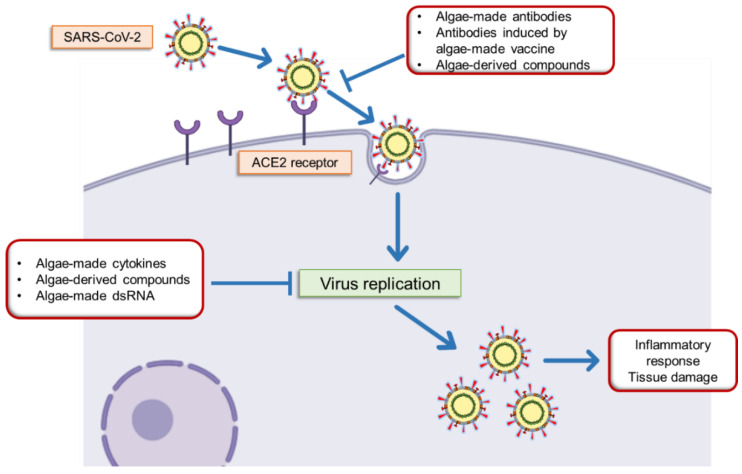
Figure 1
Figure 1
Simplified view of the SARS-CoV-2 pathogenic mechanisms and possible algae-based products to fight against it. The SARS-CoV-2 access the cells at the airway mucosa by targeting the ACE2 receptor. Upon cell entry, viral replication takes place and induces tissue damage that might result in a severe inflammatory response and systemic spread, which can cause death; especially in patients suffering of co-morbidities. Microalgae can be exploited in several directions as sources of drugs and biologicals in the fight against SARS-CoV-2 infection. Algae-derived compounds such as lectins and polysaccharides have known ability to block the entry or replication of enveloped viruses. Through genetic engineering; algae can lead to the development of low-cost production platforms for the manufacture of vaccines, monoclonal antibodies, and cytokines; all of them being key biopharmaceuticals in the prevention or treatment of COVID-19.
Figure 2
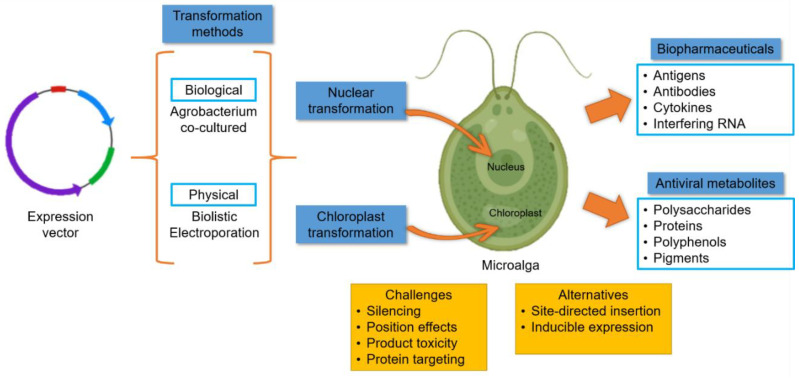
Figure 2
Genetic engineering in algae. Algae can be genetically engineered to improve the production of native antiviral compounds or introduce the biosynthetic pathway for those not produced in algae; moreover, they can be used as biofactories of biopharmaceuticals. The genomes at the nucleus and chloroplast can be engineered with specific genes to achieve the desired trait. The main challenges are genetic instability and low expression often observed in the transformed strains, which can be overcome by using site-directed insertion of the foreign DNA, inducible promoters, and optimized regulatory sequences.

References

    1. Millet J.K., Whittaker G.R. Host cell entry of Middle East respiratory syndrome coronavirus after two-step, furin-mediated activation of the spike protein. Proc. Natl. Acad. Sci. USA. 2014;111:15214–15219. doi: 10.1073/pnas.1407087111. - DOI - PMC - PubMed
    1. World Health Organization Coronavirus Disease 2019 (COVID-19) Situation Report—51, 2020. [(accessed on 11 March 2020)]; Available online: https://www.who.int/emergencies/diseases/novel-coronavirus-2019.
    1. Huang C., Wang Y., Li X., Ren L., Zhao J., Hu Y., Zhang L., Fan G., Xu J., Gu X., et al. Clinical features of patients infected with 2019 novel coronavirus in Wuhan, China. Lancet. 2020;395:497–506. doi: 10.1016/S0140-6736(20)30183-5. - DOI - PMC - PubMed
    1. Lai C.C., Shih T.P., Ko W.C., Tang H.J., Hsueh P.R. Severe acute respiratory 356 syndrome coronavirus 2 (SARS-CoV-2) and coronavirus disease-2019 (COVID-19): The epidemic and the challenges. Int. J. Antimicrob. Agents. 2020;55:105924. doi: 10.1016/j.ijantimicag.2020.105924. - DOI - PMC - PubMed
    1. Chan J.F., Lau S.K., To K.K., Cheng V.C., Woo P.C., Yuen K.Y. Middle East Respiratory syndrome coronavirus: Another zoonotic betacoronavirus causing SARS-like disease. Clin. Microbiol. Rev. 2015;28:465–522. doi: 10.1128/CMR.00102-14. - DOI - PMC - PubMed

MeSH terms

LinkOut - more resources