. 2020 Sep 8;11(1):4473.
doi: 10.1038/s41467-020-18235-9.

Synthesis of chiral anti-1,2-diamine derivatives through copper(I)-catalyzed asymmetric α-addition of ketimines to aldimines

Affiliations

Synthesis of chiral anti-1,2-diamine derivatives through copper(I)-catalyzed asymmetric α-addition of ketimines to aldimines

Xu-Cheng Gan et al. Nat Commun. .

Abstract

Chiral 1,2-diamines serve as not only common structure units in bioactive molecules but also useful ligands for a range of catalytic asymmetric reactions. Here, we report a method to access anti-1,2-diamine derivatives. By means of the electron-withdrawing nature of 2- or 4-nitro-phenyl group, a copper(I)-catalyzed asymmetric α-addition of ketimines derived from trifluoroacetophenone and 2- or 4-NO2-benzylamines to aldimines is achieved, which affords a series of chiral anti-1,2-diamine derivatives in moderate to high yields with moderate to high diastereoselectivity and high to excellent enantioselectivity. Aromatic aldimines, heteroaromatic aldimines, and aliphatic aldimines serve as suitable substrates. The nitro group is demonstrated as a synthetical handle by several transformations, including a particularly interesting Fe(acac)3-catalyzed radical hydroamination with a trisubstituted olefin. Moreover, the aryl amine moiety obtained by the reduction of the nitro group serves as a synthetically versatile group, which leads to the generation of several functional groups by the powerful Sandmeyer reaction, such as -OH, -Br, -CF3, and -BPin.


Conflict of interest statement

The authors declare no competing interests.

Figures
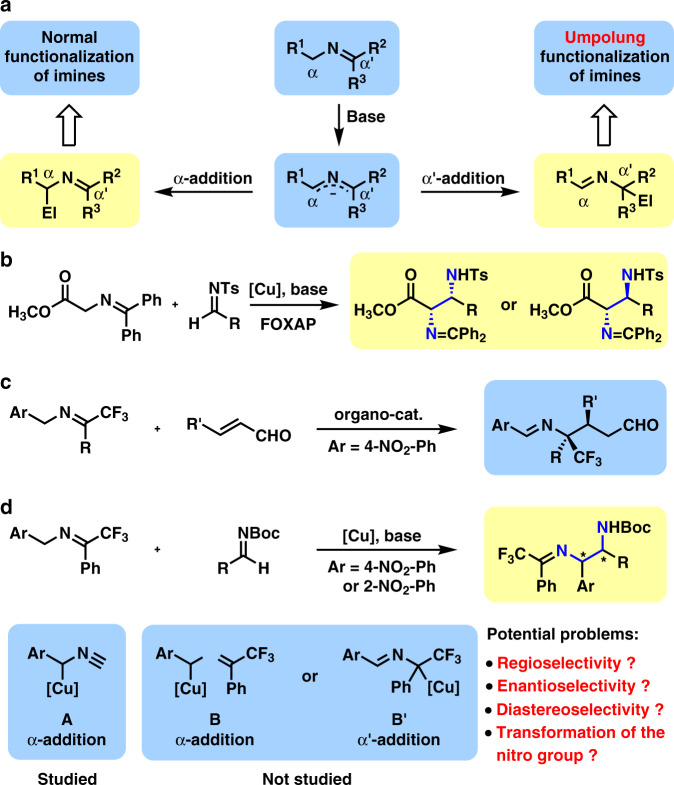
Fig. 1
Fig. 1. Prior arts and our work in the catalytic asymmetric reactions with 2-azaallyl anions.
a Regioselectivity in the nucleophilic addition of 2-azaallyl anions. b Reported catalytic asymmetric α-addition by Hou and Wu. c Reported catalytic asymmetric α′-addition (umpolung addition) by Deng. d Our work: synthesis of 1,2-diamines through copper(I)-catalyzed α-addition.
Fig. 2
Fig. 2. Substrate scope of aldimines 2a.
Both aromatic aldimines and aliphatic aldimines are employed. a1a: 0.2 mmol, 2: 0.3 mmol. Isolated yield. Dr determined by 1H NMR analysis of the crude reaction mixture. Enantioselectivity determined by chiral-stationary-phase HPLC analysis. b4 equiv 2. cThe reaction is performed with 10 mol % mesitylcopper and 10 mol % (R,RP)-TANIAPHOS in THF at RT for 8 h.
Fig. 3
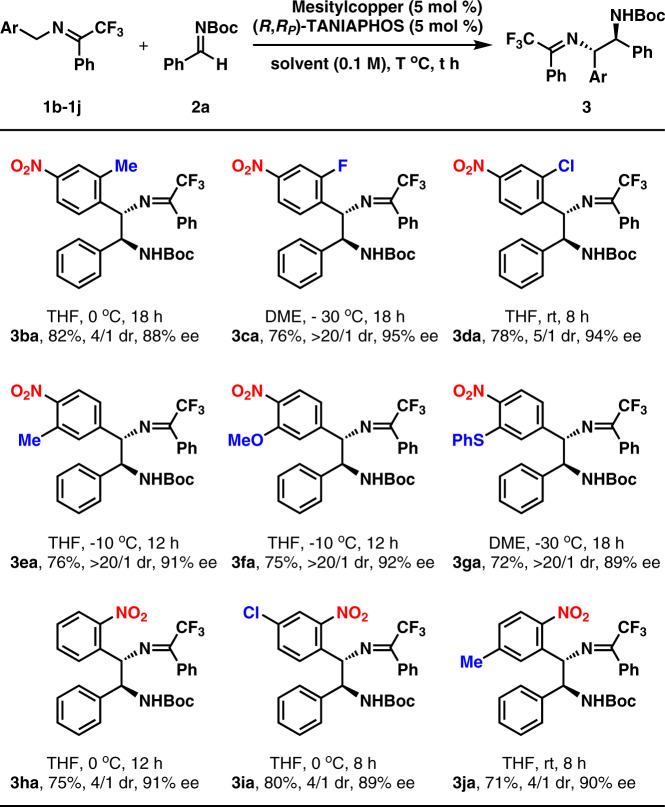
Fig. 3. Substrate scope of ketimines 1a.
Ketimines derived from both 4-nitro-benzylamines and 2-nitro-benzylamines are employed. a1b-1j: 0.2 mmol, 2a: 0.3 mmol. Isolated yield. Dr determined by 1H NMR analysis of the crude reaction mixture. Enantioselectivity determined by chiral-stationary-phase HPLC analysis.
Fig. 4
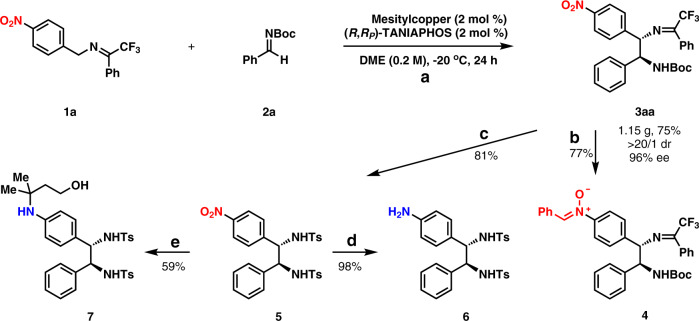
Fig. 4. Gram-scale reaction and transformations of the nitro group.
a Gram-scale reaction. b Transformation of the nitro group to the nitrone group. Zn (6.0 equiv), HOAc (12.0 equiv), EtOH, 0 °C to RT. c Removal of the ketimine moiety and protection of the newly generated free amine moiety. (1) 12 M HCl, MeOH, RT; (2) TsCl, Et3N, DMAP, DCM, RT. d Reduction of the nitro group to the amine group. Pd/C, H2 (1 atm), MeOH, RT. e Radical hydroamination. (1) 3-methylbut-3-en-1-ol (3.0 equiv), Fe(acac)3 (30 mol %), PhSiH3, EtOH, 60 °C; (2) Zn, HCl, 60 °C.
Fig. 5
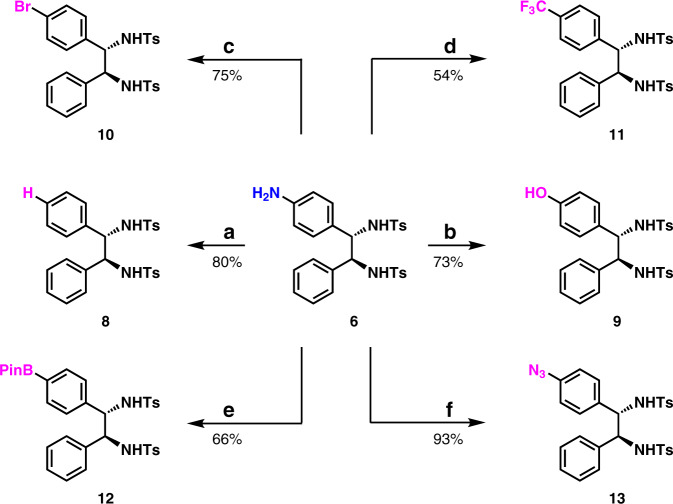
Fig. 5. Synthetic applications.
a Removal of the amine moiety. NaNO2, HCl, H3PO2, H2O, 0 °C. b transformation of the arylamine to phenol. NaNO2, H2SO4, H2O, 0 to 100 °C. c transformation of the arylamine to arylbromide. CuBr2 (1 mol %), tBuONO, TsOH, TBAB, MeCN, RT. d transformation of the arylamine to trifluoromethyl arene. tBuONO, HCl, AgCF3, MeCN, −40 °C. e Transformation of the arylamine to arylBPin. tBuONO, B2Pin2, MeCN, 80 °C. f Transformation of the arylamine to aryl azide. KHCO3, FSO2N3, MTBE/DMF/H2O, RT.

Similar articles

Cited by

References

    1. Lucet D, Le Gall T, Mioskowski C. The chemistry of vicinal diamines. Angew. Chem. Int. Ed. 1998;37:2580–2627. - PubMed
    1. Kotti SRSS, Timmons C, Li G. Vicinal diamino functionalities as privileged structural elements in biologically active compounds and exploitation of their synthetic chemistry. Chem. Biol. Drug Des. 2006;67:101–114. - PubMed
    1. Lin G-Q, Xu M-H, Zhong Y-W, Sun X-W. An advance on exploring N-tert-butanesulfinyl imines in asymmetric synthesis of chiral amines. Acc. Chem. Res. 2008;41:831–840. - PubMed
    1. Zhu Y, Cornwall RG, Du H, Zhao B, Shi Y. Catalytic diamination of olefins via N–N bond activation. Acc. Chem. Res. 2014;47:3665–3678. - PMC - PubMed
    1. Gladiali S, Alberico E. Asymmetric transfer hydrogenation: chiral ligands and applications. Chem. Soc. Rev. 2006;35:226–236. - PubMed

Publication types