Temporomandibular disorder, body pain and systemic diseases: assessing their associations in adolescents
- PMID: 32901693
- PMCID: PMC7480668
- DOI: 10.1590/1678-7757-2019-0608
Temporomandibular disorder, body pain and systemic diseases: assessing their associations in adolescents
Abstract
Painful temporomandibular disorders (TMD) in children and adolescents may impact negatively the individual´s life. The presence of comorbidities associated with TMD tends to increase the persistence of pain and to facilitate its chronification.
Objective: To investigate the presence of other painful conditions and systemic diseases and their association with painful TMD.
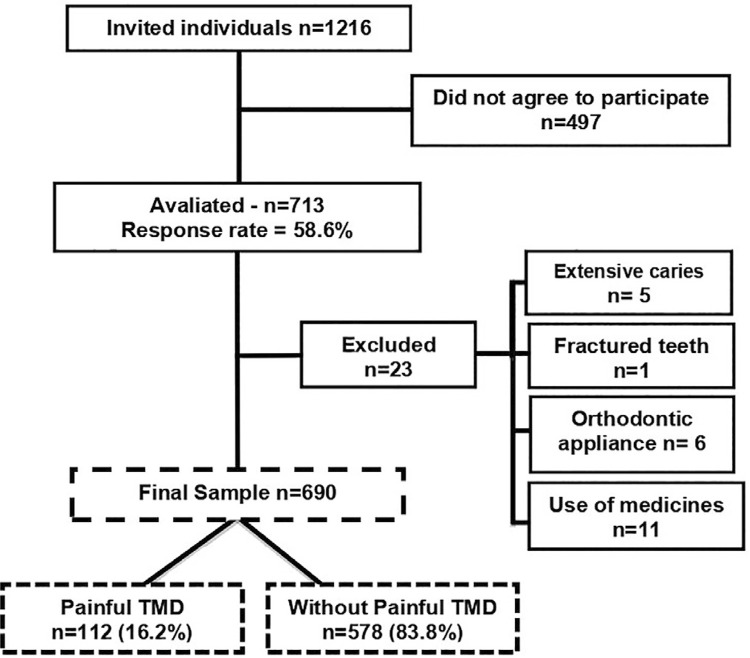
Methodology: In this cross-sectional study, 690 adolescents aged between 12-14 years old were evaluated through questionnaires and clinical examinations.
Results: Painful TMD was found in 16.2% of the sample, with a significant association with bronchitis (OR= 2.5; p=0.003) and asthma (OR=3.1; p=0.013), reported by the parents/legal guardians of the participants. Adolescents with regional and widespread pain were 2.7 (95% CI: 1.65-4.55) and 3.6 (95% CI: 1.29-10.14) more likely to also present painful TMD. Painful TMD was associated with a higher number of body pain sites in the last 12 months (4.26 vs. 2.90; p<0.001), as well as a higher number of systemic diseases (1.48 vs. 1.18; p=0.048), when compared to adolescents without painful TMD.
Conclusion: The findings of this study point out the importance of considering the presence of comorbid conditions in the diagnosis and management of painful TMD in adolescents. A multidisciplinary approach would contribute to better control of painful TMD and decrease its chronification risk.
References
-
- - Malta DC, Sardinha LM, Mendes I, Barreto SM, Giatti L, Castro IR, et al. Prevalence of risk health behavior among adolescents: results from the 2009 National Adolescent School-based Health Survey (PeNSE). Cien Saude Colet. 2010;15 Suppl 2:3009-19. doi: 10.1590/s1413-81232010000800002 - PubMed
- Malta DC, Sardinha LM, Mendes I, Barreto SM, Giatti L, Castro IR, et al. Prevalence of risk health behavior among adolescents: results from the 2009 National Adolescent School-based Health Survey (PeNSE) Cien Saude Colet. 2010;15(Suppl 2):3009–3019. doi: 10.1590/s1413-81232010000800002. - DOI - PubMed
-
- - Hestbaek L, Leboeuf-Yde C, Kyvik KO. Is comorbidity in adolescence a predictor for adult low back pain? A prospective study of a young population. BMC Musculoskelet Disord. 2006;7:29. doi: 10.1186/1471-2474-7-29 - PMC - PubMed
- Hestbaek L, Leboeuf-Yde C, Kyvik KO. Is comorbidity in adolescence a predictor for adult low back pain? A prospective study of a young population. BMC Musculoskelet Disord. 2006;7(29) doi: 10.1186/1471-2474-7-29. - DOI - PMC - PubMed
-
- - Saps M, Seshadri R, Sztainberg M, Schaffer G, Marshall BM, Di Lorenzo C. A prospective school-based study of abdominal pain and other common somatic complaints in children. J Pediatr. 2009;154(3):322–6. doi: 10.1016/j.jpeds.2008.09.047 - PubMed
- Saps M, Seshadri R, Sztainberg M, Schaffer G, Marshall BM, Di Lorenzo C. A prospective school-based study of abdominal pain and other common somatic complaints in children. J Pediatr. 2009;154(3):322–326. doi: 10.1016/j.jpeds.2008.09.047. - DOI - PubMed
-
- - American Academy of Orofacial Pain, Leeuw R, Klasser GD, editors. Orofacial pain: guidelines for assessment, diagnosis, and management. 5th ed. Chicago: Quintessence Publishing Co; 2013. 301 p.
- American Academy of Orofacial Pain. Leeuw R, Klasser GD.editors . Orofacial pain: guidelines for assessment, diagnosis, and management. 5th ed. Chicago: Quintessence Publishing Co; 2013. 301 p.
MeSH terms
LinkOut - more resources
Full Text Sources
Medical