. 2020 Nov;44(5):1929-1938.
doi: 10.3892/or.2020.7746. Epub 2020 Sep 1.

Targeting CDK9: A novel biomarker in the treatment of endometrial cancer

Affiliations

Targeting CDK9: A novel biomarker in the treatment of endometrial cancer

Shasha He et al. Oncol Rep. 2020 Nov.

Abstract

Endometrial cancer is one of the three major malignant tumors of the female reproductive system. Although cyclin‑dependent kinase 9 (CDK9) has a definitive pathogenic role in various types of cancer, little is known concerning its function in endometrial cancer. Our study was conducted to evaluate the expression and therapeutic potential of CDK9 in endometrial cancer. CDK9 expression was determined by immunohistochemistry in endometrial cancer tissues constructed with paired primary, metastatic, and recurrent tumor tissues from 32 endometrial cancer patients. Small interfering RNA (siRNA) and inhibitors of CDK9 were used to evaluate the effect of CDK9 inhibition on the anti‑apoptotic activity and proliferation in endometrial cancer cells. Colony formation assay and wound‑healing assays were adopted to assess clonal formation and migratory capacity. The results of the immunohistochemistry demonstrated that CDK9 was highly expressed in the human endometrial cancer cell lines; moreover, it was elevated in metastatic and recurrent endometrial tumor tissue compared when compared with that in patient‑matched primary endometrial tumor tissue. Knockdown of CDK9 with siRNA and inhibition of CDK9 activity with the inhibitor suppressed cell proliferation and promoted apoptosis in endometrial cancer. In conclusion, our results provide evidence that CDK9 may be a potential prognostic biomarker and a promising therapeutic target for the treatment of endometrial cancer in the future.

Keywords: endometrial cancer; cyclin-dependent kinase 9; siRNA; LDC067; biomarker.


Figures
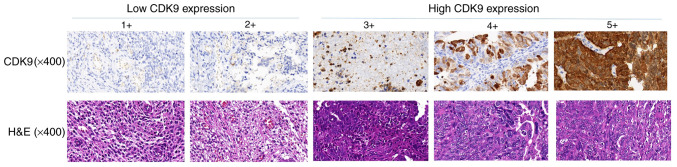
Figure 1.
Figure 1.
Different CDK9 staining intensities and H&E staining of endometrial cancer tissues. According to the CDK9 staining in the tumor samples, the staining patterns were divided into 5 groups: i) l<10% positive cells (1+); ii) 10–25% positive cells (2+); iii) 26–50% positive cells (3+); iv) 51–75% positive cells (4+); v) >75% positive cells (5+). (Original magnification, ×400). CDK9, cyclin-dependent kinase 9; H&E, hematoxylin and eosin.
Figure 2.
Figure 2.
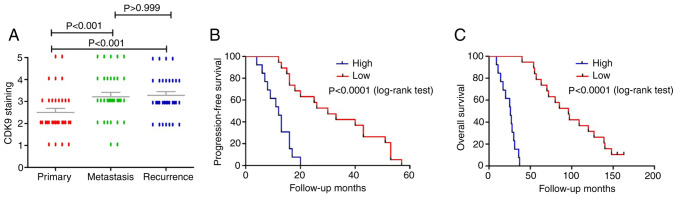
Higher expression of CDK9 is present in metastatic and recurrent endometrial cancer tissues compared with that found in the patient matched primary tumors and CDK9 is correlated with poor patient prognosis. (A) Distribution of CDK9 immunohistochemical staining scores among primary, metastatic, and recurrent endometrial cancer tissues. (B and C) Correlation between expression of CDK9 in the primary endometrial cancer tissues (Low, CDK9 staining ≤2+; High, CDK9 staining ≥3+) and PFS (B) or OS (C) in endometrial cancer patients by Kaplan-Meier survival curve analysis. CDK9, cyclin-dependent kinase 9; PFS, progression-free survival; OS, overall survival.
Figure 3.
Figure 3.
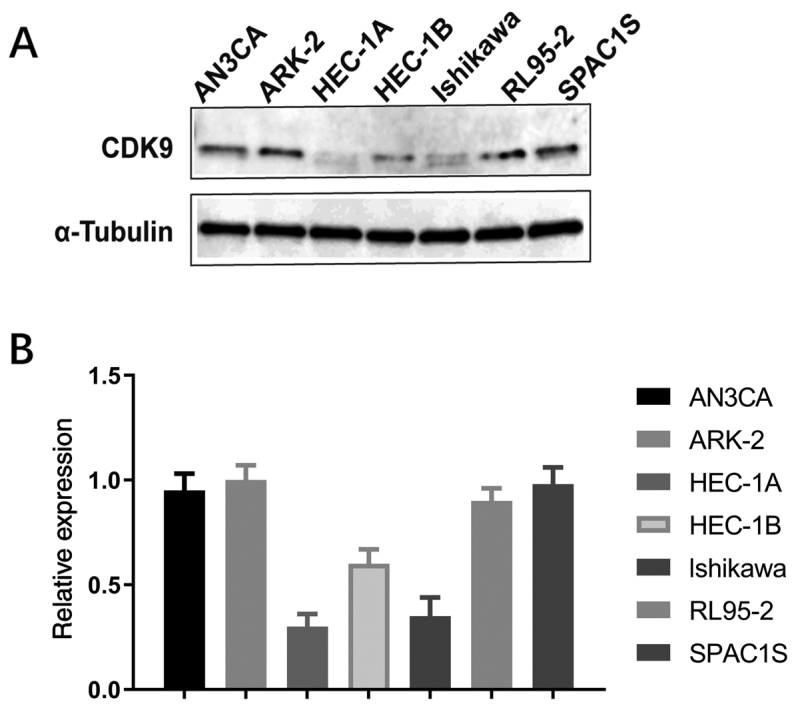
CDK9 expression in endometrial cancer cell lines. (A) Expression levels of CDK9 in endometrial cancer cell lines (AN3CA, ARK-2, HEC-1A, HEC-1B, lshikawa, RL95-2 and SPAC1S) as determined by western blotting. (B) Relative expression of CDK9 and α-tubulin in the endometrial cancer cell lines. CDK9, cyclin-dependent kinase 9.
Figure 4.
Figure 4.
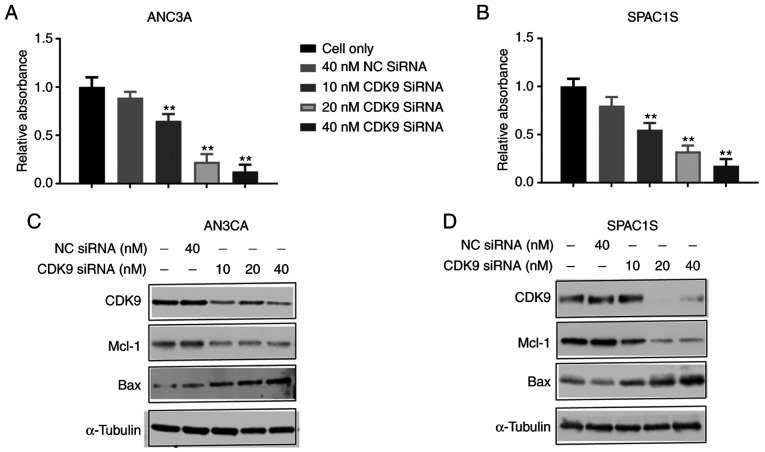
CDK9 knockdown by siRNA transfection suppresses endometrial cancer cell proliferation. (A and B) MTT assay revealed significant dose-dependent inhibition of cell proliferation after CDK9 siRNA treatment. **P<0.01 compared with the cell only control group. (C and D) Expression levels of CDK9 and related signaling pathway proteins involved in transcription and apoptosis after transfection of CDK9 siRNA and nonspecific siRNA (NC siRNA) in AN3CA and SPAC1S cell lines by western blot analysis. CDK9, cyclin-dependent kinase 9; Mcl-1, myeloid cell leukemia-1; Bax, proapoptotic protein BCL2 associated X, apoptosis regulator.
Figure 5.
Figure 5.
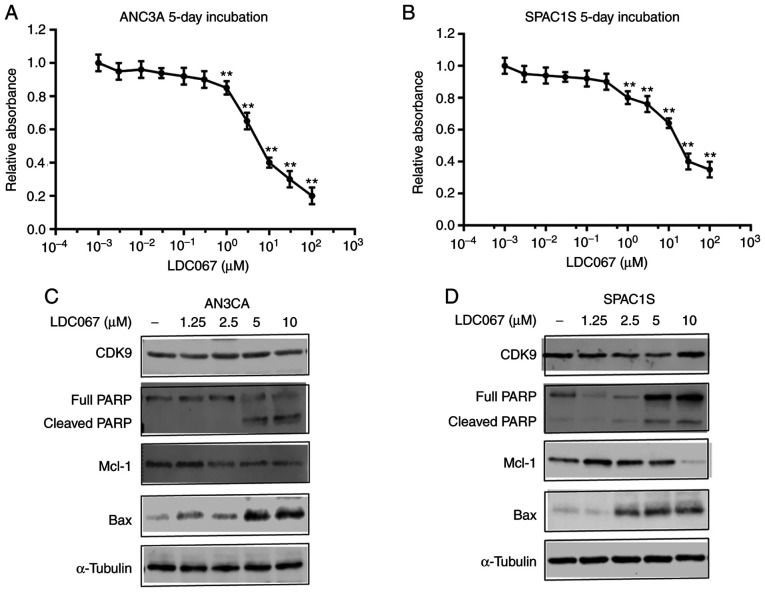
CDK9 inhibitor reduces endometrial cancer cell proliferation by suppressing transcription elongation and inducing apoptosis in endometrial cancer cells. (A and B) Relative cell viability of AN3CA and SPAC1S cells after exposure to different concentrations of the CDK9 inhibitor LDC067 for 5 days. **P<0.01 compared with the lowest concentration group (1×10⁻³ µM). (C and D) Expression levels of CDK9 and related signaling pathway proteins involved in transcription and apoptosis after treatment with LDC067 in cells by western blot analysis. CDK9, cyclin-dependent kinase 9; Mcl-1, myeloid cell leukemia-1; Bax, proapoptotic protein BCL2 associated X, apoptosis regulator; PARP, poly(ADP-ribose) polymerase.
Figure 6.
Figure 6.
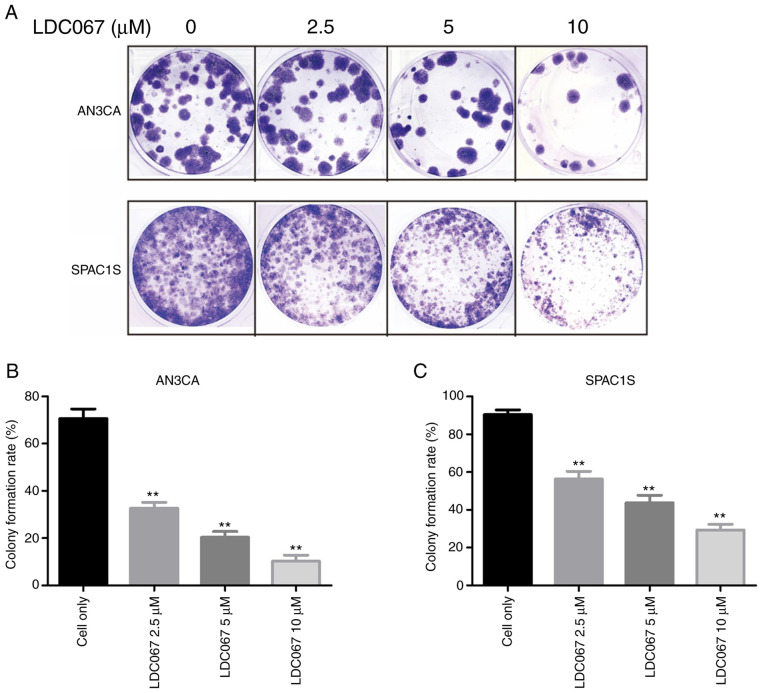
Inhibition of CDK9 suppresses endometrial cancer cell colony formation. (A) Representative images of endometrial cancer cell colony formation after incubation with different concentrations of LDC067 (0, 2.5, 5.0, and 10 µM) for 14 days. (B and C) Quantification of clonogenicity formation of AN3CA (B) and SPAC1S (C) cells after LDC067 treatment. **P<0.01 compared with the Cell only group. CDK9, cyclin-dependent kinase 9.
Figure 7.
Figure 7.
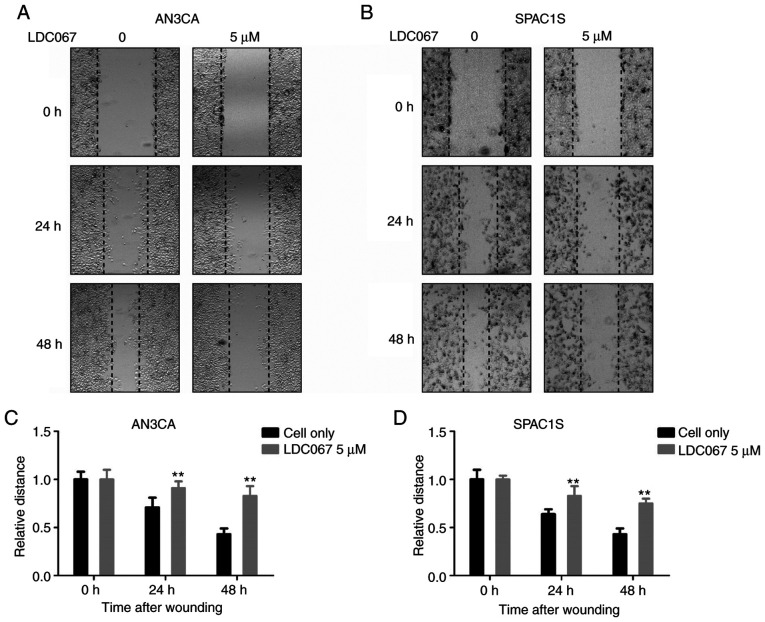
Inhibition of CDK9 reduces endometrial cancer cell migration. (A and B) Representative images of AN3CA and SPAC1S cell migration after CDK9 inhibitor LDC067 treatment for 0, 24, and 48 h. (C and D) Quantification of cell migration distance of AN3CA and SPAC1S cells after LDC067 treatment. **P<0.01 compared with the Cell only group. CDK9, cyclin-dependent kinase 9.

References

    1. Siegel RL, Miller KD, Jemal A. Cancer statistics, 2019. CA Cancer J Clin. 2019;69:7–34. doi: 10.3322/caac.21551. - DOI - PubMed
    1. Wong YF, Cheung TH, Lo KW, Yim SF, Siu NS, Chan SC, Ho TW, Wong KW, Yu MY, Wang VW, et al. Identification of molecular markers and signaling pathway in endometrial cancer in Hong Kong Chinese women by genome-wide gene expression profiling. Oncogene. 2007;26:1971–1982. doi: 10.1038/sj.onc.1209986. - DOI - PubMed
    1. Zhang Y, Liu Z, Yu X, Zhang X, Lü S, Chen X, Lü B. The association between metabolic abnormality and endometrial cancer: A large case-control study in China. Gynecol Oncol. 2010;117:41–46. doi: 10.1016/j.ygyno.2009.12.029. - DOI - PubMed
    1. Siegel RL, Miller KD, Jemal A. Cancer statistics, 2018. CA Cancer J Clin. 2018;68:7–30. doi: 10.3322/caac.21442. - DOI - PubMed
    1. Boren T, Xiong Y, Hakam A, Wenham R, Apte S, Wei Z, Kamath S, Chen DT, Dressman H, Lancaster JM. MicroRNAs and their target messenger RNAs associated with endometrial carcinogenesis. Gynecol Oncol. 2008;110:206–215. doi: 10.1016/j.ygyno.2008.03.023. - DOI - PubMed

MeSH terms