


Heterogeneous groups of alveolar type II cells in lung homeostasis and repair
- PMID: 32903031
- PMCID: PMC7768230
- DOI: 10.1152/ajpcell.00341.2020
Heterogeneous groups of alveolar type II cells in lung homeostasis and repair
Abstract
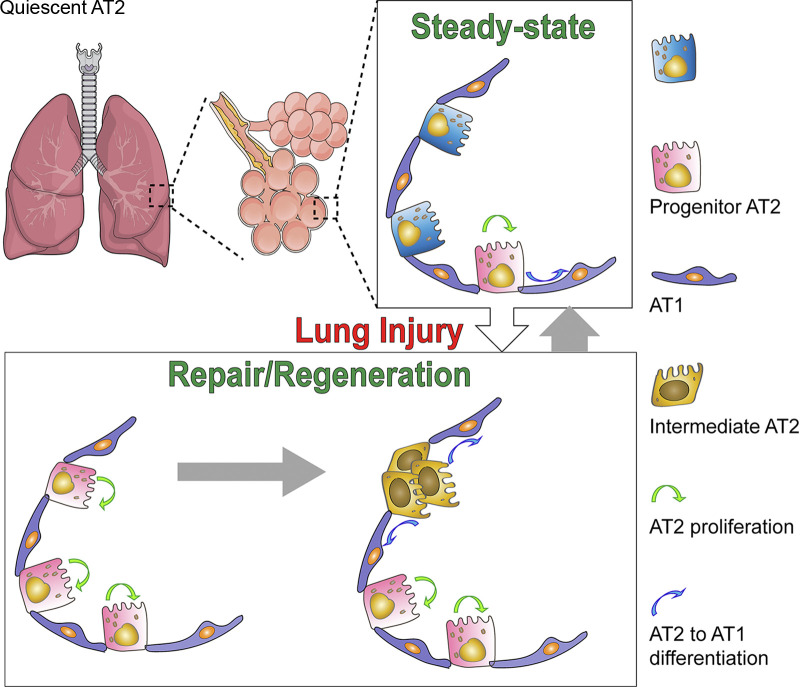
Alveoli are the gas-exchanging units of the lung, and the alveolar barrier is often a key battleground where pathogens, allergens, and other insults from the environment are encountered. This is seen in the current coronavirus disease 2019 (COVID-19) pandemic, as alveolar epithelium is one of the major targets of SARS-COV-2, the virus that causes COVID-19. Thus, it is essential to understand the mechanisms in order to maintain the integrity of alveoli epithelium. Alveolar type II (AT2) cells behave as tissue stem cells that repair alveoli epithelium during steady-state replacement and after injury. However, not all AT2 cells are equal in their ability for self-renewal or differentiation. Through marker gene identification, lineage tracing, and single-cell RNA-sequencing (scRNA-seq), distinct subpopulations of AT2 cells have been identified that play the progenitor role in a different context. The revelation of AT2 heterogeneity has brought new insights into the role of AT2 cells in various lung disease settings and potentiates the finding of more therapeutics targets. In this mini review, we discuss the recently identified subpopulations of AT2 cells and their functions under steady-state, postinjury, and pathological conditions.
Keywords: alveoli; lung; progenitor; stem cells; type II cells.
Conflict of interest statement
No conflicts of interest, financial or otherwise, are declared by the authors.
Figures
References
-
- Adams TS, Schupp JC, Poli S, Ayaub EA, Neumark N, Ahangari F, Chu SG, Raby BA, DeIuliis G, Januszyk M, Duan Q, Arnett HA, Siddiqui A, Washko GR, Homer R, Yan X, Rosas IO, Kaminski N. Single-cell RNA-seq reveals ectopic and aberrant lung-resident cell populations in idiopathic pulmonary fibrosis. Sci Adv 6: eaba1983, 2020. doi: 10.1126/sciadv.aba1983. - DOI - PMC - PubMed
-
- Bradley BT, Maioli H, Johnston R, Chaudhry I, Fink SL, Xu H, Najafian B, Deutsch G, Lacy JM, Williams T, Yarid N, Marshall DA. Histopathology and ultrastructural findings of fatal COVID-19 infections in Washington State: a case series. Lancet 396: 320–332, 2020. doi: 10.1016/S0140-6736(20)31305-2. - DOI - PMC - PubMed
Publication types
MeSH terms
LinkOut - more resources
Full Text Sources
Medical
Miscellaneous
