Review
. 2019 Mar 29:1:8.
doi: 10.1186/s42490-019-0006-z. eCollection 2019.

Compressed sensing MRI: a review from signal processing perspective

Affiliations
Review

Compressed sensing MRI: a review from signal processing perspective

Jong Chul Ye. BMC Biomed Eng. .

Abstract

Magnetic resonance imaging (MRI) is an inherently slow imaging modality, since it acquires multi-dimensional k-space data through 1-D free induction decay or echo signals. This often limits the use of MRI, especially for high resolution or dynamic imaging. Accordingly, many investigators has developed various acceleration techniques to allow fast MR imaging. For the last two decades, one of the most important breakthroughs in this direction is the introduction of compressed sensing (CS) that allows accurate reconstruction from sparsely sampled k-space data. The recent FDA approval of compressed sensing products for clinical scans clearly reflect the maturity of this technology. Therefore, this paper reviews the basic idea of CS and how this technology have been evolved for various MR imaging problems.

Keywords: MRI; compressed sensing; k-space.


Conflict of interest statement

Competing interestsThe author declares that he has no competing interests.

Figures

Fig. 1
Fig. 1
Various types of sparsity in MRI. (a) Sparsity from spatial domain redundancy, (b) Sparsity from temporal redundancy, and (c) sparsity from mu.ti-channel redundancy
Fig. 2
Fig. 2
Various under-sampling patterns: (a) Cartesian undersampling, (b) radial undersampling, and (c) spiral undersampling
Fig. 3
Fig. 3
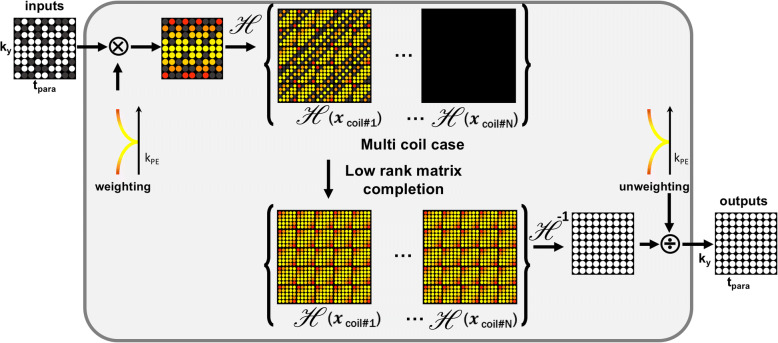
Construction of Hankel matrix for MR parameter mapping [59]
Fig. 4
Fig. 4
Construction of Hankel matrix for multi-channel filter data for the case of MR parameter mapping [59]

References

    1. Pruessmann KP, Weigher M, Scheidegger MB, Boesiger P. SENSE: Sensitivity encoding for fast MRI. Magn. Reson. Med. 1999;42(5):952–962. doi: 10.1002/(SICI)1522-2594(199911)42:5<952::AID-MRM16>3.0.CO;2-S. - DOI - PubMed
    1. Sodickson DK, Manning WJ. Simultaneous acquisition of spatial harmonics (SMASH): fast imaging with radiofrequency coil arrays. Magn Reson Med. 1997;38(4):591–603. doi: 10.1002/mrm.1910380414. - DOI - PubMed
    1. Griswold MA, Jakob PM, Heidemann RM, Nittka M, Jellus V, Wang J, Kiefer B, Haase A. Generalized autocalibrating partially parallel acquisitions(GRAPPA) Magn. Reson. Med. 2002;47(6):1202–1210. doi: 10.1002/mrm.10171. - DOI - PubMed
    1. Madore B, Glover GH, Pelc NJ. Unaliasing by Fourier-encoding the overlaps using the temporal dimension(UNFOLD), applied to cardiac imaging and fMRI. Magn. Reson. Med. 1999;42(5):813–828. doi: 10.1002/(SICI)1522-2594(199911)42:5<813::AID-MRM1>3.0.CO;2-S. - DOI - PubMed
    1. Tsao J, Boesiger P, Pruessmann KP. k-t BLAST and k-t SENSE: Dynamic MRI with high frame rate exploiting spatiotemporal correlations. Magn Reson Med. 2003;50(5):1031–1042. doi: 10.1002/mrm.10611. - DOI - PubMed

LinkOut - more resources