Review
. 2019 Feb 27:1:5.
doi: 10.1186/s42490-019-0005-0. eCollection 2019.

Battling adhesions: from understanding to prevention

Affiliations
Review

Battling adhesions: from understanding to prevention

Héctor Capella-Monsonís et al. BMC Biomed Eng. .

Abstract

Adhesions represent a major burden in clinical practice, particularly following abdominal, intrauterine, pericardial and tendon surgical procedures. Adhesions are initiated by a disruption in the epithelial or mesothelial layer of tissue, which leads to fibrin adhesion sites due to the downregulation of fibrinolytic activity and an increase in fibrin deposition. Hence, the metabolic events involved in tissue healing, coagulation, inflammation, fibrinolysis and angiogenesis play a pivotal role in adhesion formation. Understanding these events, their interactions and their influence on the development of post-surgical adhesion is crucial for the development of effective therapies to prevent them. Mechanical barriers, antiadhesive agents and combination thereof are customarily used in the battle against adhesions. Although these systems seem to be effective at reducing adhesions in clinical procedures, their prevention remains still elusive, imposing the need for new antiadhesive strategies.

Keywords: Antiadhesion agents; Antiadhesion barrier; Postoperative adhesions; Surgery.


Conflict of interest statement

Competing interestsThe authors declare that they have no competing interests.

Figures
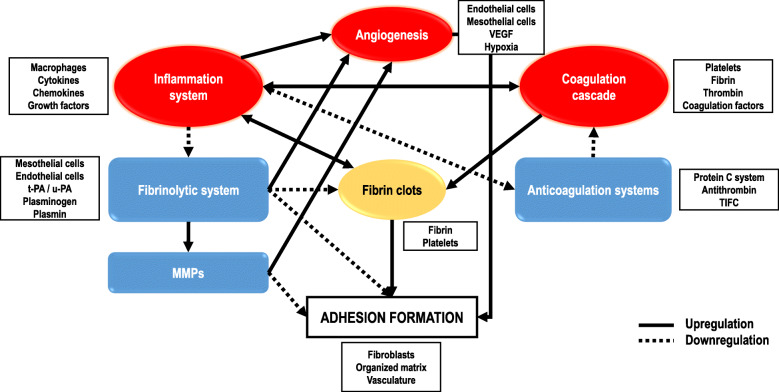
Fig. 1
Fig. 1
Interaction of the main pathways involved in adhesion formation. Inflammation, which is mainly mediated by macrophages, through cytokines and growth factors initiates the healing process by promoting fibrin exudate formation. Coagulation is simultaneously elicited, resulting in the formation of fibrin clots, which amplify the inflammatory response and attract inflammatory cells. When coagulation occurs, the anticoagulation system activates to downregulate the formation of thrombin and subsequently, fibrin. Both inflammation and anticoagulation downregulate each other. The fibrinolytic system degrades fibrin and extracellular matrix (ECM) components; however, inflammatory cytokines regulate the formation of plasminogen activator inhibitors (PAI), downregulating fibrinolytic activity. Fibrinolytic system components can activate MMPs, which are in charge of degrading ECM components. Both MMPs and the fibrinolytic system are involved in angiogenesis, the production of new vasculature that is promoted by inflammatory cytokines and hypoxia. Hypoxia occurs in fibrin clots, sparking the differentiation of fibroblasts to adhesion phenotype fibroblasts. This process, together with angiogenesis, promotes the deposition of organised ECM and subsequently, adhesions

References

    1. Okabayashi K, Ashrafian H, Zacharakis E, Hasegawa H, Kitagawa Y, Athanasiou T, Darzi A. Adhesions after abdominal surgery: a systematic review of the incidence, distribution and severity. Surg Today. 2014;44(3):405–420. doi: 10.1007/s00595-013-0591-8. - DOI - PubMed
    1. Evans-Hoeker EA, Young SL. Endometrial receptivity and intrauterine adhesive disease. Semin Reprod Med. 2014;32(05):392–401. doi: 10.1055/s-0034-1376358. - DOI - PubMed
    1. Cannata A, Petrella D, Russo CF, Bruschi G, Fratto P, Gambacorta M, Martinelli L. Postsurgical intrapericardial adhesions: mechanisms of formation and prevention. Ann Thorac Surg. 2013;95(5):1818–1826. doi: 10.1016/j.athoracsur.2012.11.020. - DOI - PubMed
    1. Park CB, Suri RM, Burkhart HM, Greason KL, Dearani JA, Schaff HV, Sundt Iii TM. Identifying patients at particular risk of injury during repeat sternotomy: analysis of 2555 cardiac reoperations. J Thorac Cardiovasc Surg. 2010;140(5):1028–1035. doi: 10.1016/j.jtcvs.2010.07.086. - DOI - PubMed
    1. Drake DB, Tilt AC, DeGeorge BR. Acellular flexor tendon allografts: a new horizon for tendon reconstruction. J Hand Surg. 2013;38(12):2491–2495. doi: 10.1016/j.jhsa.2013.03.039. - DOI - PubMed

LinkOut - more resources