


Adverse childhood experiences and chronic pain among children and adolescents in the United States
- PMID: 32903388
- PMCID: PMC7431222
- DOI: 10.1097/PR9.0000000000000839
Adverse childhood experiences and chronic pain among children and adolescents in the United States
Abstract
Objective: To evaluate the association between adverse childhood experiences (ACEs) and chronic pain during childhood and adolescence.
Methods: Cross-sectional analysis of the 2016-2017 National Survey of Children's Health, including 48,567 child participants of 6 to 17 years of age. Parents of children reported on 9 ACEs. Chronic pain was defined as parents reporting that their children had "frequent or chronic difficulty with repeated or chronic physical pain, including headache or other back or body pain during the past 12 months." Multivariate logistic regression analysis adjusted for sociodemographic and health-related factors.
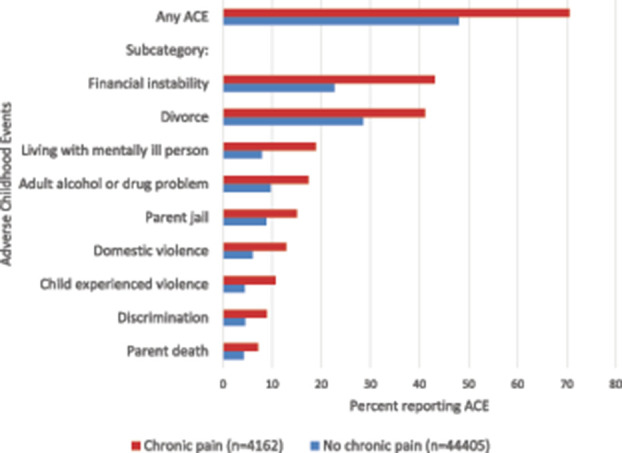
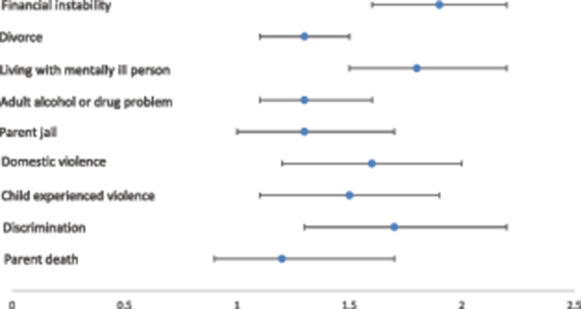
Results: In this nationally representative sample, 49.8% of children were exposed to one or more ACEs during their lifetime. Children with exposure to 1 or more ACEs had higher rates of chronic pain (8.7%) as compared to those with no reported ACEs (4.8%). In multivariate analysis, children with ACEs had increased odds for chronic pain (adjusted odds ratio [aOR]: 1.6, 95% confidence interval [CI]: 1.3-2.2, for 0 vs 1 ACE and aOR: 2.7, 95% CI: 2.1-3.4 for 0 vs 4+ ACEs). The strongest associations of individually measured ACEs with chronic pain included financial instability (aOR: 1.9, 95% CI: 1.6-2.2), living with a mentally ill adult (aOR: 1.8, 95% CI: 1.5-2.2), and having experienced discrimination based on race (aOR: 1.7, 95% CI: 1.3-2.2).
Conclusions: Children and adolescents with ACEs had increased risk for chronic pain, and this association increased in a dose-dependent fashion.
Keywords: Adolescence; Adverse childhood experiences; Childhood.
Copyright © 2020 The Author(s). Published by Wolters Kluwer Health, Inc. on behalf of The International Association for the Study of Pain.
Conflict of interest statement
The authors have no conflicts of interest to declare. This work was partially funded by grants from the National Institutes of Health: (grant number K23HL138155 awarded to C.B.G.) and (grant number F32HD097807 awarded to C.B.M.).Sponsorships or competing interests that may be relevant to content are disclosed at the end of this article.
Figures
References
-
- Centers for Disease Control and Prevention. Preventing Adverse Childhood Experiences: Leveraging the Best Available Evidence. Atlanta, GA: National Center for Injury Prevention and Control, Centers for Disease Control and Prevention, 2019. Available at: https://www.cdc.gov/violenceprevention/pdf/preventingACES.pdf. Accessed January 30, 2020.
-
- Crouch E, Probst JC, Radcliff E, Bennett KJ, McKinney SH. Prevalence of adverse childhood experiences (ACEs) among US children. Child Abuse Negl 2019;92:209–18. - PubMed
-
- Denk F, McMahon SB, Tracey I. Pain vulnerability: a neurobiological perspective. Nat Neurosci 2014;17:192–200. - PubMed
Grants and funding
LinkOut - more resources
Full Text Sources
Miscellaneous