


Stressed to Death: The Role of Transcription Factors in Plant Programmed Cell Death Induced by Abiotic and Biotic Stimuli
- PMID: 32903426
- PMCID: PMC7434935
- DOI: 10.3389/fpls.2020.01235
Stressed to Death: The Role of Transcription Factors in Plant Programmed Cell Death Induced by Abiotic and Biotic Stimuli
Abstract
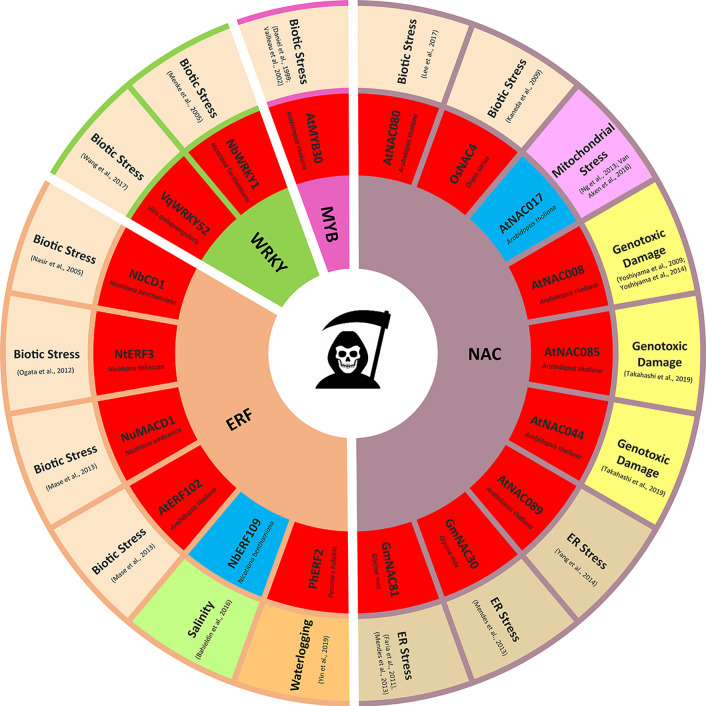
Programmed cell death (PCD) is a genetically controlled pathway that plants can use to selectively eliminate redundant or damaged cells. In addition to its fundamental role in plant development, PCD can often be activated as an essential defense response when dealing with biotic and abiotic stresses. For example, localized, tightly controlled PCD can promote plant survival by restricting pathogen growth, driving the development of morphological traits for stress tolerance such as aerenchyma, or triggering systemic pro-survival responses. Relatively little is known about the molecular control of this essential process in plants, especially in comparison to well-described cell death models in animals. However, the networks orchestrating transcriptional regulation of plant PCD are emerging. Transcription factors (TFs) regulate the clusters of stimuli inducible genes and play a fundamental role in plant responses, such as PCD, to abiotic and biotic stresses. Here, we discuss the roles of different classes of transcription factors, including members of NAC, ERF and WRKY families, in cell fate regulation in response to environmental stresses. The role of TFs in stress-induced mitochondrial retrograde signaling is also reviewed in the context of life-and-death decisions of the plant cell and future research directions for further elucidation of TF-mediated control of stress-induced PCD events are proposed. An increased understanding of these complex signaling networks will inform and facilitate future breeding strategies to increase crop tolerance to disease and/or abiotic stresses.
Keywords: abiotic stress; biotic stress; plants; programmed cell death; transcription factors.
Copyright © 2020 Burke, Schwarze, Sherwood, Jnaid, McCabe and Kacprzyk.
Figures
References
-
- Akcin T. A., Akcin A., Yalcin E. (2015). Anatomical Adaptations to Salinity in Spergularia marina (Caryophyllaceae) from Turkey. Proc. Natl. Acad. Sci. India B 85 (2), 625–634. 10.1007/s40011-014-0386-8 - DOI
Publication types
LinkOut - more resources
Full Text Sources
Miscellaneous
