


Comprehensive Analysis of Macrocirculation and Microcirculation in Microgravity During Parabolic Flights
- PMID: 32903511
- PMCID: PMC7438475
- DOI: 10.3389/fphys.2020.00960
Comprehensive Analysis of Macrocirculation and Microcirculation in Microgravity During Parabolic Flights
Abstract
Background: Profound knowledge about cardiovascular physiology in the setting of microgravity can help in the course of preparations for human space missions. So far, influences of microgravity on the cardiovascular system have been demonstrated, particularly pertaining to venous fluid shifts. Yet, little is known about the mechanisms of these adaptations on continuous macrocirculatory level and regarding the microcirculation.
Methods: Twelve healthy volunteers were subjected to alternating microgravity and hypergravity in the course of parabolic flight maneuvers. Under these conditions, as well as in normal gravity, the sublingual microcirculation was assessed by intravital sidestream dark field microscopy. Furthermore, hemodynamic parameters such as heart rate, blood pressure, and cardiac output were recorded by beat-to-beat analysis. In these settings, data acquisition was performed in seated and in supine postures.
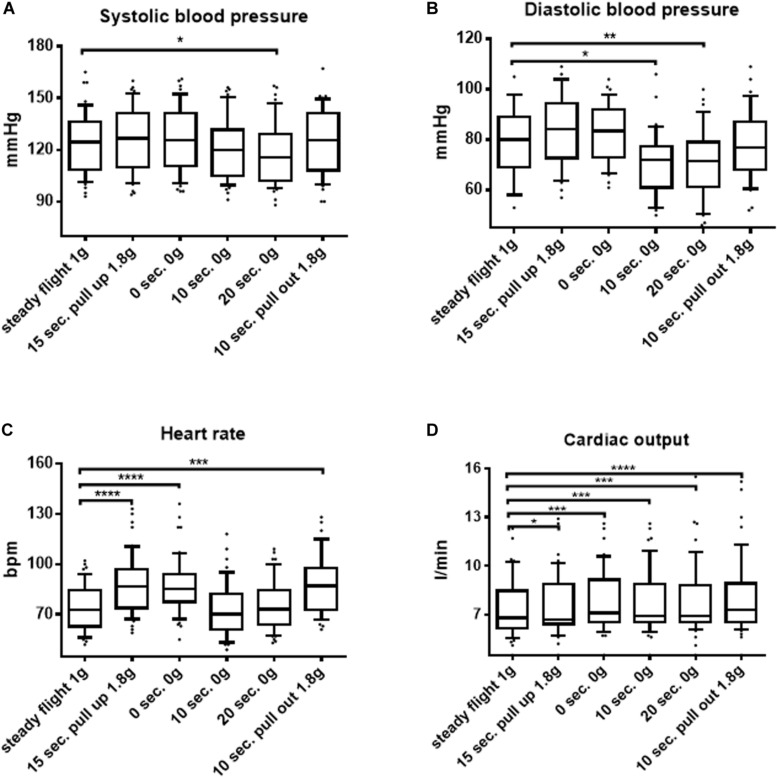
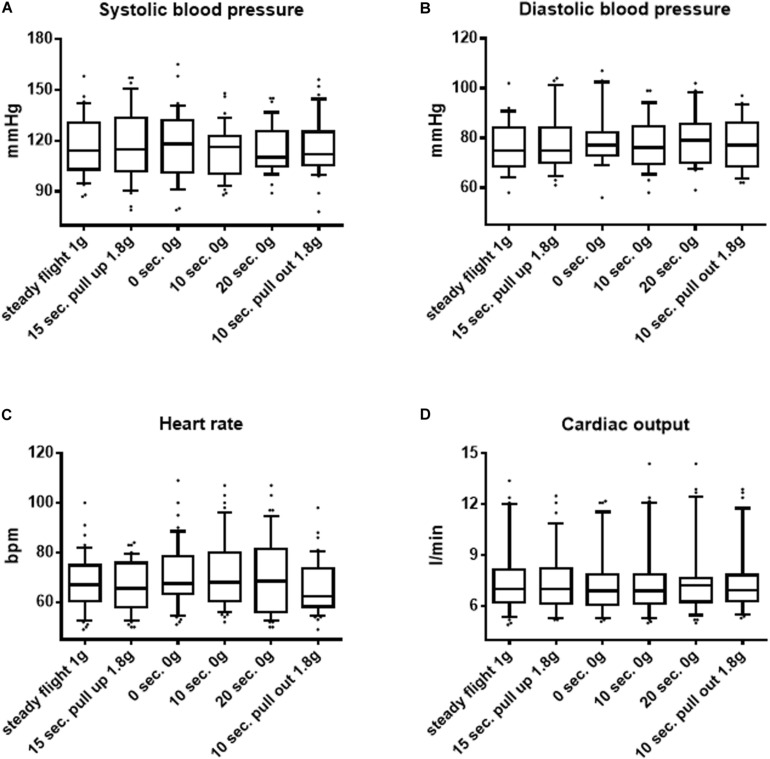
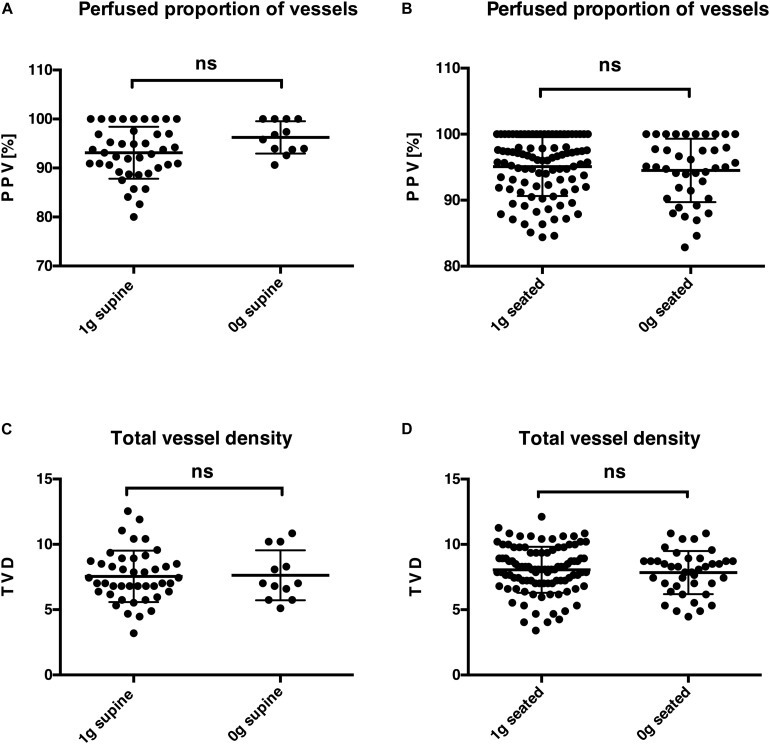
Results: Systolic [median 116 mmHg (102; 129) interquartile range (IQR) vs. 125 mmHg (109; 136) IQR, p = 0.01] as well as diastolic [median 72 mmHg (61; 79) IQR vs. 80 mmHg (69; 89) IQR, p = 0.003] blood pressure was reduced, and cardiac output [median 6.9 l/min (6.5; 8.8) IQR vs. 6.8 l/min (6.2; 8.5) IQR, p = 0.0002] increased in weightlessness compared to normal gravitation phases in the seated but not in the supine posture. However, microcirculation represented by perfused proportion of vessels and by total vessel density was unaffected in acute weightlessness.
Conclusion: Profound changes of the macrocirculation were found in seated postures, but not in supine postures. However, microcirculation remained stable in all postures.
Keywords: hemodynamic changes; microcirculation; microgravity; parabolic flight; weightlessness.
Copyright © 2020 Bimpong-Buta, Muessig, Knost, Masyuk, Binneboessel, Nia, Kelm and Jung.
Figures
References
-
- Aratow M., Hargens A. R., Meyer J. U., Arnaud S. B. (1991). Postural responses of head and foot cutaneous microvascular flow and their sensitivity to bed rest. Aviat. Space Environ. Med. 62 246–251. - PubMed
-
- Baisch J. F., Wolfram G., Beck L., Drummer C., Stormer I., Buckey J., et al. (2000). Orthostatic stress is necessary to maintain the dynamic range of cardiovascular control in space. Pflugers Arch. 441 R52–R61. - PubMed
LinkOut - more resources
Full Text Sources
