Review
. 2020 Aug 13:11:1792.
doi: 10.3389/fimmu.2020.01792. eCollection 2020.

Engineering Immune Cells for in vivo Secretion of Tumor-Specific T Cell-Redirecting Bispecific Antibodies

Affiliations
Review

Engineering Immune Cells for in vivo Secretion of Tumor-Specific T Cell-Redirecting Bispecific Antibodies

Belén Blanco et al. Front Immunol. .

Abstract

Immunotherapeutic approaches based on the redirection of T cell activity toward tumor cells are actively being investigated. The impressive clinical success of the continuously intravenously infused T cell-redirecting bispecific antibody (T-bsAb) blinatumomab (anti-CD19 x anti-CD3), and of engineered T cells expressing anti-CD19 chimeric antigen receptors (CAR-T cells) in hematological malignancies, has led to renewed interest in a novel cancer immunotherapy strategy that combines features of antibody- and cell-based therapies. This emerging approach is based on the endogenous secretion of T-bsAbs by engineered T cells (STAb-T cells). Adoptive transfer of genetically modified STAb-T cells has demonstrated potent anti-tumor activity in both solid tumor and hematologic preclinical xenograft models. We review here the potential benefits of the STAb-T strategy over similar approaches currently being used in clinic, and we discuss the potential combination of this promising strategy with the well-established CAR-T cell approach.

Keywords: T cell-redirection; bispecific antibodies; cancer immunotherapy; chimeric antigen receptors; in situ secretion.


Figures

Figure 1
Figure 1
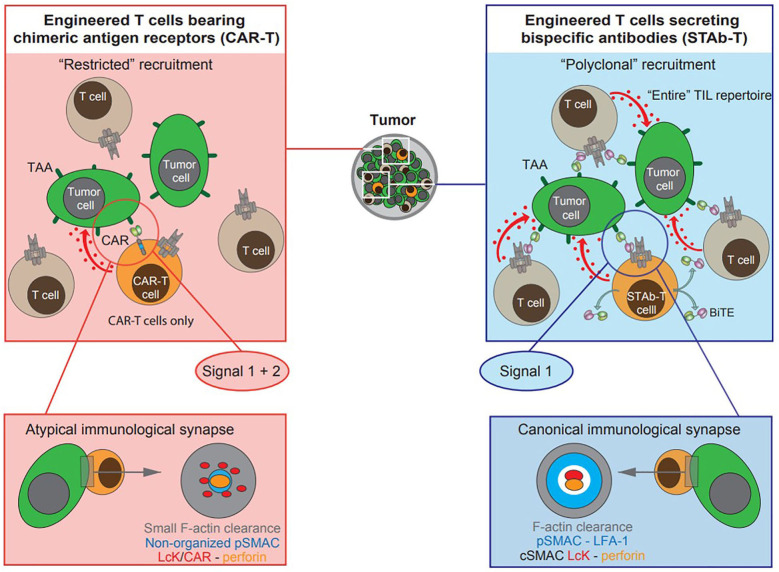
Schematic diagram depicting cell-based T cell-redirecting strategies for cancer immunotherapy. Engineered T cells (orange cells) expressing second-generation scFv-based chimeric antigen receptors (CAR-T cells), and engineered T cells secreting T cell-redirecting bispecific antibodies (STAb-T cells) in BiTE format. The tumor-associated antigen (TAA)-specific scFv is displayed in light green and the anti-CD3ζ scFv in magenta. Red arrows and dots represent delivery of the “lethal hit” to tumor cells (green cells) by CAR- or BiTE-activated T cells: engineered and/o bystander non-engineered tumor infiltrating T lymphocytes (TILs, gray cells). In engineered T cells expressing second generation CARs, a single molecular interaction provides both signals 1 and 2, whereas TAA-specific BiTEs do not provide co-stimulatory signaling to T cells. Topology observed in CAR-mediated and BiTE-mediated immunological synapse (IS): the CAR-mediated IS shows a rather disordered structure whereas the BiTE-mediated IS displays a well-organized canonical “bull's eye” structure.

References

    1. Schreiber RD, Old LJ, Smyth MJ. Cancer immunoediting: integrating immunity's roles in cancer suppression and promotion. Science. (2011) 331:1565–70. 10.1126/science.1203486 - DOI - PubMed
    1. Khong HT, Restifo NP. Natural selection of tumor variants in the generation of “tumor escape” phenotypes. Nat Immunol. (2002) 3:999–1005. 10.1038/ni1102-999 - DOI - PMC - PubMed
    1. Rabinovich GA, Gabrilovich D, Sotomayor EM. Immunosuppressive strategies that are mediated by tumor cells. Annu Rev Immunol. (2007) 25:267–96. 10.1146/annurev.immunol.25.022106.141609 - DOI - PMC - PubMed
    1. Alvarez-Vallina L. Genetic approaches for antigen-selective cell therapy. Curr Gene Ther. (2001) 1:385–97. 10.2174/1566523013348418 - DOI - PubMed
    1. Sanz L, Blanco B, Alvarez-Vallina L. Antibodies and gene therapy: teaching old 'magic bullets' new tricks. Trends Immunol. (2004) 25:85–91. 10.1016/j.it.2003.12.001 - DOI - PubMed

Publication types

Substances

LinkOut - more resources