


Recent Advances in the Use of Exosomes in Sjögren's Syndrome
- PMID: 32903777
- PMCID: PMC7438915
- DOI: 10.3389/fimmu.2020.01509
Recent Advances in the Use of Exosomes in Sjögren's Syndrome
Abstract
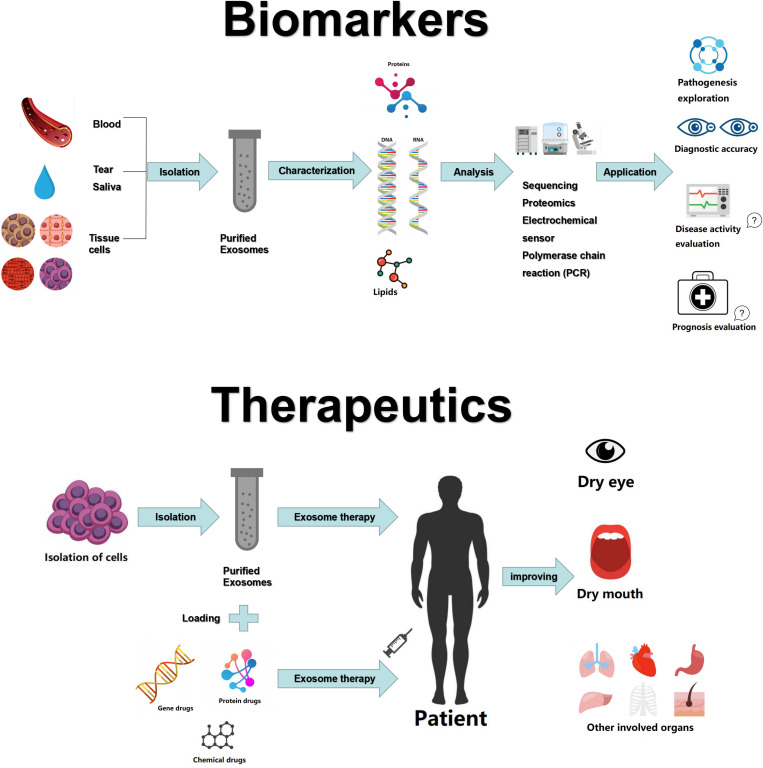
Sjögren's syndrome (SS) is a chronic autoimmune disorder of the exocrine glands mediated by lymphocytic infiltrates damaging the body tissues and affecting the life quality of patients. Although traditional methods of diagnosis and treatment for SS are effective, in the time of personalized medicine, new biomarkers, and novel approaches are required for the detection and treatment of SS. Exosomes represent an emerging field in the discovery of biomarkers and the management of SS. Exosomes, a subtype of extracellular vesicles, are secreted by various cell types and can be found in most bodily fluids. Exosomes are packed with cytokines and other proteins, bioactive lipids, and nucleic acids (mRNA, circular RNA, non-coding RNA, tRNA, microRNA, genomic DNA, and ssDNA), and transport such cargo between cells. Evidence has indicated that exosomes may play roles in processes such as the modulation of the immune response and activation of inflammation. Moreover, due to features such as stability, low immunogenicity and toxicity, long half-life, and the capacity to penetrate the blood-brain barrier, exosomes have also emerged as therapeutic tools for SS. In this review, we summarize existing literature regarding the biogenesis, isolation, and function of exosomes, specifically focusing on exosomes as novel biomarkers and their potential therapeutic uses in SS.
Keywords: Sjögren’s syndrome; biomarkers; exosomes; immune response; treatment.
Copyright © 2020 Huang, Li, Ye, Lin, Yin and Xie.
Figures
References
-
- Shiboski SC, Shiboski CH, Criswell L, Baer A, Challacombe S, Lanfranchi H, et al. American college of rheumatology classification criteria for Sjogren’s syndrome: a data-driven, expert consensus approach in the Sjogren’s international collaborative clinical alliance cohort. Arthritis Care Res. (2012) 64:475–87. 10.1002/acr.21591 - DOI - PMC - PubMed
-
- Shiboski CH, Shiboski SC, Seror R, Criswell LA, Labetoulle M, Lietman TM, et al. 2016 American college of rheumatology/European league against rheumatism classification criteria for primary Sjogren’s syndrome: a consensus and data-driven methodology involving three international patient cohorts. Ann Rheum Dis. (2017) 76:9–16. 10.1136/annrheumdis-2016-210571 - DOI - PubMed
Publication types
MeSH terms
Substances
LinkOut - more resources
Full Text Sources
Medical
