Comparison between SLAP Repair and Biceps Tenodesis with Concomitant Rotator Cuff Repair in Patients Older than 45 Years: Minimum 2-Year Clinical and Imaging Outcomes
- PMID: 32904029
- PMCID: PMC7449846
- DOI: 10.4055/cios19157
Comparison between SLAP Repair and Biceps Tenodesis with Concomitant Rotator Cuff Repair in Patients Older than 45 Years: Minimum 2-Year Clinical and Imaging Outcomes
Abstract
Backgroud: There is controversy over how to surgically treat symptomatic superior labrum anterior to posterior (SLAP) tears in middle-aged patients with concomitant rotator cuff tears. The aim of the study was to compare the clinical and imaging outcomes of SLAP repair versus biceps tenodesis (BT) each combined with arthroscopic rotator cuff repair (ARCR).
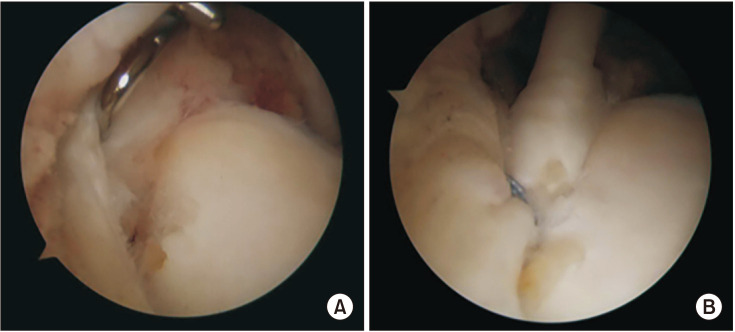
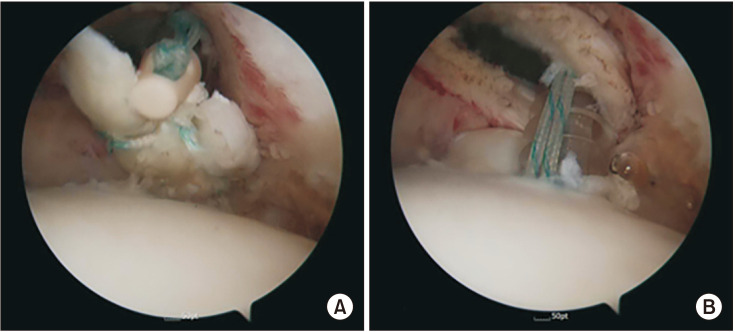
Methods: We retrospectively reviewed 35 patients older than 45 years who underwent arthroscopic surgery to manage concomitant SLAP tears and rotator cuff tears. In addition to ARCR, 17 patients underwent SLAP repair, whereas 18 patients underwent BT. Shoulder range of motion (ROM), visual analog scale (VAS) for pain, American Shoulder and Elbow Surgeons (ASES) score, Constant score, and University of California at Los Angeles (UCLA) score were used for clinical assessment. The integrity of rotator cuff repair and change of superior labrum-biceps complex were evaluated by postoperative magnetic resonance imaging (MRI).
Results: There was significant improvement in the pain VAS and all functional scores in both groups (p < 0.001) at a mean followup of 29.4 ± 11.4 months (range, 24-84 months) postoperatively. Shoulder ROM showed significant improvement postoperatively (p < 0.05). No significant difference in outcomes could be found between the 2 groups after surgery. The retear rate of rotator cuff repair on MRI was 11.8% in the SLAP repair group and 11.1% in the BT group.
Conclusions: In middle-aged patients with combined SLAP lesions and rotator cuff tears, both SLAP repair and BT can be safe adjuncts to ARCR.
Keywords: Arthroscopic rotator cuff repair; Clinical outcomes; Long head of biceps tendon; SLAP tears; Tenodesis.
Copyright © 2020 by The Korean Orthopaedic Association.
Conflict of interest statement
CONFLICT OF INTEREST: No potential conflict of interest relevant to this article was reported.
Figures
References
-
- Andrews JR, Carson WG, Jr, McLeod WD. Glenoid labrum tears related to the long head of the biceps. Am J Sports Med. 1985;13(5):337–341. - PubMed
-
- Snyder SJ, Karzel RP, Del Pizzo W, Ferkel RD, Friedman MJ. SLAP lesions of the shoulder. Arthroscopy. 1990;6(4):274–279. - PubMed
-
- Rhee YG, Lee DH, Lim CT. Unstable isolated SLAP lesion: clinical presentation and outcome of arthroscopic fixation. Arthroscopy. 2005;21(9):1099. - PubMed
-
- Coleman SH, Cohen DB, Drakos MC, et al. Arthroscopic repair of type II superior labral anterior posterior lesions with and without acromioplasty: a clinical analysis of 50 patients. Am J Sports Med. 2007;35(5):749–753. - PubMed
Publication types
MeSH terms
LinkOut - more resources
Full Text Sources
Medical