


Elevated levels of autoantibodies against DNAJC2 in sera of patients with atherosclerotic diseases
- PMID: 32904265
- PMCID: PMC7452465
- DOI: 10.1016/j.heliyon.2020.e04661
Elevated levels of autoantibodies against DNAJC2 in sera of patients with atherosclerotic diseases
Abstract
Background: Serum antibody markers have been increasingly identified not only for cancer and autoimmune diseases but also for atherosclerosis-related diseases such as acute ischemic stroke (AIS), acute myocardial infarction (AMI), diabetes mellitus (DM), and chronic kidney disease (CKD). Biomarkers for transient ischemic attack (TIA) and non-ST segment elevation acute coronary syndrome (NSTEACS) are potentially useful for detection of early phase of atherosclerotic changes against AIS and AMI, respectively.
Methods: We utilized serological identification of antigens by recombinant cDNA expression cloning (SEREX) using a human aortic endothelial cell cDNA phage library and sera from patients with TIA or NSTEACS. Serum antibody levels were measured by amplified luminescent proximity homogeneous assay-linked immunosorbent assay (AlphaLISA) using purified recombinant antigens.
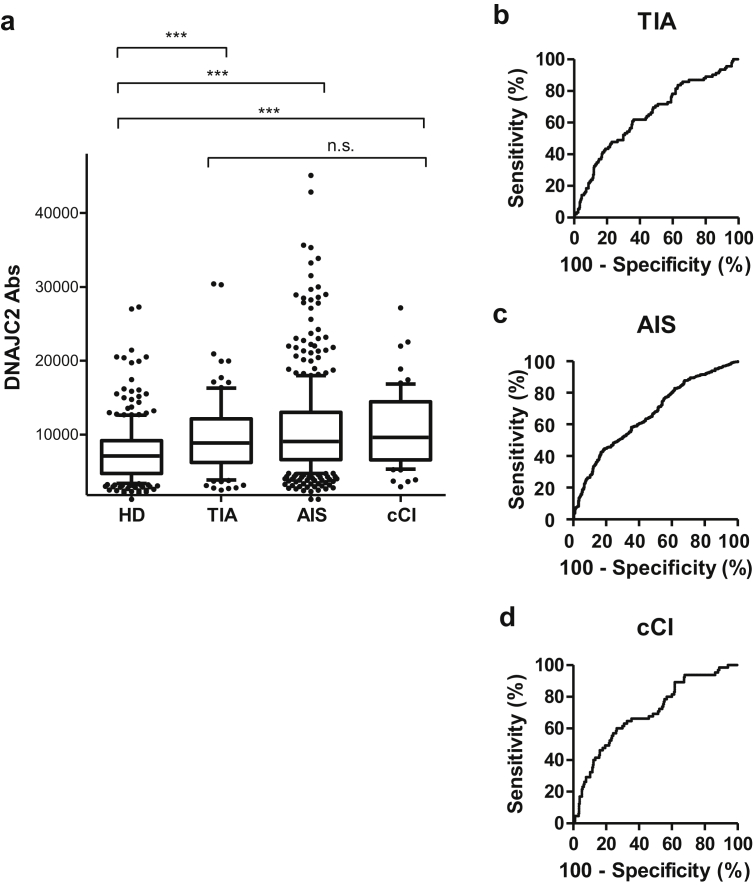
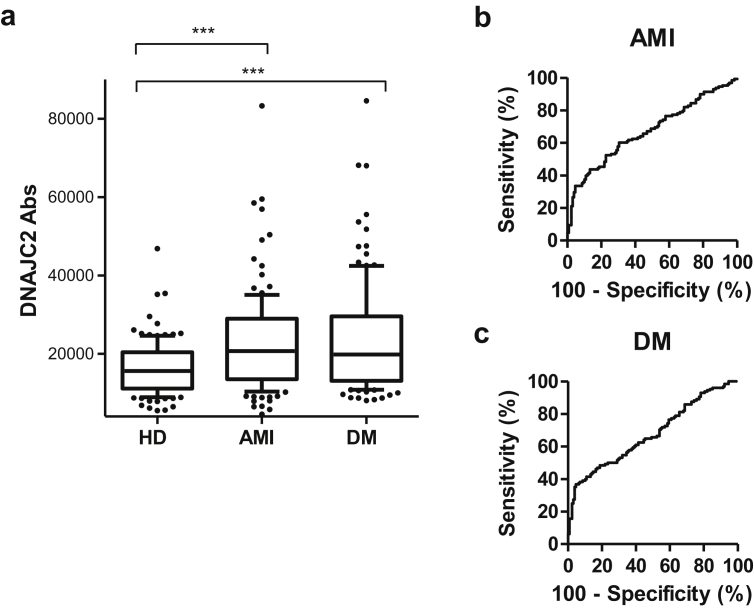
Results: Screening of sera from patients with TIA identified DnaJ heat shock protein family (Hsp40) member C2 (DNAJC2) as a candidate antigen, which was also isolated by SEREX screening using sera of patients with NSTEACS. The validation cohort revealed significantly higher DNAJC2 antibody (DNAJC2-Ab) levels in the sera of patients with TIA or AIS than those in healthy donors (HDs). Multivariate logistic regression analysis indicated that the predictive odds ratios (OR) of DNAJC2-Ab levels for TIA and AIS were 2.54 (95% confidence interval [CI]: 1.36-4.74, p = 0.0034) and 2.14 (95% CI: 1.39-3.30, p = 0.0005), respectively. Serum DNAJC2-Ab levels were also higher in patients with AMI, DM, and CKD than those in HDs.
Conclusion: Serum DNAJC2-Ab level may be useful for early detection of atherosclerotic lesions, which lead to AIS and AMI.
Keywords: Acute ischemic stroke; Acute myocardial infarction; Atherosclerosis; Autoantibody biomarker; Biomarkers; Cardiology; Cardiovascular system; Clinical research; DNAJC2; Diagnostics; Hematological system; Neurology; Neurosurgery.
© 2020 The Author(s).
Figures


References
-
- Goldstein L.B., Bushnell C.D., Adams R.J., Appel L.J., Braun L.T., Chaturvedi S. Guideline for the primary prevention of stroke: a guideline for healthcare professionals from the American Heart Association/American Stroke Association. Stroke. 2011;42:517–584. PMID: 21127304. - PubMed
-
- Carandang R., Seshadri S., Beiser A., Kelly-Hayes M., Kase C.S., Kannel W.B. Trends in incidence, lifetime risk, severity, and 30-day mortality of stroke over the past 50 years. J. Am. Med. Assoc. 2006;296:2939–2946. PMID: 17190894. - PubMed
-
- Kubo M., Hata J., Doi Y., Tanizaki Y., Iida M., Kiyohara Y. Secular trends in the incidence of and risk factors for ischemic stroke and its subtypes in Japanese population. Circulation. 2008;118:2672–2678. PMID: 19106389. - PubMed
-
- Libby P., Ridker P.M., Hansson G.K. Progress and challenges in translating the biology of atherosclerosis. Nature. 2011;473:317–325. PMID: 21593864. - PubMed
-
- Rollins K.E., Varadhan K.K., Dhatariya K., Lobo D.N. Systematic review of the impact of HbA1c on outcomes following surgery in patients with diabetes mellitus. Clin. Nutr. 2015;35:308–316. PMID: 25840840. - PubMed
LinkOut - more resources
Full Text Sources
Miscellaneous
