


Comparison of Low Dose versus High Dose of Oxytocin for Initiating Uterine Contraction During Cesarean Delivery: A Randomized, Controlled, Non-Inferiority Trial
- PMID: 32904472
- PMCID: PMC7455765
- DOI: 10.2147/IJWH.S260073
Comparison of Low Dose versus High Dose of Oxytocin for Initiating Uterine Contraction During Cesarean Delivery: A Randomized, Controlled, Non-Inferiority Trial
Abstract
Background: Oxytocin is used for initiating uterine contraction and preventing postpartum hemorrhage during caesarean delivery. Using a lower dosage of oxytocin may lower the risk of adverse effects while still being effective in stimulating initial uterine contraction. We aimed to compare the effectiveness and side effects of the standard 10 IU bolus of oxytocin with those of a 5 IU bolus during caesarean delivery.
Patients and methods: We enrolled women in a randomized, double-blind, study comparing intravenous injections of high-dose (10 IU) and low-dose (5 IU) oxytocin administered after clamping of the umbilical cord. The primary outcome was adequate uterine contraction within the first 3 mins after administration. Secondary outcomes included uterine tone, use of additional uterotonic agents, additional obstetrics procedures, and oxytocin-related adverse events.
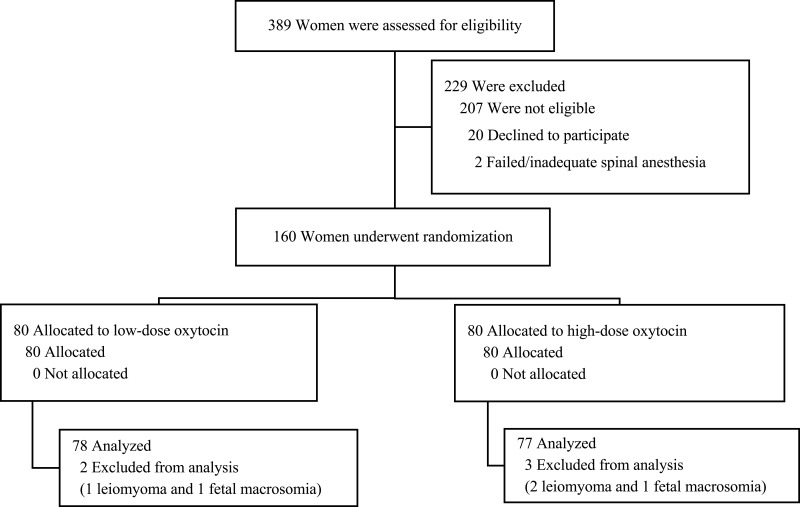
Results: A total of 155 women underwent randomization, with 78 in the low-dose group and 77 in the high-dose group. The proportion of women with adequate uterine contraction during the first 3 mins was 84.6% in the low-dose group and 77.9% in the high-dose group (relative risk, 1.09; 95% CI, 0.93 to 1.26). Methylergonovine maleate was used in 14.1% of cases in the low-dose group and 36.4% in the high-dose group (relative risk, 0.40; 95% CI, 0.22 to 0.73). The necessity for additional obstetric procedures, estimated blood loss >500 mL, neonatal outcomes, and oxytocin-related adverse effects did not differ significantly between the two groups.
Conclusion: The 5 IU bolus of oxytocin was noninferior to the standard 10 IU bolus of oxytocin for initiating adequate uterine contraction, required fewer additional uterotonic agents, and led to fewer oxytocin-related adverse events.
Keywords: cesarean section; oxytocin; uterine contraction.
© 2020 Somjit et al.
Conflict of interest statement
The authors have no conflicts of interest to report for this work.
References
-
- The International Federation of Gynecology and Obstetrics. PPH leading to unnecessary deaths. 2018; Available from: https://www.figo.org/news/pph-leading-unnecessary-deaths-0016005.
LinkOut - more resources
Full Text Sources
