


Short-Term Effect of Self-Selected Training Intensity on Ambulatory Blood Pressure in Hypertensive Older Women: A Randomized Controlled Trial
- PMID: 32904579
- PMCID: PMC7457386
- DOI: 10.2147/CIA.S260134
Short-Term Effect of Self-Selected Training Intensity on Ambulatory Blood Pressure in Hypertensive Older Women: A Randomized Controlled Trial
Abstract
Purpose: To investigate the short-term effect of self-selected training intensity (SSTI) on ambulatory blood pressure (BP) in hypertensive older women.
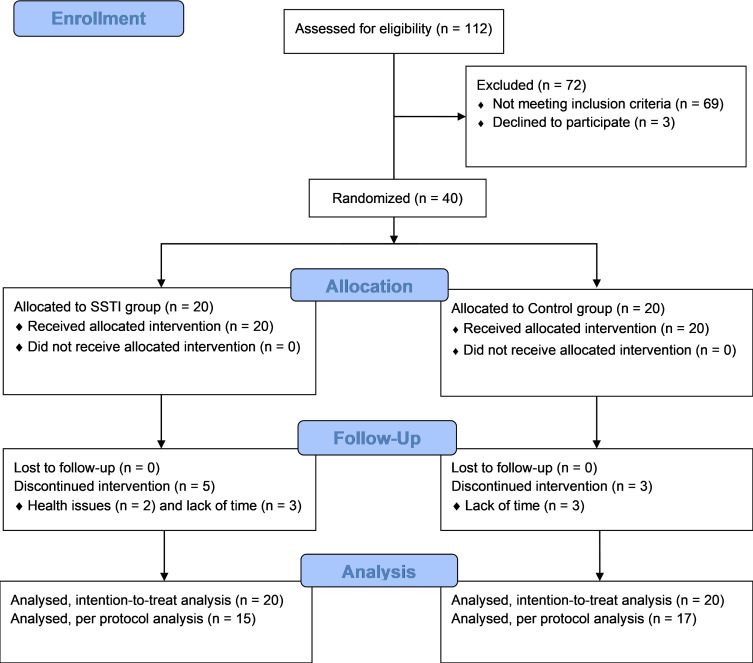
Participants and methods: This is a randomized, single-blind, two-arm, parallel-group controlled trial that included 40 medicated hypertensive older women (64.4±3.6 years; resting systolic 118±19 and diastolic BP 68±9 mmHg). SSTI intervention was performed three times per week, 30-50 minutes per session (n=20). The control group participated in health education meetings once per week (n=20). Ambulatory BP (primary outcome) and six-minute walking test performance (secondary outcome) were assessed at baseline and following 8 weeks of intervention. Heart rate (HR), rating of perceived exertion (RPE, 6-20), and affective valence (ie, feeling scale, -5/+5) were recorded during all SSTI sessions. Intention-to-treat and per-protocol analyses were used for data analyses.
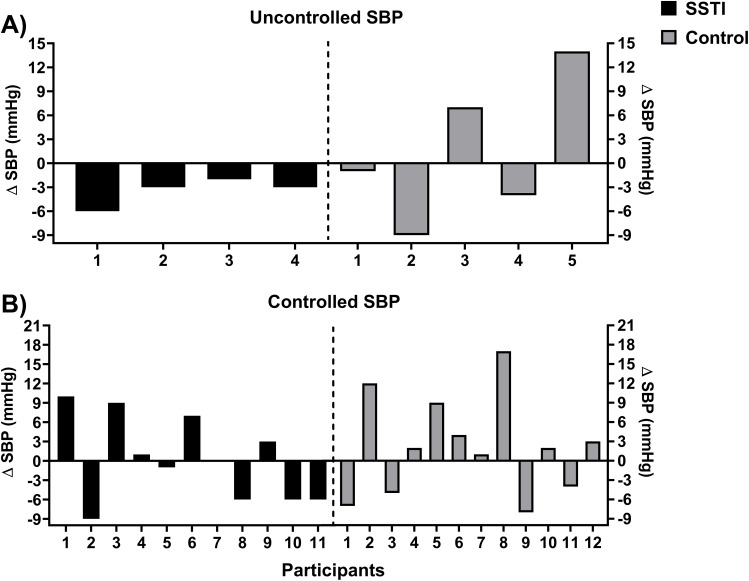
Results: Fifteen participants from the SSTI group and 17 from the control group completed the study. No differences in ambulatory BP (24-h, awake, and asleep) were observed between SSTI and control groups (intention-to-treat and per-protocol analyses; p>0.05). The SSTI group showed a greater six-minute walking test performance than the control group in the intention-to-treat and per-protocol analyses (p<0.05). The participants exercised at 52±10% of HR reserve reported an RPE of 11±1 and an affective valence of 3.4±1.1 over the 8-week period.
Conclusion: SSTI is a feasible approach to induce a more active lifestyle and increase health-related fitness in hypertensive older women, although it does not improve BP control over a short-term period.
Keywords: aging; exercise; hypertension.
© 2020 Sócrates et al.
Conflict of interest statement
The authors report no conflicts of interest in this work.
Figures
References
-
- Whelton PK, Carey RM, Aronow WS, et al. ACC/AHA/AAPA/ABC/ACPM/AGS/APhA/ASH/ASPC/NMA/PCNA guideline for the prevention, detection, evaluation, and management of high blood pressure in adults: executive summary: a report of the American College of Cardiology/American Heart Association Task F. Hypertens (Dallas, Tex 1979). 2017;2018(71):1269–1324. - PubMed
Publication types
MeSH terms
LinkOut - more resources
Full Text Sources
Medical
