. 2019 Mar 9:1:100004.
doi: 10.1016/j.vpoa.2019.100004. eCollection 2019 May.

Applying I see inside histological methodology to evaluate gut health in broilers challenged with Eimeria

Affiliations

Applying I see inside histological methodology to evaluate gut health in broilers challenged with Eimeria

Bruna L Belote et al. Vet Parasitol X. .

Abstract

The present study evaluated the effects of coccidiosis on histological parameters and performance of broilers submitted to a mild challenge with Eimeria sp. A total of 132 broilers were randomly divided into two groups with 6 replicates of 11 birds each: negative control (NC) - birds uninfected and challenge (CH) - birds infected by gavage at day-one with 10x the manufacturer recommended dose of Bio-Coccivet R® live vaccine by Biovet, with strains of E. acervulina, E. brunetti, E. maxima, E. necatrix, E. praecox, E. tenella and E. mitis. From 1 to 28 d of age, weekly the zootechnical performance was evaluated and samples of the liver, duodenum, jejunum and ileum were collected and submitted to histological analysis by the I See Inside methodology (ISI). The ISI methodology is a metric evaluation of histological alterations in the intestine and liver. Which translates macroscopic and microscopic alterations into numbers and allows their correlation with the animal zootechnical performance. Pearson's correlation was used to demonstrates how the damages to the gut, evaluated by ISI method, could affect negatively the performance of broilers. The presence of oocysts in histological analysis of the jejunum and ileum at 7d indicate a negative effect on performance over the next 2 weeks (14d and 21d). When the ISI total score was measured in the ileum at 14d, we observed a strong negative effect on zootechnical performance from that period on 14d, 21d and 28d. The obtained data demonstrates that the higher the ISI scores, the worse are the zootechnical performance results of broilers challenged with Eimeria sp. and the I See Inside scores could be applied to evaluate coccidiosis effect on performance in future.

Keywords: Coccidiosis; Histological lesions; Performance; Small intestine.


Figures

Fig. 1
Fig. 1
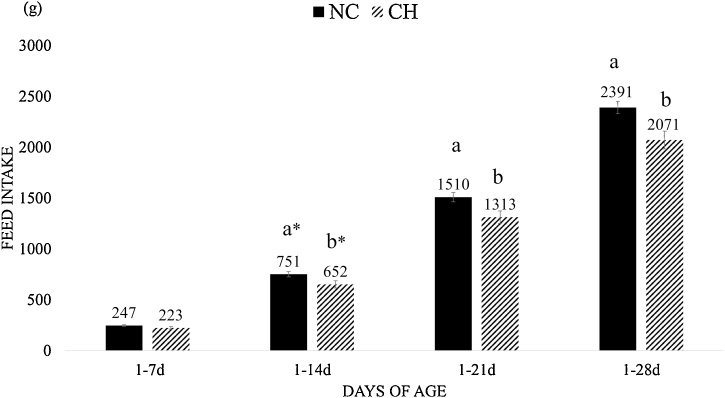
Feed Intake (FI, grams) mean and standard error of treatment at different time periods. Treatments were negative control (NC) –and uninfected, untreated and Challenge (CH) – where animals were infected with 10x the manufactured recommended dose. Different superscript letters indicate significant difference with Tukey test (P < 0.05); * sign on letters indicate a significant level of P<0.07.
Fig. 2
Fig. 2
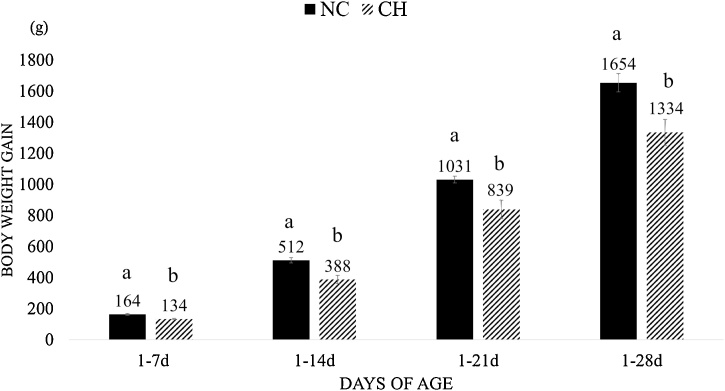
Body weight gain (BWG, grams) mean and standard error of treatment at different time periods. Treatments are negative control (NC) and uninfected, untreated and Challenge (CH), where animals were infected with 10x the manufactured recommended dose. Different supercript letters indicate significant difference with Tukey test (P < 0.05).
Fig. 3
Fig. 3
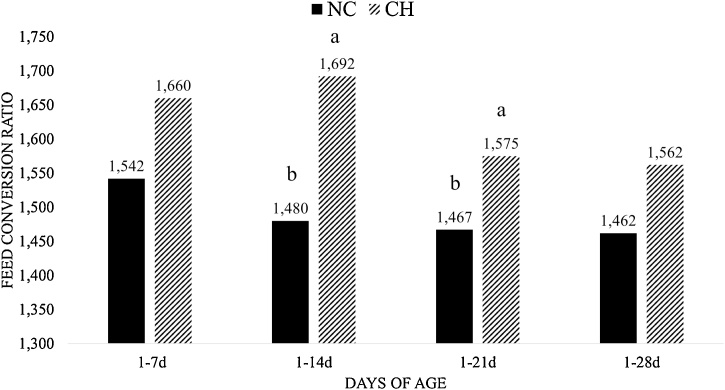
Mean Feed Conversion Ratio (FCR) of treatment at different time periods. Treatments are negative control (NC) and uninfected, untreated and Challenge (CH), where animals were infected with 10x the manufactured recommended dose. Different superscript letters indicate a significant difference with Tukey test (P < 0.10).
Fig. 4
Fig. 4
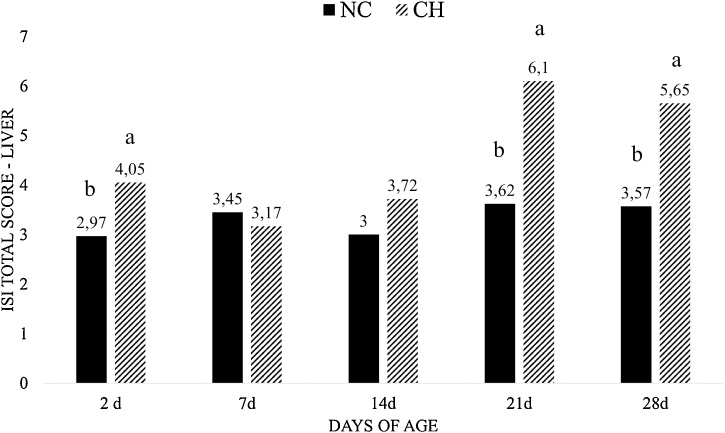
ISI total score of liver lesions at all periods. Data is the mean value of each treatment at different time intervals. Treatments are negative control (NC) and uninfected, untreated and Challenge (CH) – where individuals were infected with 10x the manufactured recommended dose. Different superscript letters indicate significant difference with Tukey test (P < 0.05).
Fig. 5
Fig. 5
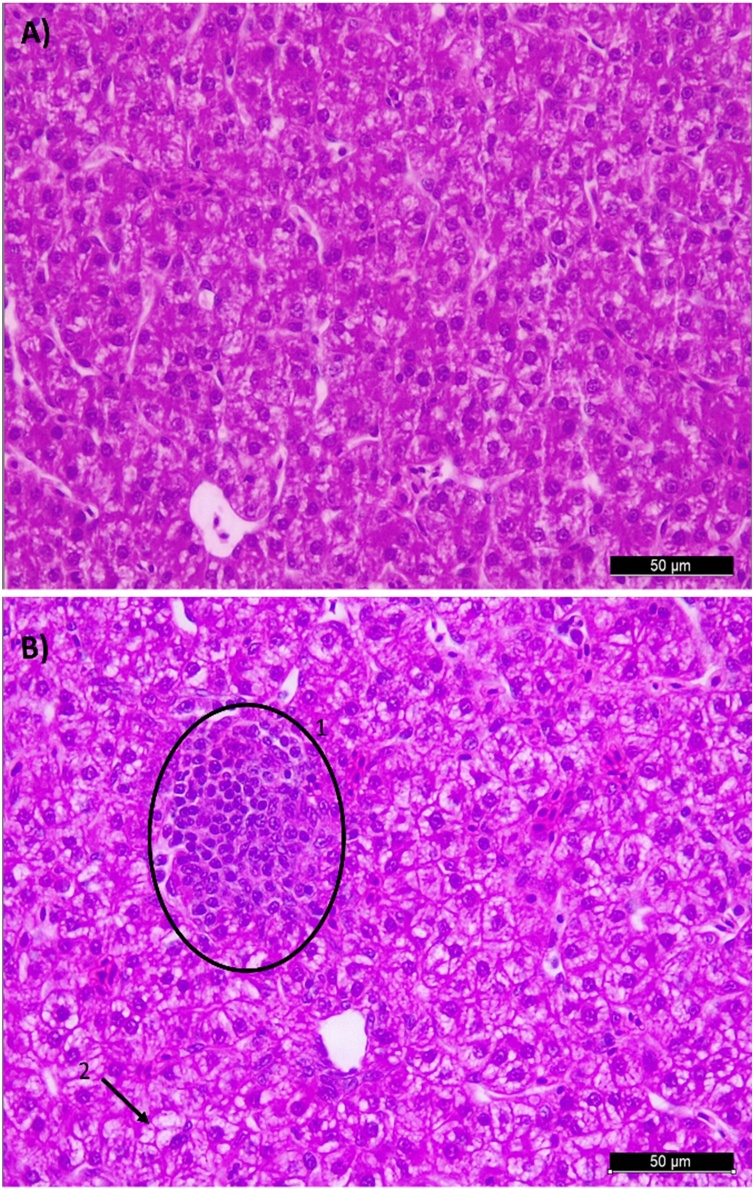
Photomicrographs chicken liver sections stained with hematoxylin and eosin. A) normal liver histological structure of non-challenge (NC) group (400X); B) 1. Inflammatory cell infiltration (circle) and 2. Presence of vacuolization (arrow) in liver of an individual from the Challenged group (CH) (400X). These changes contributed to the highest (P< 0.05) ISI index in Eimeria sp. challenge group at 21 days of age.
Fig. 6
Fig. 6
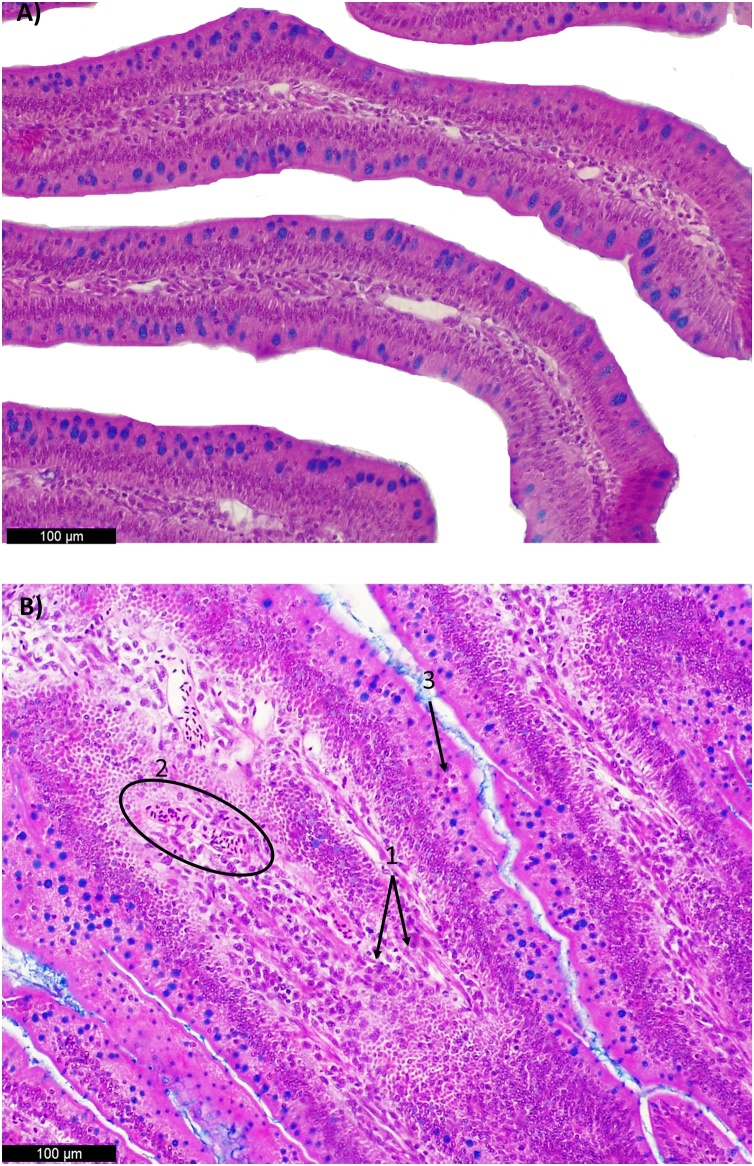
Photomicrographs of chicken duodenum sections stained with hematoxylin and eosin. Alcian Blue was used to stain goblet cells. A) Normal histological duodenum structure of non-challenge treatment (NC) (200X); B) Challenged treatment (CH) (200x) 1. Inflammatory cell infiltration in the lamina propria; 2. Congestion and 3. Inflammatory cell infiltration in the epithelium; These alterations contributed to the highest ISI index (P< 0.05) in coccidiosis challenged group at 28 days in comparison to the non-challenged group.
Fig. 7
Fig. 7
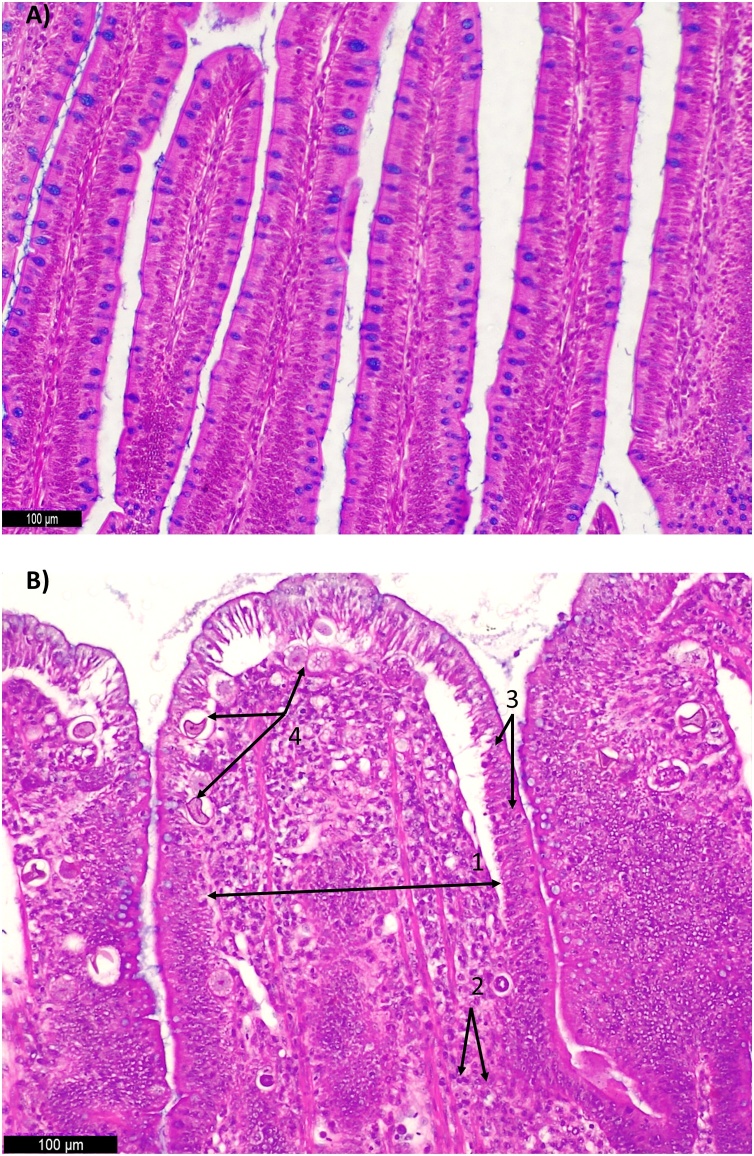
Photomicrographs of chicken jejunum sections stained with hematoxylin and eosin. Alcian Blue was used to stain goblet cells. A) Normal histological structure of non-challenge treatment (NC) in jejunum (200X); B) Challenged treatment (CH) (200x) 1. Increase of lamina propria thickness; 2. Inflammatory cell infiltration in the lamina propria; 3 Inflammatory cell infiltration in the epithelium and 4. Presence of oocysts; These alterations contributed to the highest ISI index (P< 0.05) in coccidiosis challenged group at 21 days in comparison to the non-challenged treatment.
Fig. 8
Fig. 8
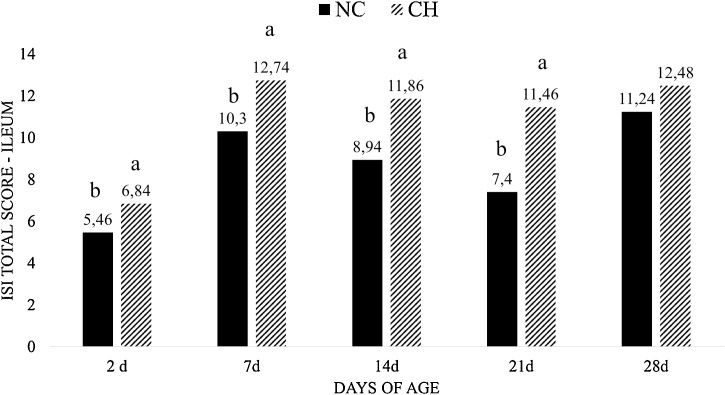
ISI total score of ileum at all periods. Data is the mean of treatments in all time intervals. Treatments are negative control (NC) and uninfected, untreated and Challenge (CH) – where animals were infected with 10x the manufactured recommended dose. Different superscript letters indicate a significant difference with Tukey test (P < 0.05).
Fig. 9
Fig. 9
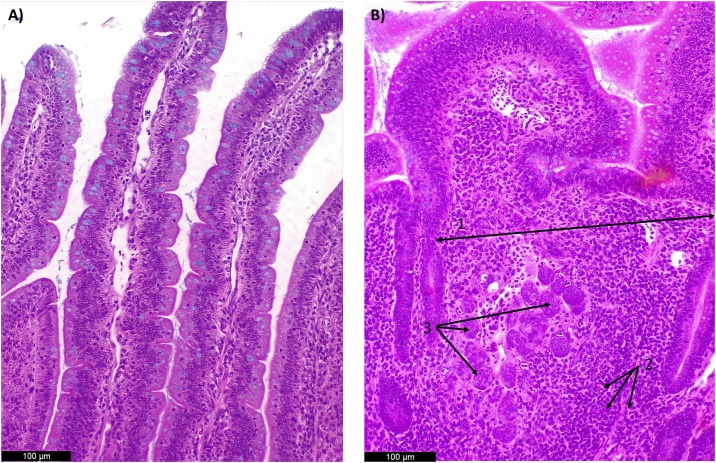
Photomicrographs of chicken ileum sections stained with hematoxylin and eosin. Alcian Blue was used to stain the goblet cells. A) Normal ileum histological structure of non-challenge treatment (NC) (200X); B) Challenged treatment (CH) (200x) 1. Higher lamina propria thickness; 2. Inflammatory cell infiltration in the lamina propria; 3. Presence of oocysts; These alterations contributed to the highest ISI index (P< 0.05) in coccidiosis challenged group at 21 days in comparison to the non-challenged group.

References

    1. Belote B.L., Tujimoto-Silva A., Hümmelgen P.H., Sanches A.W.D., Wammes J.C.S., Hayashi R.M., Santin E. Histological parameters to evaluate intestinal health on broilers challenged with Eimeria and Clostridium perfringens with or without enramycin as growth promoter. Poult. Sci. 2018;97:2287–2294. - PubMed
    1. Chapman H.D. Origins of coccidiosis research in the fowl— The first fifty years. Avian Dis. 2003;47:1–20. - PubMed
    1. Chapman H.D., Barta J.R., Hafeez M.A., Matsler P., Rathinam T., Raccoursier M. The epizootiology of Eimeria infections in commercial broiler chickens where anticoccidial drug programs were employed in six successive flocks to control coccidiosis. Poult. Sci. 2016;95:1774–1778. - PubMed
    1. Dalloul R.A., Lillehoj H.S. Poultry coccidiosis. Recent advancements in control measures and vaccine development. Expert Rev. Vaccines. 2006;5:143–163. - PubMed
    1. Hofacre C.L., Beacorn T., Collett S. Using competitive exclusion, mannan-oligosaccharide and other necrotic enteritis. Poult. Sci. 2003;12:60–64.

LinkOut - more resources