


Infection dynamics of Cryptosporidium bovis and Cryptosporidium ryanae in a Swedish dairy herd
- PMID: 32904819
- PMCID: PMC7458383
- DOI: 10.1016/j.vpoa.2019.100010
Infection dynamics of Cryptosporidium bovis and Cryptosporidium ryanae in a Swedish dairy herd
Abstract
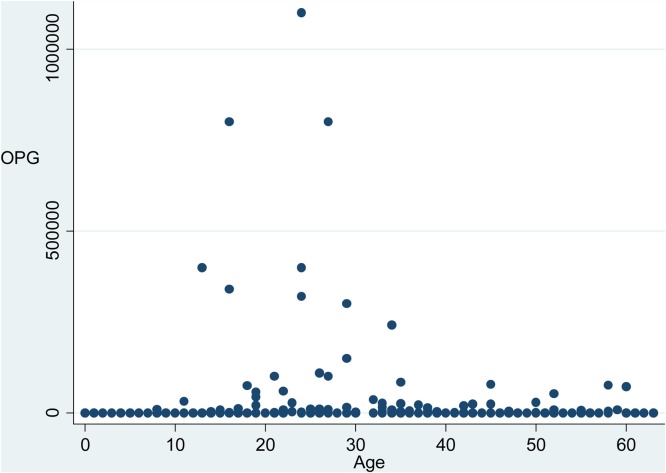
In order to investigate the infection dynamics of Cryptosporidium bovis and Cryptosporidium ryanae, a Swedish dairy farm known to be free of C. parvum was recruited for a one-year study. Fecal samples were collected every four weeks (a total of 13 occasions) from 20 randomly selected calves younger than 65 days. A total of 238 feces samples were collected directly from the rectum and then examined with immunofluorescence microscopy; those positive for Cryptosporidium spp. oocysts were further processed by molecular species determination. Oocysts were found in 92 samples, and in 72 of these the species was successfully determined: 87.5% C. bovis, 9.7% C. ryanae and 2.8% a mix of both species. No C. parvum was found. The prevalence of shedding calves was highest at ages 4 and 5 weeks; however, the feces with the highest oocyst per gram (OPG) were registered at 2-4 weeks of age. This is earlier than what has been found in most other studies, indicating that the infection dynamics of C. bovis/C. ryanae may be affected by the presence of C. parvum. The OPG for the positive calves ranged from 200 to 1.1 × 10⁶ (geometric mean 6.88 × 10³). The youngest calf in which C. bovis was identified was 5 days old, and the youngest calf in which C. ryanae was identified was 15 days old. Calves' housing type and seasonality were not associated with differences in the shedding of oocysts. Furthermore, there was no association between the presence of diarrhea and oocyst shedding.
Keywords: Cattle; Cryptosporidiosis; Cryptosporidium spp.; Diarrhea; Pre-weaned calves.
© 2019 The Authors.
Figures
References
-
- Budu-Amoako E., Greenwood S.J., Dixon B.R., Barkema H.W., McClure J.T. Giardia and Cryptosporidium on dairy farms and the role these farms may play in contaminating water sources in Prince Edward Island, Canada. J. Vet. Intern. Med. 2012;26:668–673. - PubMed
-
- Chalmers R.M., Ferguson C., Cacciò S., Gasser R.B., Abs El-Osta Y.G., Heijnen L., Xiao L., Elwin K., Hadfield S., Sinclair M., Stevens M. Direct comparison of selected methods for genetic categorisation of Cryptosporidium parvum and Cryptosporidium hominis species. Int. J. Parasitol. 2005;35:397–410. - PubMed
LinkOut - more resources
Full Text Sources
Miscellaneous