


Imperial Pandemicide
- PMID: 32904989
- PMCID: PMC7460927
- DOI: 10.1111/ssqu.12854
Imperial Pandemicide
Abstract
Objective: To provide a quick, in the moment analysis of the social and political aspects of the COVID-19 pandemic to preserve the possibly ephemeral aspects that might be overlooked in future historical studies.
Methods: Qualitative and a statistical analyses of real time information.
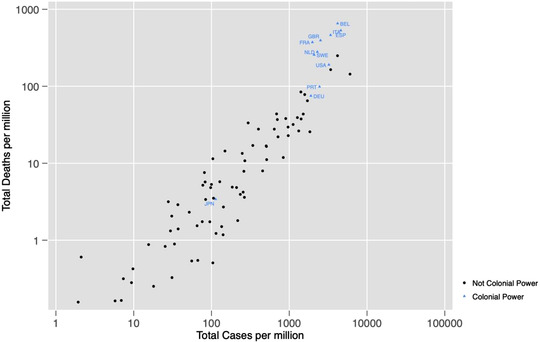
Results: The clustering of former imperial powers as states suffering extreme initial impacts, combined with a brief qualitative commentary on the domestic politics related to the pandemic response, suggests that colonial imperialism has lingering domestic political effects.
Conclusion: The domestic political power bases that enabled colonial imperialism may be a significant and previously unrecognized factor in politics both in the context of disaster response and more broadly.
© 2020 by the Southwestern Social Science Association.
Figures
References
-
- Coser, L. A. 1956. The Functions of Social Conflict (Vol.). Abingdon: Routledge.
-
- Hunt, W. B. 1997. Getting to War: Predicting International Conflict with Mass Media Indicators. Ann Arbor, MI: University of Michigan Press.
-
- Jamieson, T. 2020. “‘Go Hard, Go Early’: Preliminary Lessons from New Zealand's Response to COVID‐19.” The American Review of Public Administration. Omaha: University of Nebraska; 50:6–7.
-
- Kahneman, D. , and Tversky, A. 1979. “Prospect Theory: An Analysis of Decision Under Risk.” Econometrica: Journal of the Econometric Society 47:263–91.
-
- Roser, M. , Ritchie, H. , Ortiz‐Ospina, E. , and Hasell, J. 2020. Coronavirus Pandemic (COVID‐19) . Available at 〈https://ourworldindata.org/coronavirus〉.
LinkOut - more resources
Full Text Sources