


Molecular Pathogenesis and Classification of Colorectal Carcinoma
- PMID: 32905465
- PMCID: PMC7469945
- DOI: 10.1007/s11888-020-00458-z
Molecular Pathogenesis and Classification of Colorectal Carcinoma
Abstract
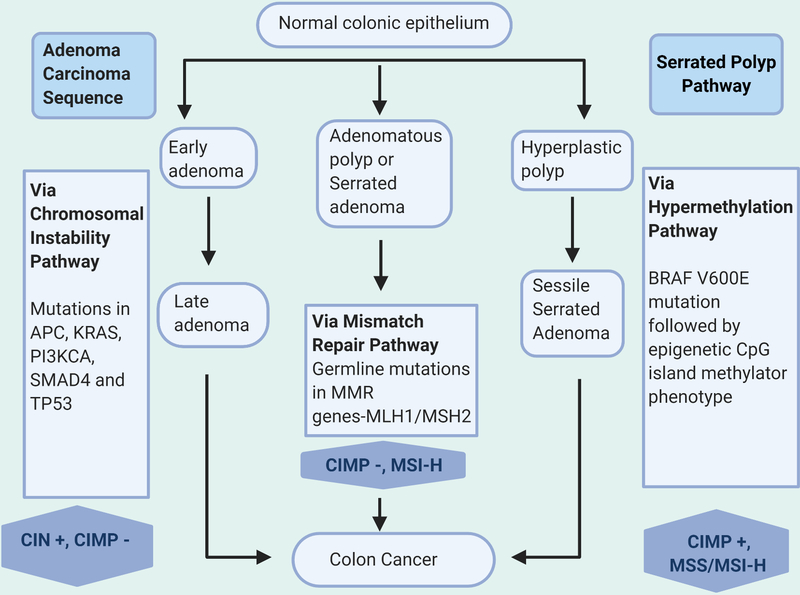
Purpose of review: Molecular pathways in colorectal carcinogenesis involve several complex genetic and epigenetic modulations that cause normal colonic mucosa to metamorphose into a benign polyp and subsequently into a malignant tumor. Our purpose is to recapitulate historical and recent genomic research in order to augment the understanding of colorectal cancer pathogenesis.
Recent findings: In 2015, the molecular classification for colorectal cancers was unified into one system with four distinct groups, also called as consensus molecular subtypes. This led to an enhanced understanding of molecular and immune signatures which has implications on predicting the clinical behavior as well as response to different therapeutic agents.
Summary: In this review, we expound on the current literature as well as draw on our own experience to present the important molecular pathogenesis pathways, key genetic mutations, differences in pathogenesis of left versus right sided tumors as well as the molecular classification of colorectal cancers.
Keywords: Colorectal Carcinoma; Molecular Pathogenesis; Molecular Subtypes.
Conflict of interest statement
Compliance with Ethics Guidelines Conflict of Interest Anup Kasi, Shivani Handa, Sajjad Bhatti, Shahid Umar, Ajay Bansal, and Weijing Sun each declare no potential conflicts of interest.
Figures
References
-
- Dekker E, Tanis PJ, Vleugels JLA, Kasi PM, Wallace MB. Colorectal cancer. Lancet. 2019;394(10207):1467–80. - PubMed
-
- Fearon ER, Vogelstein B. A genetic model for colorectal tumorigenesis. Cell. 1990;61(5):759–67. - PubMed
-
-
De Palma FDE, D’Argenio V, Pol J, Kroemer G, Maiuri MC, Salvatore F. The Molecular Hallmarks of the Serrated Pathway in Colorectal Cancer. Cancers. 2019;11(7).
• A focused review summarizing the genetic and epigenetic basis of the Serrated polyp pathway
-
-
- Ito M, Kanno S, Nosho K, Sukawa Y, Mitsuhashi K, Kurihara H, et al. Association of Fusobacterium nucleatum with clinical and molecular features in colorectal serrated pathway. International Journal of Cancer. 2015;137(6):1258–68. - PubMed
Grants and funding
LinkOut - more resources
Full Text Sources
Research Materials
