. 2020 Sep;1(2):26.
doi: 10.3847/psj/ab974e. Epub 2020 Jul 14.

Stratification Dynamics of Titan's Lakes via Methane Evaporation

Affiliations

Stratification Dynamics of Titan's Lakes via Methane Evaporation

Jordan K Steckloff et al. Planet Sci J. 2020 Sep.

Abstract

Saturn's moon Titan is the only extraterrestrial body known to host stable lakes and a hydrological cycle. Titan's lakes predominantly contain liquid methane, ethane, and nitrogen, with methane evaporation driving its hydrological cycle. Molecular interactions between these three species lead to non-ideal behavior that causes Titan's lakes to behave differently than Earth's lakes. Here, we numerically investigate how methane evaporation and non-ideal interactions affect the physical properties, structure, dynamics, and evolution of shallow lakes on Titan. We find that, under certain temperature regimes, methane-rich mixtures are denser than relatively ethane-rich mixtures. This allows methane evaporation to stratify Titan's lakes into ethane-rich upper layers and methane-rich lower layers, separated by a strong compositional gradient. At temperatures above 86K, lakes remain well-mixed and unstratified. Between 84 and 86K, lakes can stratify episodically. Below 84K, lakes permanently stratify, and develop very methane-depleted epilimnia. Despite small seasonal and diurnal deviations (<5K) from typical surface temperatures, Titan's rain-filled ephemeral lakes and "phantom lakes" may nevertheless experience significantly larger temperature fluctuations, resulting in polymictic or even meromictic stratification, which may trigger ethane ice precipitation.


Figures
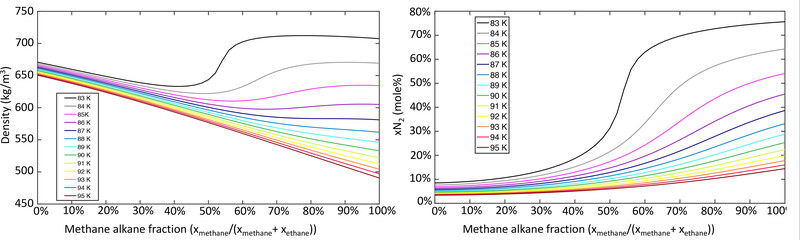
Figure 1:
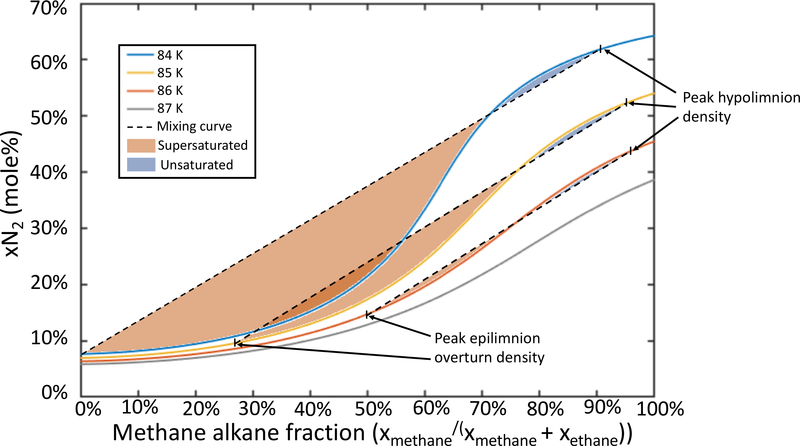
Figure 1:. Nitrogen solubility and density of methane–ethane–nitrogen mixtures at Titan surface pressures as a function of temperature and composition.
Plots made with TITANPOOL. Left, the density of methane–ethane–nitrogen mixtures in equilibrium, as a function of temperature and composition. At temperatures below 87 K, a local density minimum and maximum form, enabling stratification. Right, the equilibrium mole fraction of nitrogen in a methane–ethane–nitrogen mixture as a function of temperature and composition. Nitrogen solubility drops as the amount of methane in the mixture decreases, with largest reductions in nitrogen solubility associated with cooler temperatures.
Figure 2:
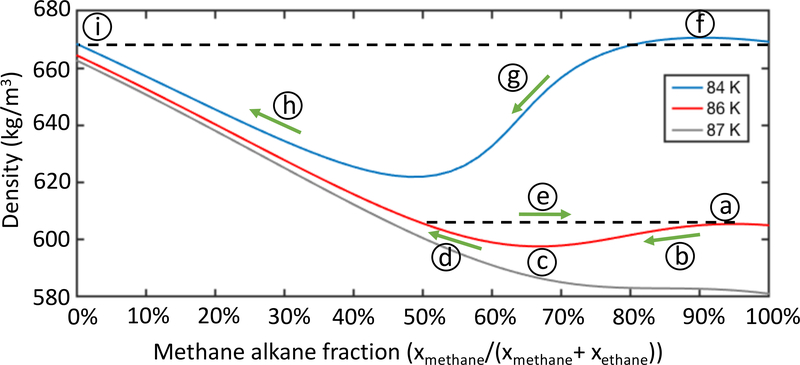
Figure 2:. Evaporation-driven Stratification and Overturn.
Below 86K, methane evaporation drives the bulk composition of a very methane-rich mixture toward the local density maximum (a). Further methane evaporation decreases the surface-layer density (b), forming a buoyant epilimnion floating atop a hypolimnion with the local density maximum’s composition. Evaporation then drives the epilimnion to the local density minimum composition (c). Further methane evaporation increases the epilimnion density (d) slightly above that of the hypolimnion, resulting in lake overturn and mixing (e). This cycle of stratification and overturn repeats until the bulk composition reaches the local density minimum (c), after which the lake will be holomictic. Below 84K, a similar process occurs, forming a hypolimnion with the local density maximum composition (f), and methane evaporation driving the epilimnion toward the local minimum (g). Continued evaporation increases the epilimnion density (h). However, the methane-depleted epilimnion density (i) is lower than that of the hypolimnion (f), preventing overturn and forming a meromictic lake.
Figure 3:
Figure 3:. Overturn events can lead to supersaturated or unsaturated lakes.
Upon overturning, a lake will mix the epilimnion and hypolimnion, forming a new uniform mixture. The possible mixtures are a linear combination of compositions bounded by the epilimnion and hypolimnion compositions on the ends (dashed black line), here representing the composition of peak density (as would be expected prior to the first overturn event) and epilimnion composition upon overturn. The resulting mole fraction of dissolved nitrogen may be lower than equilibrium (blue shaded region), resulting in atmospheric nitrogen dissolving into the mixed lake. Conversely, the combined composition may be supersaturated in nitrogen (red shaded region), resulting in an unstable composition that will exsolve nitrogen. Such nitrogen exsolution may be very rapid, and trigger bubble formation (e.g., Farnsworth et al. 2020).
Figure 4:
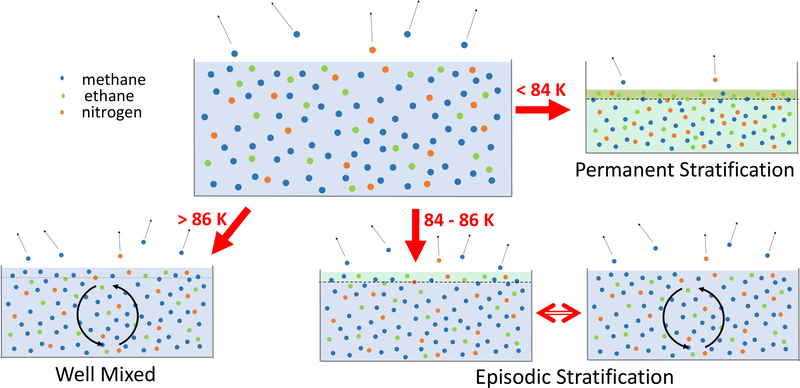
Figure 4:. Modes of Stratification.
The temperature of the lake determines the mode of stratification. Above 86K, a liquid methane–ethane–nitrogen mixture on Titan will remain well mixed, preventing stratification. Between 84 and 86K, the mixture becomes polymictic, undergoing cycles of stratification and overturn, until the bulk composition is poorer in methane than the local density minimum and becomes holomictic. Below 84K, the mixture becomes meromictic, eventually forming a nearly methane-free epilimnion.
Figure 5.
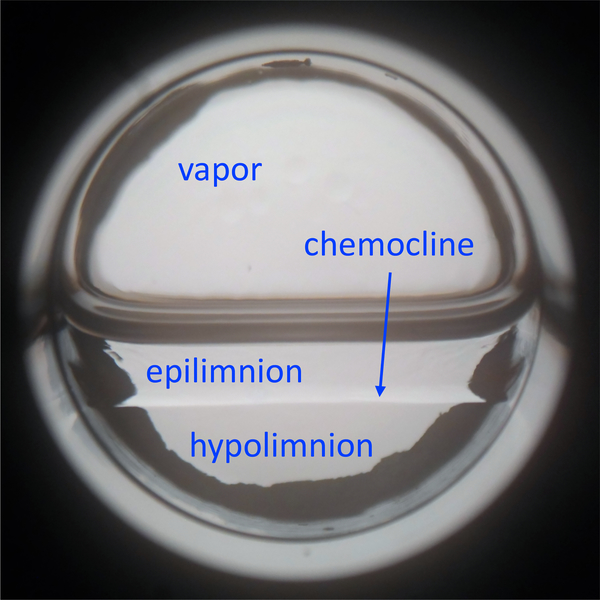
Figure 5.. Experimental demonstration of stratification.
This stratification has been observed in the laboratory. These results show the stratification of a 50% methane and 50% ethane mixture saturated with nitrogen under Titan conditions at 85 K. The pressure was initially slightly greater than Titan’s 1.5 bar atmosphere, then reduced to 1.5 bar to allow nitrogen and methane to exsolve from the surface, which has a similar effect to methane evaporating from the surface. The liquid separates into an ethane-enriched epilimnion and methane- and nitrogen-enriched hypolimnion, separated by a visible chemocline. The vapor is dominated by nitrogen.

References

    1. Barnes JW et al. Precipitation-induced surface brightenings seen on Titan by Cassini VIMS and ISS. Planetary Science 2, 1 (2013)
    1. Battino R, Rettich TR & Tominaga T The solubility of nitrogen and air in liquids. J. Phys. & Chem. Ref. Data 13, 563–600 (1984)
    1. Cordier D, García-Sánchez F, Justo-García DM & Liger-Belair G Bubble streams in Titan’s seas as a product of liquid N2+CH4+C2H6 cryogenic mixture. Nature Astro. 1, 0102 (2017)
    1. Cottini V et al. Spatial and temporal variations in Titan’s surface temperatures from Cassini CIRS observations. Planet. Space Sci. 60, 62–71 (2012)
    1. Farnsworth K et al. Experimental study of the effects of freezing on liquid hydrocarbons on the surface of Titan. Lunar and Planetary Science Conference XLVIII. #1974 (2017)

LinkOut - more resources