. 2020 Aug 1;10(8):2546-2554.
eCollection 2020.

The m6A readers YTHDF1 and YTHDF3 aberrations associated with metastasis and predict poor prognosis in breast cancer patients

Affiliations

The m6A readers YTHDF1 and YTHDF3 aberrations associated with metastasis and predict poor prognosis in breast cancer patients

Ramesh Anita et al. Am J Cancer Res. .

Abstract

N6-Methyladenosine (m6A) is the most common RNA modification in eukaryotic mRNAs and growing evidence suggests the crucial roles of m6A and its regulators in human tumorigenesis. Recent studies have shown that the m6A regulators promote tumorigenesis of various types of cancer. However, the underlying molecular mechanisms of m6A regulators in breast cancer remain largely unknown. We therefore assessed the genetic alterations, expression and prognostic role of m6A regulators in breast cancer using openly available data from The Cancer Genome Atlas (TCGA). Analysis of TCGA data revealed that m6A regulators including KIAA1429, YTHDF1, and YTHDF3 were upregulated in breast cancer tissues, and the expression level significantly correlated with intrinsic subclasses and nodal metastasis. Importantly, we found for the first time that YTHDF1 and YTHDF3 were frequently amplified which contribute to the overexpression of YTHDF1 and YTHDF3 transcripts, thereby promoting breast cancer progression. Moreover, overexpression of YTHDF1 and YTHDF3 were associated with poor prognosis of breast cancer patients. Therefore, YTHDF1 and YTHDF3 serve a crucial role in the pathogenesis of breast cancer, which are potentially useful for prognosis stratification and therapeutic target for breast cancer.

Keywords: Breast cancer; m6A readers aberrations; prognostic signature; survival analysis.


Conflict of interest statement

None.

Figures
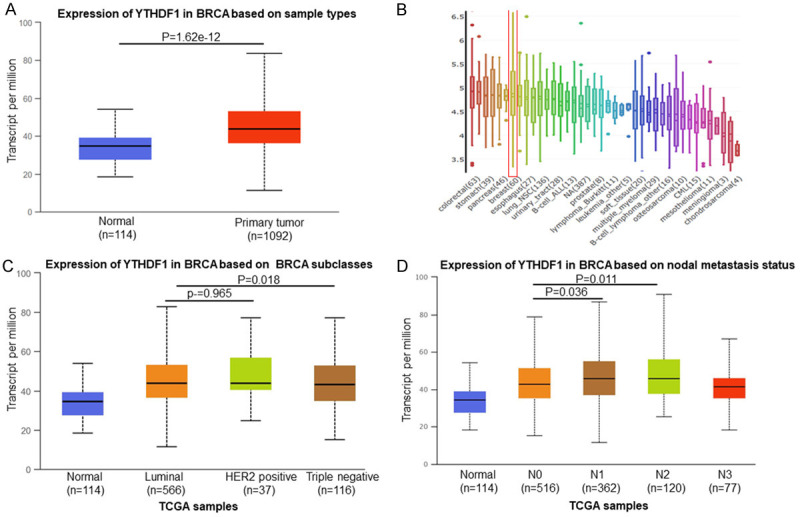
Figure 1
Figure 1
YTHDF1 was overexpressed in breast cancer. Expression of YTHDF1 significantly increased in breast cancer tissues compared with adjacent normal tissues (P=1.62e-12) (A) and breast cancer cells (B). The increased expression of YTHDF1 correlated with intrinsic subclasses (C) and nodal metastasis (D).
Figure 2
Figure 2
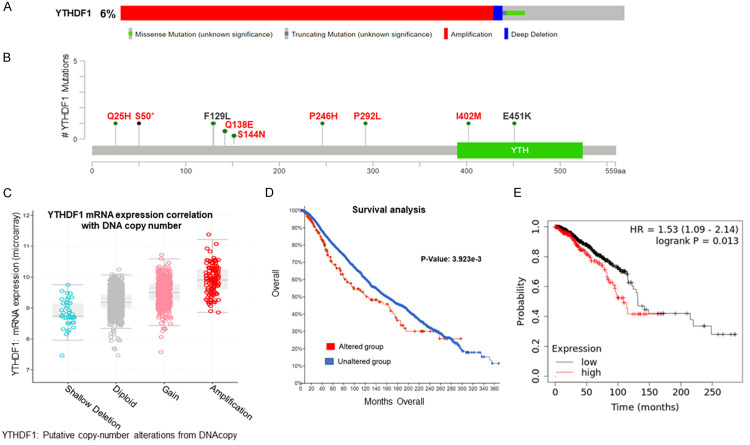
Correlation between the genetic alterations of YTHDF1 and mRNA level in breast cancer tissues. Oncoprint in cBioPortal database exhibited the proportion and distribution of specimens with genetic alterations in YTHDF1 (A). Schematic diagram of the YTHDF1 protein and the positions of mutations (red letters are novel mutations, that were not presented in gnomAD) (B). Copy gain (gain and amplification) of YTHDF1 was associated with notably increased YTHDF1 mRNA levels compared with the copy-neutral (diploid) and copy-loss (shallow deletion) cases (C). Survival analysis of breast cancer patients with and without YTHDF1 gene alteration (D). The prognostic value of mRNA level of YTHDF1 in breast cancer patients, analyzed by Kaplan-Meier plotter (P=0.013) (E).
Figure 3
Figure 3
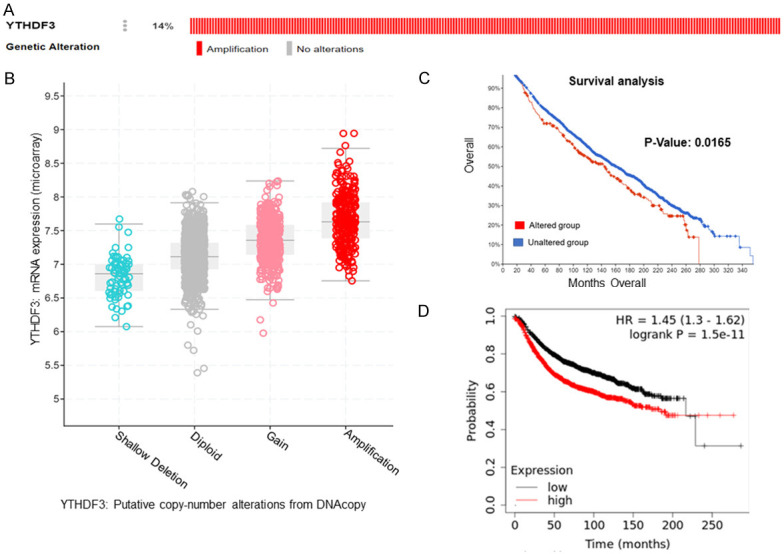
Correlation between the genetic alterations of YTHDF3 and mRNA level in breast cancer tissues. Oncoprint in cBioPortal database exhibited YTHDF3 amplification in breast cancer (A). Correlation between YTHDF3 amplification and its mRNA level (B). Survival analysis of breast cancer patients with and without YTHDF3 gene alteration (C). The prognostic value of mRNA level of YTHDF3 in breast cancer patients, analyzed by Kaplan-Meier plotter (P=1.5e-11) (D).
Figure 4
Figure 4
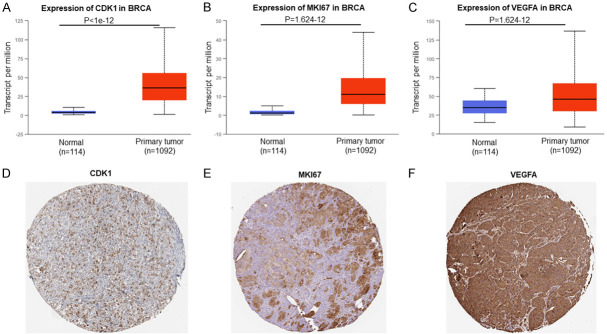
The m6A regulators target genes expression in breast cancer. CDK1 (A), MKI67 (B) and VEGFA (C) mRNAs expression were analysed using UALCAN database. CDK1 (D), MKI67 (E) and VEGFA (F) proteins expression were analysed in breast cancer tissue using the Human Protein Atlas (https://www.proteinatlas.org/).
Figure 5
Figure 5
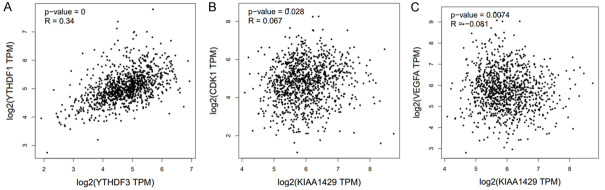
Correlation between the expression of YTHDF1 and YTHDF3 (A). Correlation between the expression of KIAA1429 and cancer associated genes CDK1 (B) and VEGFA (C).

References

    1. Siegel RL, Miller KD, Jemal A. Cancer statistics, 2019. CA Cancer J Clin. 2019;69:7–34. - PubMed
    1. Liu T, Wei Q, Jin J, Luo Q, Liu Y, Yang Y, Cheng C, Li L, Pi J, Si Y, Xiao H, Li L, Rao S, Wang F, Yu J, Yu J, Zou D, Yi P. The m6A reader YTHDF1 promotes ovarian cancer progression via augmenting EIF3C translation. Nucleic Acids Res. 2020;48:3816–3831. - PMC - PubMed
    1. Paramasivam A, Priyadharsini JV, Raghunandhakumar S. Implications of m6A modification in autoimmune disorders. Cell Mol Immunol. 2019;17:550–551. - PMC - PubMed
    1. Paramasivam A, Vijayashree Priyadharsini J. Novel insights into m6A modification in circular RNA and implications for immunity. Cell Mol Immunol. 2020;17:668–669. - PMC - PubMed
    1. Paramasivam A, Vijayashree Priyadharsini J, Raghunandhakumar S. N6-adenosine methylation (m6A): a promising new molecular target in hypertension and cardiovascular diseases. Hypertens Res. 2019;43:153–154. - PubMed

LinkOut - more resources