


Roles of the Polyphenol-Gut Microbiota Interaction in Alleviating Colitis and Preventing Colitis-Associated Colorectal Cancer
- PMID: 32905583
- PMCID: PMC8009754
- DOI: 10.1093/advances/nmaa104
Roles of the Polyphenol-Gut Microbiota Interaction in Alleviating Colitis and Preventing Colitis-Associated Colorectal Cancer
Abstract
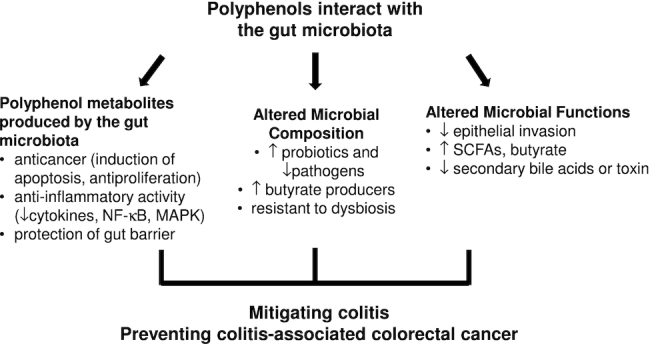
Accumulating evidence indicates that the gut microbiota can promote or inhibit colonic inflammation and carcinogenesis. Promotion of beneficial gut bacteria is considered a promising strategy to alleviate colonic diseases including colitis and colorectal cancer. Interestingly, dietary polyphenols, which have been shown to attenuate colitis and inhibit colorectal cancer in animal models and some human studies, appear to reach relatively high concentrations in the large intestine and to interact with the gut microbial community. This review summarizes the modulatory effects of polyphenols on the gut microbiota in humans and animals under healthy and diseased conditions including colitis and colitis-associated colorectal cancer (CAC). Existing human and animal studies indicate that polyphenols and polyphenol-rich whole foods are capable of elevating butyrate producers and probiotics that alleviate colitis and inhibit CAC, such as Lactobacillus and Bifidobacterium. Studies in colitis and CAC models indicate that polyphenols decrease opportunistic pathogenic or proinflammatory microbes and counteract disease-induced dysbiosis. Consistently, polyphenols also change microbial functions, including increasing butyrate formation. Moreover, polyphenol metabolites produced by the gut microbiota appear to have anticancer and anti-inflammatory activities, protect gut barrier integrity, and mitigate inflammatory conditions in cells and animal models. Based on these results, we conclude that polyphenol-mediated alteration of microbial composition and functions, together with polyphenol metabolites produced by the gut microbiota, likely contribute to the protective effects of polyphenols on colitis and CAC. Future research is needed to validate the causal role of the polyphenol-gut microbiota interaction in polyphenols' anti-colitis and anti-CAC effects, and to further elucidate mechanisms underlying such interaction.
Keywords: 16S rRNA; chemoprevention; colitis; colitis-associated colorectal cancer; gut microbiota; polyphenol; probiotics; short-chain fatty acids.
Copyright © The Author(s) on behalf of the American Society for Nutrition 2020.
Figures
References
-
- Siegel RL, Miller KD, Jemal A. Cancer statistics, 2020. CA A Cancer J Clin. 2020;70(1):7–30. - PubMed
-
- Lutgens MW, van Oijen MG, van der Heijden GJ, Vleggaar FP, Siersema PD, Oldenburg B. Declining risk of colorectal cancer in inflammatory bowel disease: an updated meta-analysis of population-based cohort studies. Inflamm Bowel Dis. 2013;19(4):789–99. - PubMed
-
- Sobczak M, Wlazłowski M, Zatorski H, Sałaga M, Fichna J. Current overview of colitis-associated colorectal cancer. Open Life Sci. 2014;9(11):1022–9.. doi: 10.2478/s11535-014-0345-7.
-
- Terzic J, Grivennikov S, Karin E, Karin M. Inflammation and colon cancer. Gastroenterology. 2010;138(6):2101–14 e5. - PubMed
