


Considerations for Human Blood-Feeding and Arthropod Exposure in Vector Biology Research: An Essential Tool for Investigations and Disease Control
- PMID: 32905735
- PMCID: PMC7698847
- DOI: 10.1089/vbz.2020.2620
Considerations for Human Blood-Feeding and Arthropod Exposure in Vector Biology Research: An Essential Tool for Investigations and Disease Control
Abstract
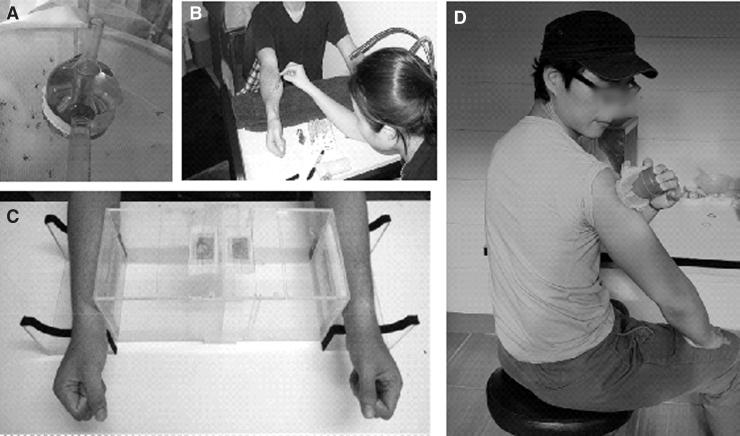
Eventually there may be a broadly acceptable, even perfected, substitute for the human host requirement for direct feeding experiments by arthropods, most notably mosquitoes. However, for now, direct and indirect feeding on human volunteers is an important, if not essential, tool in vector biology research (VBR). This article builds on the foundational publication by Achee et al. (2015) covering considerations for the use of human participants in VBR pursuits. The authors introduced methods involving human participation in VBR, while detailing human-landing collections (catches) as a prime example. Benedict et al. (2018) continued this theme with an overview of human participation and considerations for research that involves release of mosquito vectors into the environment. In this study, we discuss another important aspect of human use in VBR activities: considerations addressing studies that require an arthropod to feed on a live human host. Using mosquito studies as our principal example, in this study, we discuss the tremendous importance and value of this approach to support and allow study of a wide variety of factors and interactions related to our understanding of vector-borne diseases and their control. This includes establishment of laboratory colonies for test populations, characterization of essential nutrients that contribute to mosquito fitness, characterization of blood-feeding (biting) behavior and pathogen transmission, parameterization for modeling transmission dynamics, evaluation of human host attraction and/or agents that repel, and the effectiveness of antivector or parasite therapeutic drug studies.
Keywords: biosafety; ethics; human host; human subjects; vector biology research; vector-borne diseases.
Conflict of interest statement
No competing financial interests exist.
Figures
References
-
- Bancroft WH, Scott RM, Brandt WE, McCown JM, et al. Dengue-2 vaccine: Infection of Aedes aegypti mosquitoes by feeding on viremic recipients. Am J Trop Med Hyg 1982; 31:1229–1231 - PubMed
-
- Bar-Zeev M, Ben-Tamar D. Evaluation of mosquito repellents. Mosquito News 1971; 31:56–61
-
- Barnard DR. Biological assay methods for mosquito repellents. J Am Mosq Control Assoc 2005; 21:12–16 - PubMed
Publication types
MeSH terms
Grants and funding
LinkOut - more resources
Full Text Sources
