


Trends in anxiety among adults in the United States, 2008-2018: Rapid increases among young adults
- PMID: 32905958
- PMCID: PMC7441973
- DOI: 10.1016/j.jpsychires.2020.08.014
Trends in anxiety among adults in the United States, 2008-2018: Rapid increases among young adults
Abstract
Introduction: In a time of global uncertainty, understanding the psychological health of the American public is imperative. There are no current data on anxiety trends among adults in the United States (US) over time. This study aimed to investigate prevalence of anxiety among US adults from 2008 to 2018.
Methods: Data from the National Survey on Drug Use and Health (NSDUH), which is an annual, cross-sectional survey on substance use and mental health in the US, were analyzed in 2020. Prevalence of past-month anxiety was estimated among those ages ≥18, by survey year from 2008 to 2018. Time trends were tested using logistic regression.
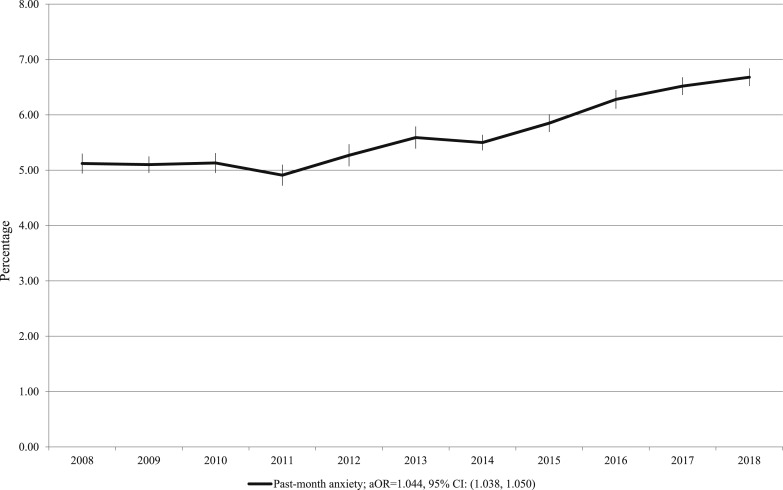
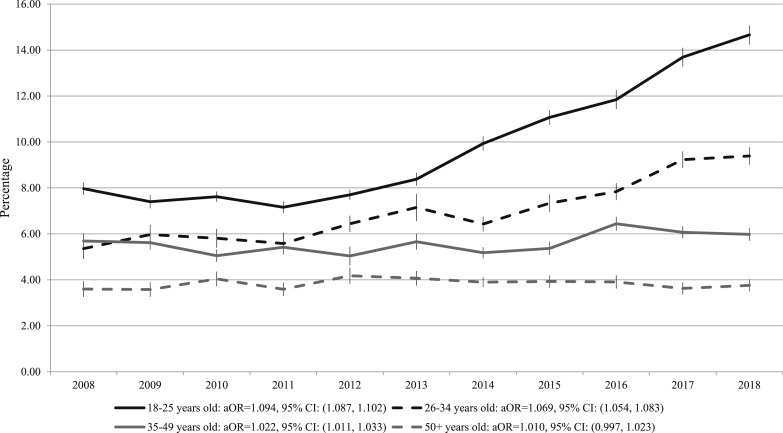
Results: Anxiety increased from 5.12% in 2008 to 6.68% in 2018 (p < 0.0001) among adult Americans. Stratification by age revealed the most notable increase from 7.97% to 14.66% among respondents 18-25 years old (p < 0.001), which was a more rapid increase than among 26-34 and 35-49 year olds (differential time trend p < 0.001). Anxiety did not significantly increase among those ages 50 and older. Anxiety increased more rapidly among those never married and with some college education, relative to their respective counterparts. Apart from age, marital status and education, anxiety increased consistently among sociodemographic groups.
Conclusions: Anxiety is increasing among adults under age 50 in the US, with more rapid increase among young adults. To prepare for a healthier adulthood and given direct and indirect (via 24/7 media) exposure to anxiety-provoking world events, prophylactic measures that can bolster healthy coping responses and/or treatment seeking seem warranted on a broad scale.
Keywords: Anxiety; Epidemiology; Mental health; NSDUH; Nervousness.
Copyright © 2020 Elsevier Ltd. All rights reserved.
Conflict of interest statement
None declared.
Figures
References
-
- American Psychological Association . Stress in America™ Survey. American Psychological Association; Washington, DC: 2014. Stress in America: are teens adopting adults' stress habits?
-
- American Psychological Association . Stress in AmericaTM Survey. American Psychological Association; Washington, DC: 2016. Stress in America: the impact of discrimination.
-
- American Psychological Association . Stress in America™ Survey. American Psychological Association; Washington, DC: 2017. Stress in America: coping with change.
-
- American Psychological Association . Stress in America™ Survey. American Psychological Association; Washington, DC: 2019. Stress in America: stress and current events.
Publication types
MeSH terms
LinkOut - more resources
Full Text Sources
Medical
Miscellaneous
