


Hemostasis and Liver Regeneration
- PMID: 32906177
- PMCID: PMC7895330
- DOI: 10.1055/s-0040-1715450
Hemostasis and Liver Regeneration
Abstract
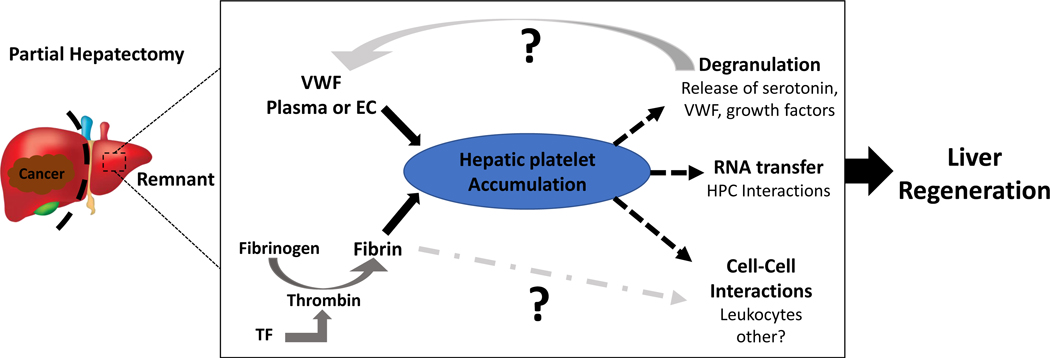
The liver is unique in its remarkable regenerative capacity, which enables the use of liver resection as a treatment for specific liver diseases, including removal of neoplastic liver disease. After resection, the remaining liver tissue (i.e, liver remnant) regenerates to maintain normal hepatic function. In experimental settings as well as patients, removal of up to two-thirds of the liver mass stimulates a rapid and highly coordinated process resulting in the regeneration of the remaining liver. Mechanisms controlling the initiation and termination of regeneration continue to be discovered, and many of the fundamental signaling pathways controlling the proliferation of liver parenchymal cells (i.e., hepatocytes) have been uncovered. Interestingly, while hemostatic complications (i.e., bleeding and thrombosis) are primarily thought of as a complication of surgery itself, strong evidence suggests that components of the hemostatic system are, in fact, powerful drivers of liver regeneration. This review focuses on the clinical and translational evidence supporting a link between the hemostatic system and liver regeneration, and the mechanisms whereby the hemostatic system directs liver regeneration discovered using experimental settings.
Thieme. All rights reserved.
Conflict of interest statement
Dr. Groeneveld reports grants from the European Hematology Association during the conduct of the study. Dr. Luyendyk reports grants from the National Institutes of Health during the conduct of the study.
Figures
References
-
- Van Cutsem E, Nordlinger B, Adam R, Kohne CH, Pozzo C, Poston G, Ychou M, Rougier P: Towards a pan-European consensus on the treatment of patients with colorectal liver metastases. European journal of cancer (Oxford, England : 1990) 2006, 42:2212–21. - PubMed
-
- Adam R, de Haas RJ, Wicherts DA, Aloia TA, Delvart V, Azoulay D, Bismuth H, Castaing D: Is hepatic resection justified after chemotherapy in patients with colorectal liver metastases and lymph node involvement? Journal of clinical oncology : official journal of the American Society of Clinical Oncology 2008, 26:3672–80. - PubMed
-
- Kopetz S, Chang GJ, Overman MJ, Eng C, Sargent DJ, Larson DW, Grothey A, Vauthey JN, Nagorney DM, McWilliams RR: Improved survival in metastatic colorectal cancer is associated with adoption of hepatic resection and improved chemotherapy. Journal of clinical oncology : official journal of the American Society of Clinical Oncology 2009, 27:3677–83. - PMC - PubMed
Publication types
MeSH terms
Grants and funding
LinkOut - more resources
Full Text Sources
Medical
