


Estimating indirect mortality impacts of armed conflict in civilian populations: panel regression analyses of 193 countries, 1990-2017
- PMID: 32907570
- PMCID: PMC7487992
- DOI: 10.1186/s12916-020-01708-5
Estimating indirect mortality impacts of armed conflict in civilian populations: panel regression analyses of 193 countries, 1990-2017
Abstract
Background: Armed conflict can indirectly affect population health through detrimental impacts on political and social institutions and destruction of infrastructure. This study aimed to quantify indirect mortality impacts of armed conflict in civilian populations globally and explore differential effects by armed conflict characteristics and population groups.
Methods: We included 193 countries between 1990 and 2017 and constructed fixed effects panel regression models using data from the Uppsala Conflict Data Program and Global Burden of Disease study. Mortality rates were corrected to exclude battle-related deaths. We assessed separately four different armed conflict variables (capturing binary, continuous, categorical, and quintile exposures) and ran models by cause-specific mortality stratified by age groups and sex. Post-estimation analyses calculated the number of civilian deaths.
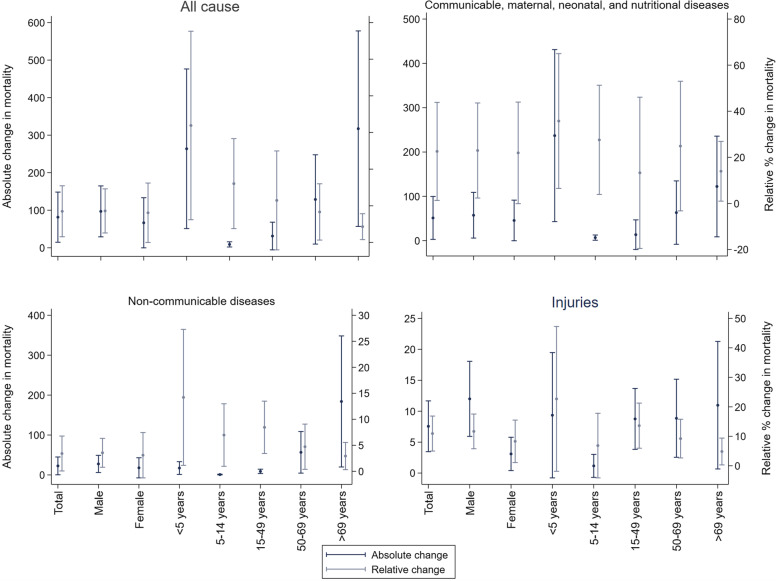
Results: We identified 1118 unique armed conflicts. Armed conflict was associated with increases in civilian mortality-driven by conflicts categorised as wars. Wars were associated with an increase in age-standardised all-cause mortality of 81.5 per 100,000 population (β 81.5, 95% CI 14.3-148.8) in adjusted models contributing 29.4 million civilian deaths (95% CI 22.1-36.6) globally over the study period. Mortality rates from communicable, maternal, neonatal, and nutritional diseases (β 51.3, 95% CI 2.6-99.9); non-communicable diseases (β 22.7, 95% CI 0.2-45.2); and injuries (β 7.6, 95% CI 3.4-11.7) associated with war increased, contributing 21.0 million (95% CI 16.3-25.6), 6.0 million (95% CI 4.1-8.0), and 2.4 million deaths (95% CI 1.7-3.1) respectively. War-associated increases in all-cause and cause-specific mortality were found across all age groups and both genders, but children aged 0-5 years had the largest relative increases in mortality.
Conclusions: Armed conflict, particularly war, is associated with a substantial indirect mortality impact among civilians globally with children most severely burdened.
Keywords: Conflict; Health; Mortality; War.
Conflict of interest statement
The authors declare that they have no competing interests.
Figures
References
-
- Uppsala Universitet. Department of Peace and Conflict Research [online]. Available at: https://bit.ly/2Xant85 [Date of Access 27 June 2019].
-
- UN Chronical. Implemeting the 2030 Agenda: the challenge of conflict [online]. Available at: https://bit.ly/2aucPAX [Date of Access 15 July 2019]. 2015.
-
- Iqbal Z, Zorn C. Violent conflict and the spread of HIV/AIDS in Africa. J Polilt. 2010;72(1):149–162. doi: 10.1017/S0022381609990533. - DOI
Publication types
MeSH terms
LinkOut - more resources
Full Text Sources
Miscellaneous
