


Caffeine supplementation induces higher IL-6 and IL-10 plasma levels in response to a treadmill exercise test
- PMID: 32907591
- PMCID: PMC7487741
- DOI: 10.1186/s12970-020-00375-4
Caffeine supplementation induces higher IL-6 and IL-10 plasma levels in response to a treadmill exercise test
Abstract
Background: An acute bout of exercise induces an inflammatory response characterized by increases in several cytokines. Caffeine ingestion could modify this inflammatory response. The aim of this study was to determine the effects of caffeine supplementation on plasma levels of cytokines, mainly IL-10 and IL-6, in response to exercise.
Methods: In a randomized, crossover, double-blinded study design, thirteen healthy, well-trained recreational male athletes performed, on two different occasions, a treadmill exercise test (60 min at 70% VO2max) after ingesting 6 mg/kg body mass of caffeine or placebo. Blood samples were taken before exercising, immediately after finishing and 2 h after finishing the exercise. Plasma concentrations of IL-10, IL-6, IL-1β, IL-1ra, IL-4, IL-8, IL-12 and IFN-γ, adrenaline, cortisol and cyclic adenosine monophosphate (cAMP) were determined. The capacity of whole blood cultures to produce cytokines in response to endotoxin (LPS) was also determined. Changes in blood variables were analyzed using a time (pre-exercise, post-exercise, recovery) x condition (caffeine, placebo) within-between subjects ANOVA with repeated measures.
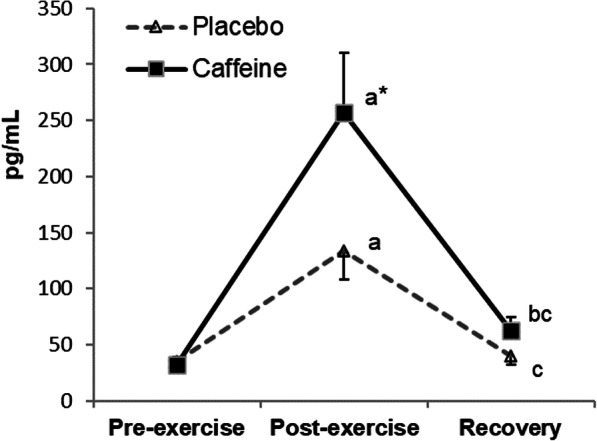
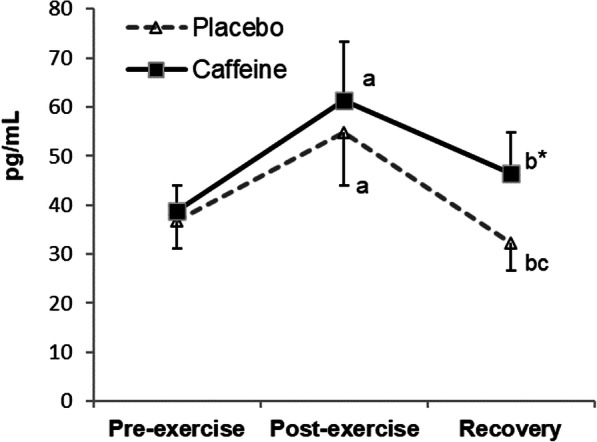
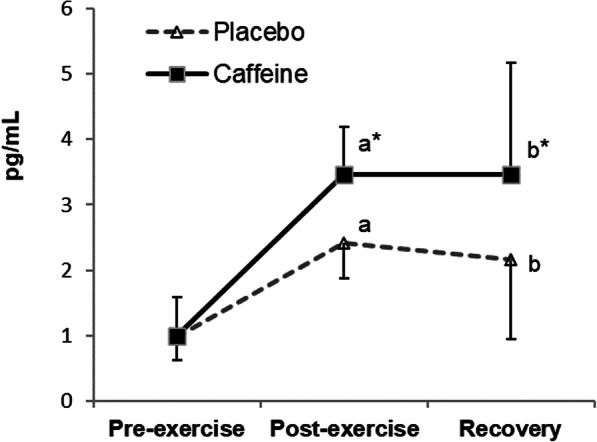
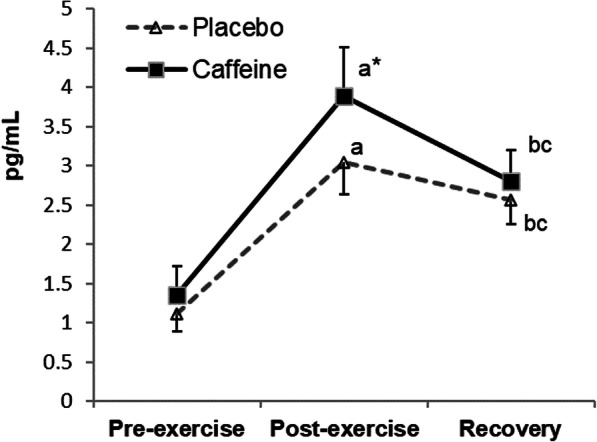
Results: Caffeine supplementation induced higher adrenaline levels in the supplemented participants after exercise (257.3 ± 53.2 vs. 134.0 ± 25.7 pg·mL- 1, p = 0.03) and higher cortisol levels after recovery (46.4 ± 8.5 vs. 32.3 ± 5.6 pg·mL- 1, p = 0.007), but it did not influence plasma cAMP levels (p = 0.327). The exercise test induced significant increases in IL-10, IL-6, IL-1ra, IL-4, IL-8, IL-12 and IFN-γ plasma levels, with IL-6 and IL-10 levels remaining high after recovery. Caffeine supplementation influenced only IL-6 (3.04 ± 0.40 vs. 3.89 ± 0.62 pg·mL- 1, p = 0.003) and IL-10 (2.42 ± 0.54 vs. 3.47 ± 0.72 pg·mL- 1, p = 0.01) levels, with higher concentrations after exercise in the supplemented condition. No effect of caffeine was observed on the in vitro stimulated cytokine production.
Conclusions: The results of the present study indicate a significant influence of caffeine supplementation increasing the response to exercise of two essential cytokines such as IL-6 and IL-10. However, caffeine did not influence changes in the plasma levels of other cytokines measured and the in vitro-stimulated cytokine production.
Keywords: Adrenaline; Caffeine; Cytokines; Exercise; Inflammation.
Conflict of interest statement
The authors declare that they have no competing interests.
Figures
References
-
- Doherty M, Smith PM. Effects of caffeine ingestion on rating of perceived exertion during and after exercise: a meta-analysis. Scand J Med Sci Sports. 2005;15:69–78. - PubMed
-
- Graham TE. Caffeine and exercise: metabolism, endurance and performance. Sports Med. 2001;31:785–807. - PubMed
-
- Chester N, Wojek N. Caffeine consumption amongst British athletes following changes to the 2004 WADA prohibited list. Int J Sports Med. 2008;29:524–8. - PubMed
-
- Fredholm BB, Battig K, Holmen J, Nehlig A, Zvartau EE. Actions of caffeine in the brain with special reference to factors that contribute to its widespread use. Pharmacol Rev. 1999;51:83–133. - PubMed
-
- Pedersen BK, Hoffman-Goetz L. Exercise and the immune system: regulation, integration, and adaptation. Physiol Rev. 2000;80:1055–1081. - PubMed
Publication types
MeSH terms
Substances
Grants and funding
LinkOut - more resources
Full Text Sources
Medical
