


The threat of reduced efficacy of anthelmintics against gastrointestinal nematodes in sheep from an area considered anthelmintic resistance-free
- PMID: 32907633
- PMCID: PMC7487796
- DOI: 10.1186/s13071-020-04329-2
The threat of reduced efficacy of anthelmintics against gastrointestinal nematodes in sheep from an area considered anthelmintic resistance-free
Abstract
Background: The worldwide increased difficulty to combat gastrointestinal nematode (GIN) infection in sheep, due to progressing anthelmintic resistance (AR), calls for an enhanced and standardized implementation of early detection of AR. This study provides a snapshot of the current AR status against benzimidazoles and macrocyclic lactones in southern Italy, generated with standardized techniques.
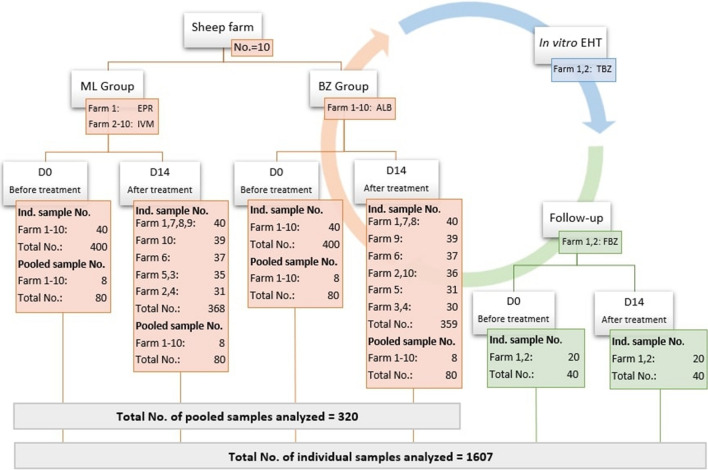
Methods: On 10 sheep farms, the efficacy of albendazole (ALB) and either eprinomectin (EPR) or ivermectin (IVM) was evaluated based on the faecal egg count reduction test (FECRT) performed with the Mini-FLOTAC. For each tested drug, 40 sheep were rectally sampled at D0 and sampled again 14 days after the treatment (D14). The FECRT was calculated from individual samples and pooled samples which consist of 5 individual samples. Efficacy was classified as 'reduced, 'suspected' and 'normal'. Coprocultures were set for D0 and D14 faecal samples of each group. From farms with FECR < 95%, an in vitro egg hatch test (EHT) and a follow-up FECRT using fenbendazole (FBZ) were conducted.
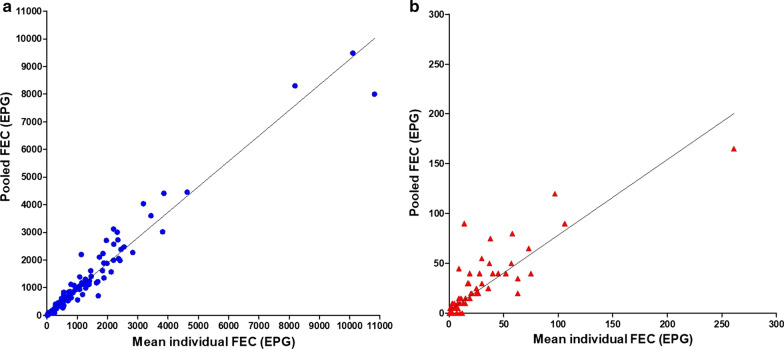
Results: Based on the FECR, high efficacy (from 95.7% to 100%) was observed for ALB and IVM in eight farms (Farms 3-10). On Farm 1 and Farm 2, the efficacy for the macrocyclic lactones was classified as 'normal', but 'reduced' efficacy was observed for ALB on Farm 1 (FECR = 75%) and 'suspected' efficacy on Farm 2 (FECR = 93.3%) with the predominant GIN genus Trichostrongylus followed by Haemonchus at D14. The FEC results of pooled samples strongly correlated with those of individual samples, for FEC at D0 (rs = 0.984; P < 0.0001) and at D14 (rs = 0.913; P < 0.0001). The classifications of efficacy in Farm 1 (FECR = 86.0%) and Farm 2 (FECR = 93.0%) in the follow-up FECRT with FBZ coincide with the main FECRT trial. The in vitro EHT confirmed AR in both farms (Farm 1: 89%; Farm 2: 74%).
Conclusions: In regions like southern Italy, where the negative impacts from AR have played a minor role, efficient monitoring of AR is important in order to evaluate potential risks and being able to promptly respond with countermeasures.
Keywords: Anthelmintic resistance; Egg hatch test; Faecal egg count reduction test; Gastrointestinal nematodes; Pooling faecal samples; Sheep.
Conflict of interest statement
The authors declare that they have no competing interests.
Figures
References
-
- Mavrot F. Livestock nematode infection in a changing world: investigating the European situation. Publisher City: University of Zurich; 2016.
-
- Glover M, Clarke C, Nabb L, Schmidt J. Anthelmintic efficacy on sheep farms in south-west England. Vet Rec. 2017;180:378. - PubMed
-
- Charlier J, Rinaldi L, Musella V, Ploeger HW, Chartier C, Rose Vineer H, et al. Initial assessment of the burden of parasitic helminth infections to the ruminant livestock industry in Europe. Prev Vet Med. 2020;182:105103. - PubMed
-
- Kaplan RM, Vidyashankar AN. An inconvenient truth: global worming and anthelmintic resistance. Vet Parasitol. 2012;186:70–78. - PubMed
MeSH terms
Substances
LinkOut - more resources
Full Text Sources
Research Materials
Miscellaneous
