


Calcium Montmorillonite-Based Dietary Supplement Attenuates Necrotic Enteritis Induced by Eimeria maxima and Clostridium perfringens in Broilers
- PMID: 32908401
- PMCID: PMC7477164
- DOI: 10.2141/jpsa.0150182
Calcium Montmorillonite-Based Dietary Supplement Attenuates Necrotic Enteritis Induced by Eimeria maxima and Clostridium perfringens in Broilers
Abstract
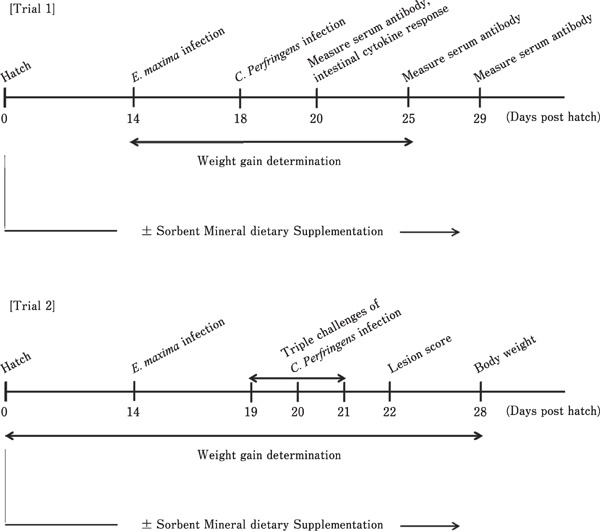
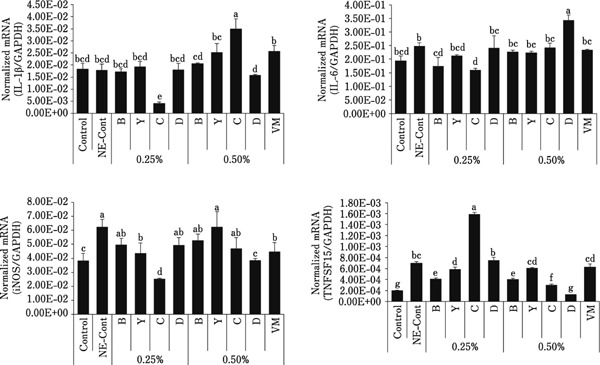
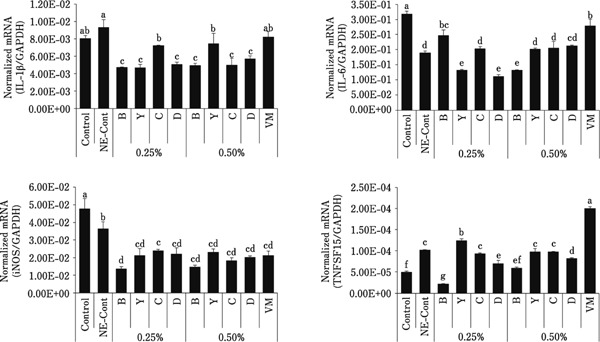
Necrotic enteritis (NE) is a poultry disease caused by Clostridium perfringens and characterized by severe intestinal necrosis. The incidence of avian NE has been progressively increasing following the removal of antibiotics from poultry feed. We evaluated the effect of diets supplemented with the thermally-processed clays, calcium montmorillonite (CaMM) on clinical signs, immunopathology, and cytokine responses in broiler chickens using an experimental model of NE consisting of co-infection with Eimeria maxima and C. perfringens. In Trial 1, Ross/Ross chickens were fed from hatch with a normal basal diet or a CaMM-supplemented diet with or without a fermentable fiber, an organic acid, and/or a plant extract, and co-infected with E. maxima and C. perfringens under conditions simulating clinical infection in the field. Chickens fed a diet supplemented with CaMM plus a fermentable fiber and an organic acid had increased body weight gain, reduced gut lesions, and increased serum antibody levels to C. perfringens α-toxin and NetB toxin compared with chickens fed the basal diet alone. Levels of transcripts for interleukin-1β (IL-1β), IL-6, inducible nitric oxide synthase, and tumor necrosis factor-α superfamily-15 were significantly altered in the intestine and spleen of CaMM-supplemented chickens compared with unsupplemented controls (p<0.05). In Trial 2, Cobb/Cobb chickens were fed an unsupplemented diet or a diet supplemented with CaMM or Varium®, each with a fermentable fiber and an organic acid, and co-infected with E. maxima and C. perfringens under subclinical infection conditions. Compared with unsupplemented controls, broilers fed with CaMM plus a fermentable fiber and an organic acid had increased body weight gain, and reduced feed conversion ratio, mortality, and intestinal lesions, compared with chickens fed an unsupplemented diet (p<0.05). Dietary supplementation of broiler chickens with CaMM plus a fermentable fiber and an organic acid might be useful to control avian NE in the field.
Keywords: Clostridium perfringens; Eimeria maxima; calcium montmorillonite; coccidiosis; necrotic enteritis; organic acid.
2016, Japan Poultry Science Association.
Conflict of interest statement
The authors have the following competing interests. The study was supported in part by a trust from Amlan International, Inc. and authors BL, FC and RLC are employees of Amlan. Some products (Varium®) are under development stage based on data presented in this report. This does not alter the authors' adherence to all the journal's policies on sharing data and materials, as in the guidance for authors.
Figures
References
-
- Branton SL, Lott BD, Deaton JW, Maslin WR, Austin FW, Pote LM, Keirs RW, Latour MA, Day EJ. The effect of added complex carbohydrates or added dietary fiber on necrotic enteritis lesions in broiler chickens. Poultry Science, 76: 24-28. 1997. - PubMed
-
- Cravens RL, Goss GR, Chi F, De Boer ED, Davis SW, Hendrix SM, Richardson JA, Johnston SL. The effects of necrotic enteritis, aflatoxin B1, and virginiamycin on growth performance, necrotic enteritis lesion scores, and mortality in young broilers. Poultry Science, 92: 1997-2004. 2013. - PubMed
-
- Dalloul RA, Lillehoj HS, Klinman DM, Ding X, Min W, Heckert RA, Lillehoj EP. In ovo administration of CpG oligodeoxynucleotides and the recombinant microneme protein MIC2 protects against Eimeria infections. Vaccine, 23: 3108-3113. 2005. - PubMed
-
- Drew MD, Syed NA, Goldade BG, Laarveld B, Van Kessel AG. Effects of dietary protein source and level on intestinal populations of Clostridium perfringens in broiler chickens. Poultry Science, 83: 414-420. 2004. - PubMed
-
- Federation of Animal Science Societies (FASS). Guide for the care and use of agricultural animals in research and teaching. Champaign (IL): Federation of Animal Science Societies; 2010.
LinkOut - more resources
Full Text Sources
Other Literature Sources
