. 2020 Dec;35(6):776-784.
doi: 10.1007/s12250-020-00288-1. Epub 2020 Sep 10.

Comparative Antiviral Efficacy of Viral Protease Inhibitors against the Novel SARS-CoV-2 In Vitro

Affiliations

Comparative Antiviral Efficacy of Viral Protease Inhibitors against the Novel SARS-CoV-2 In Vitro

Leike Zhang et al. Virol Sin. 2020 Dec.

Abstract

The recent outbreak of novel coronavirus pneumonia (COVID-19) caused by a new coronavirus has posed a great threat to public health. Identifying safe and effective antivirals is of urgent demand to cure the huge number of patients. Virus-encoded proteases are considered potential drug targets. The human immunodeficiency virus protease inhibitors (lopinavir/ritonavir) has been recommended in the global Solidarity Trial in March launched by World Health Organization. However, there is currently no experimental evidence to support or against its clinical use. We evaluated the antiviral efficacy of lopinavir/ritonavir along with other two viral protease inhibitors in vitro, and discussed the possible inhibitory mechanism in silico. The in vitro to in vivo extrapolation was carried out to assess whether lopinavir/ritonavir could be effective in clinical. Among the four tested compounds, lopinavir showed the best inhibitory effect against the novel coronavirus infection. However, further in vitro to in vivo extrapolation of pharmacokinetics suggested that lopinavir/ritonavir could not reach effective concentration under standard dosing regimen [marketed as Kaletra®, contained lopinavir/ritonavir (200 mg/50 mg) tablets, recommended dosage is 400 mg/10 mg (2 tablets) twice daily]. This research concluded that lopinavir/ritonavir should be stopped for clinical use due to the huge gap between in vitro IC50 and free plasma concentration. Nevertheless, the structure-activity relationship analysis of the four inhibitors provided further information for de novel design of future viral protease inhibitors of SARS-CoV-2.

Keywords: COVID-19; Protease inhibitor; Respiratory pharmacology; SARS-CoV-2.


Conflict of interest statement

The authors declare that they have no conflict of interest.

Figures
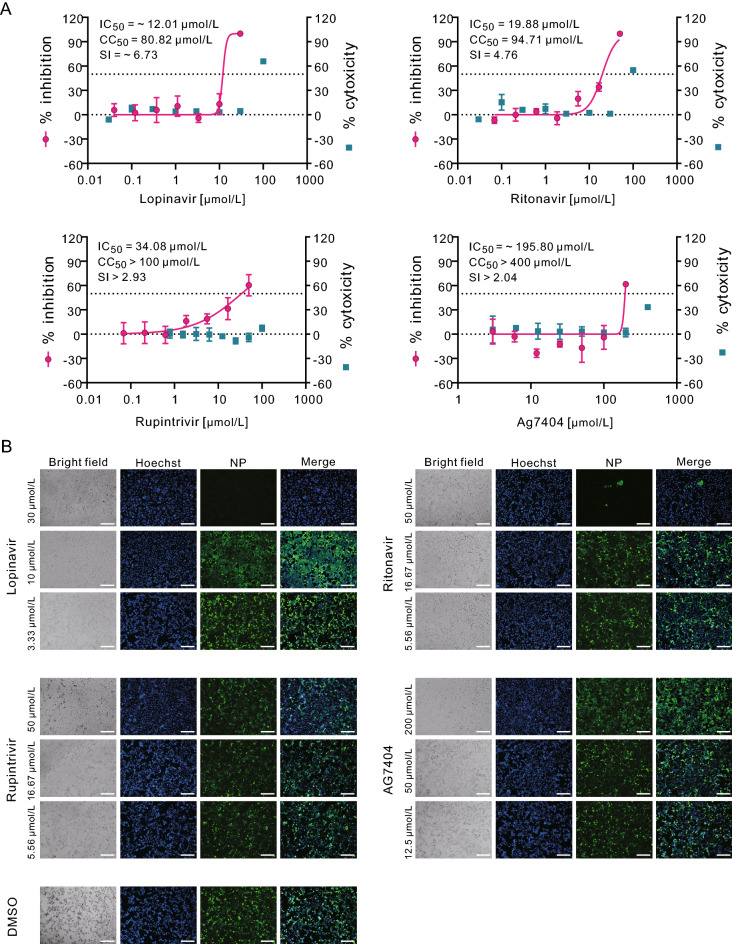
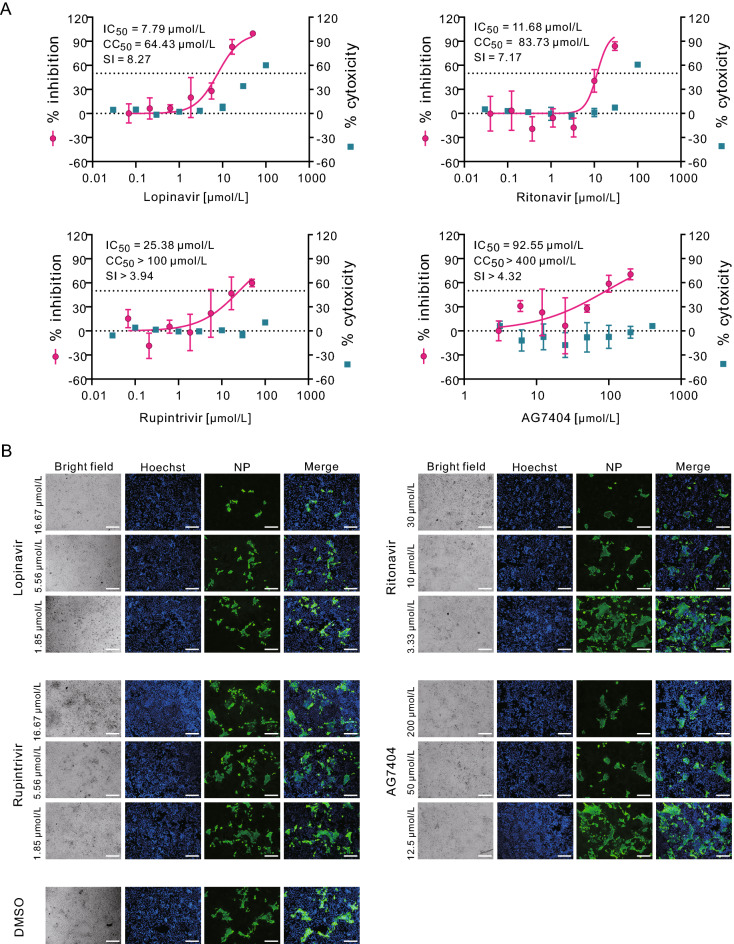
Fig. 1
Fig. 1
In vitro inhibition of viral protease inhibitors against SARS-CoV-2 in Vero E6 cells. Vero E6 cells were infected with SARS-CoV-2 at an MOI of 0.2 in the treatment of different concentrations of the indicated compounds or DMSO control. At 48 h p.i., cell supernatants were collected and cells were fixed. A The viral yield in the cell supernatant was quantified by qRT-PCR. Cytotoxicity of these drugs to Vero E6 cells was measured by CCK-8 assays. The left and right Y-axis of the graphs represent mean % inhibition of virus yield and % cytotoxicity of the drugs, respectively. The experiments were done in triplicates. B Fixed cells were subjected to IFA by employing anti-NP rabbit sera. The nuclei were stained with Hoechst dye. Bars, 100 μm.
Fig. 2
Fig. 2
In vitro inhibition of viral protease inhibitors against SARS-CoV-2 in Huh7 cells. Huh7 cells were infected with SARS-CoV-2 at an MOI of 0.1 in the treatment of different concentrations of the indicated compounds. At 48 h p.i., cell supernatants were collected and cells were fixed. A The viral yield in the cell supernatant was quantified by qRT-PCR. Cytotoxicity of these drugs to Vero E6 cells was measured by CCK-8 assays. The left and right Y-axis of the graphs represent mean % inhibition of virus yield and % cytotoxicity of the drugs, respectively. The experiments were done in triplicates. B Fixed cells were subjected to IFA by employing anti-NP rabbit sera. The nuclei were stained with Hoechst dye. Bars, 100 μm.
Fig. 3
Fig. 3
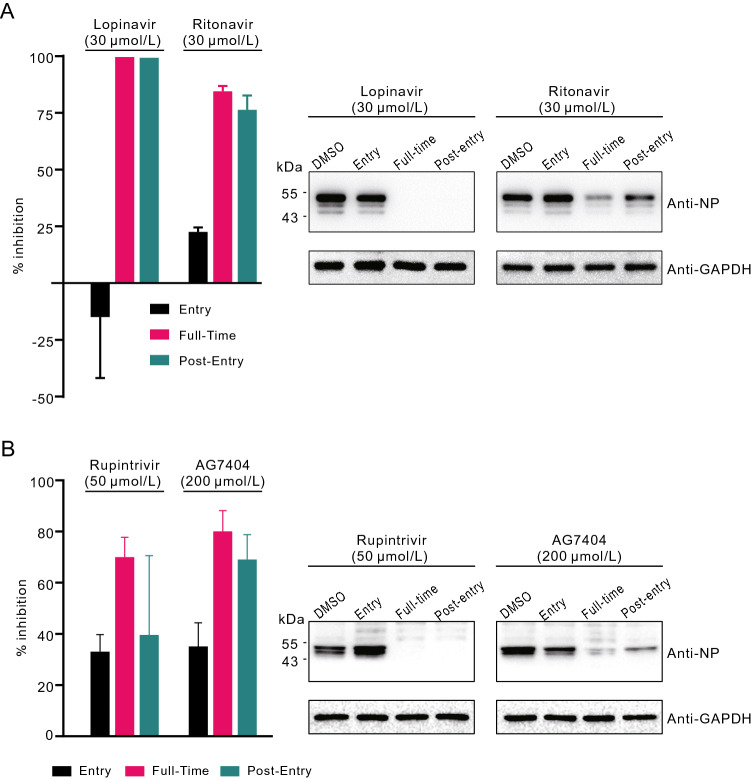
Time-of-drug-addition experiment of viral protease inhibitors. Time-of-drug-addition experiment of lopinavir and ritonavir (A) or rupintrivir and AG7404 (B). For “full-time” treatment, Vero E6 cells were pre-treated with indicated compounds for 1 h, and infected with SARS-CoV-2. Two hours later, the virus–drug mixture was removed, and the cells were cultured with compound-containing medium until the end of the experiment. For “Entry” treatment, Vero E6 cells were pre-treated with indicated compounds for 1 h, and infected with SARS-CoV-2. Two hours later, the virus–drug mixture was removed, and the cells were cultured with fresh culture medium until the end of the experiment. For “Post-entry” experiment, Vero E6 cells were infected with SARS-CoV-2. Two hours later, the virus-containing medium was removed, and the cells were cultured with compound-containing medium until the end of the experiment. For all treatments, an MOI of 0.2 was used for lopinavir and ritonavir groups, and an MOI of 0.05 was used for rupintrivir and AG7404 groups. At 14 h p.i., virus yield in the infected cell supernatants was quantified by qRT-PCR (left) and NP expression in infected cells was analyzed by Western blot (right).
Fig. 4
Fig. 4
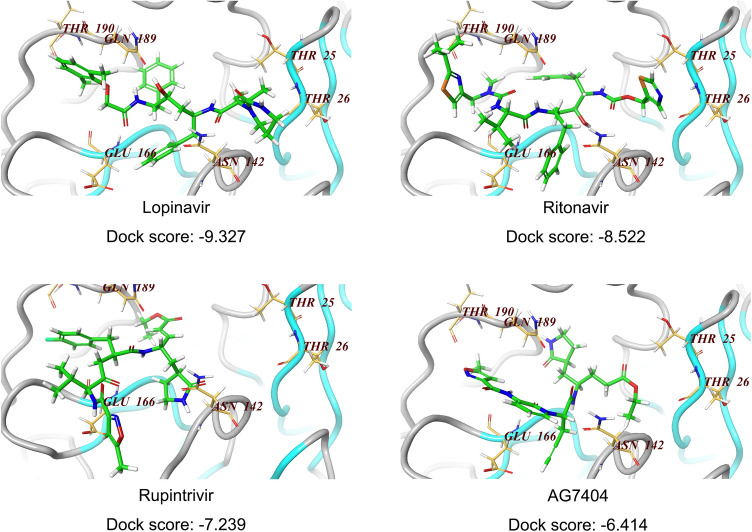
Docking of compounds on active site of SARS-CoV-2 3CLpro homology model. For molecular docking, the compounds (lopinavir, ritonavir, rupintrivir, AG7404) were built and subjected to the optimize geometry calculation in mechanics using MMFF94 parameter at DS2.5. The compounds were then docked at the homology model of SARS-CoV-2 3CLpro using Schrodinger Glide program. The docking scores of these four compounds were calculated and listed below.

References

    1. Anand K, Ziebuhr J, Wadhwani P, Mesters JR, Hilgenfeld R. Coronavirus main proteinase (3CLpro) structure: basis for design of anti-SARS drugs. Science. 2003;300:1763–1767. doi: 10.1126/science.1085658. - DOI - PubMed
    1. Cao B, Wang Y, Wen D, Liu W, Wang J, Fan G, Ruan L, Song B, Cai Y, Wei M, Li X, Xia J, Chen N, Xiang J, Yu T, Bai T, Xie X, Zhang L, Li C, Yuan Y, Chen H, Li H, Huang H, Tu S, Gong F, Liu Y, Wei Y, Dong C, Zhou F, Gu X, Xu J, Liu Z, Zhang Y, Li H, Shang L, Wang K, Li K, Zhou X, Dong X, Qu Z, Lu S, Hu X, Ruan S, Luo S, Wu J, Peng L, Cheng F, Pan L, Zou J, Jia C, Wang J, Liu X, Wang S, Wu X, Ge Q, He J, Zhan H, Qiu F, Guo L, Huang C, Jaki T, Hayden FG, Horby PW, Zhang D, Wang C. A trial of lopinavir-ritonavir in adults hospitalized with severe Covid-19. N Engl J Med. 2020;382:1787–1799. doi: 10.1056/NEJMoa2001282. - DOI - PMC - PubMed
    1. Choy KT, Wong AY, Kaewpreedee P, Sia SF, Chen D, Hui KPY, Chu DKW, Chan MCW, Cheung PP, Huang X, Peiris M, Yen HL. Remdesivir, lopinavir, emetine, and homoharringtonine inhibit SARS-CoV-2 replication in vitro. Antiviral Res. 2020;178:104786. doi: 10.1016/j.antiviral.2020.104786. - DOI - PMC - PubMed
    1. Croxtall JD, Perry CM. Lopinavir/Ritonavir: a review of its use in the management of HIV-1 infection. Drugs. 2010;70:1885–1915. doi: 10.2165/11204950-000000000-00000. - DOI - PubMed
    1. Cvetkovic RS, Goa KL. Lopinavir/ritonavir: a review of its use in the management of hiv infection. Drugs. 2003;63:769–802. doi: 10.2165/00003495-200363080-00004. - DOI - PubMed

MeSH terms

LinkOut - more resources