. 2020 Nov 13;41(11):1498-1506.
doi: 10.1093/carcin/bgaa097.

Clinical significance of a microRNA signature for the identification and predicting prognosis in colorectal cancers with mucinous differentiation

Affiliations

Clinical significance of a microRNA signature for the identification and predicting prognosis in colorectal cancers with mucinous differentiation

Juan Ruiz-Bañobre et al. Carcinogenesis. .

Abstract

Accumulating evidence supports the fact that the mere presence of mucinous differentiation in colorectal cancer (CRC), rather than its proportion, is a more accurate representative of a particular CRC subtype with distinct clinical and molecular features. In addition, the prognostic significance of the mucinous carcinoma (MC) subtype remains poorly understood and biomarkers have been barely explored in this disease. Herein, we have performed a systematic and comprehensive analysis in MCs and non-MCs and identified a panel of microRNAs (miRNAs) that are differentially expressed between these two subtypes of CRC. Next, we interrogated their clinical significance and demonstrated their robust diagnostic and prognostic clinical ability in CRCs with mucinous differentiation. Finally, we established an integrative risk-assessment model by combining the miRNA-based risk scores together with TNM staging, which was a superior predictor of prognosis in mucinous CRC patients. Collectively, we report a novel miRNA biomarker panel for the identification and predicting survival in CRC patients with mucinous differentiation.


Figures

Figure 1.
Figure 1.
TCGA-based discovery phase. Volcano plot depicting differential miRNA expression profile of MC compared with non-MC after applying the requisite sequencing miRNA sequencing (miRNA-seq) quality assurance criterion. The log2(fold change) between MC and non-MC is shown on the x-axis. The y-axis represents the log10(q-value) by t-test method (A). Violin plots of the six dysregulated miRNAs identified from miRNA-seq data from the TCGA data set showing one upregulated miRNA (miR-31) and five downregulated miRNAs (miR-196-b, miR-592, miR-1247, miR-1269 and miR-552) in MC compared with non-MC (B). ROC curve using the mucinous differentiation-associated miRNA-based panel. The area under the curve (AUC) value of distinguishing MC from non-MC was 0.835 (p < 0.0001) (C). OS analysis by Kaplan–Meier method based on miRNA-based score (high versus low) in MC patients from the TCGA cohort (D).
Figure 2.
Figure 2.
Expression levels of six mucinous differentiation-associated candidate miRNAs and ROC curve using the mucinous differentiation-associated miRNA-based panel from independent clinical patient cohorts. Relative expression of selected one upregulated miRNA (miR-31) and five downregulated miRNAs (miR-196-b, miR-592, miR-1247, miR-1269 and miR-552) in CRC with mucinous differentiation (CMD) compared with AC NOS in cohort 1, 29 CMD and 30 AC NOS (A), and cohort 2, 56 CMD and 35 AC NOS (B). The area under the curve (AUC) value of distinguishing CMD from AC NOS was 0.922 (P < 0.0001) in cohort 1 (A) and 0.799 (P < 0.0001) in cohort 2 (B).
Figure 3.
Figure 3.
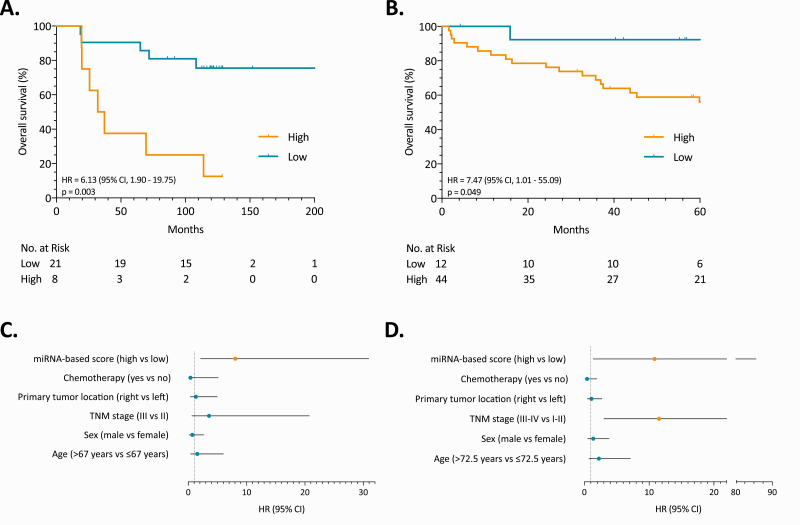
Kaplan–Meier survival analysis based on miRNA-based score (high versus low) and multivariate Cox regression analysis in CRCs with mucinous differentiation from cohort 1 and cohort 2. Kaplan–Meier curves for OS in cohort 1 (A) and in cohort 2 (B). Forest plot representing the multivariate Cox regression analysis (dots represent HR; lines represent 95% CIs) in cohort 1 (C) and cohort 2 (D).
Figure 4.
Figure 4.
AICc comparison for multiple Cox proportional hazards regression models and multivariate Cox regression analysis in CRCs with mucinous differentiation from cohort 1 and cohort 2. AICc value for the models tested in cohort 1 (A) and cohort 2 (B). Forest plot representing the multivariate Cox regression analysis (dots represent HR; lines represent 95% CIs) in cohort 1 (C) and cohort 2 (D).

References

    1. Bosman, FT et al. (2010). WHO Classification of Tumours of the Digestive System. 4th edn. In Bosman, F T, Carneiro, F, Hruban RH and Theise ND (eds). IARC Press, France, Lyon.
    1. Hugen, N et al. (2014) Insight into mucinous colorectal carcinoma: clues from etiology. Ann. Surg. Oncol., 21, 2963–2970. - PubMed
    1. Hugen, N et al. (2016) Advances in the care of patients with mucinous colorectal cancer. Nat. Rev. Clin. Oncol., 13, 361–369. - PubMed
    1. Hyngstrom, JR et al. (2012) Clinicopathology and outcomes for mucinous and signet ring colorectal adenocarcinoma: analysis from the National Cancer Data Base. Ann. Surg. Oncol., 19, 2814–2821. - PMC - PubMed
    1. Biemer-Hüttmann, AE et al. (2000) Mucin core protein expression in colorectal cancers with high levels of microsatellite instability indicates a novel pathway of morphogenesis. Clin. Cancer Res., 6, 1909–1916. - PubMed

Publication types