


Socio-economic inequalities in suffering at the end of life among advanced cancer patients: results from the APPROACH study in five Asian countries
- PMID: 32912232
- PMCID: PMC7488341
- DOI: 10.1186/s12939-020-01274-5
Socio-economic inequalities in suffering at the end of life among advanced cancer patients: results from the APPROACH study in five Asian countries
Abstract
Background: A systematic understanding of socio-economic inequalities in end-of-life (EOL) suffering among advanced cancer patients is required to inform efforts to reduce these inequalities as part of Universal Health Coverage goals.
Aims: To assess inequalities in multiple domains of EOL suffering among advanced cancer patients - physical, functional, psychological, social, and spiritual -, using two socio-economic status (SES) indicators, education and perceived economic status of the household.
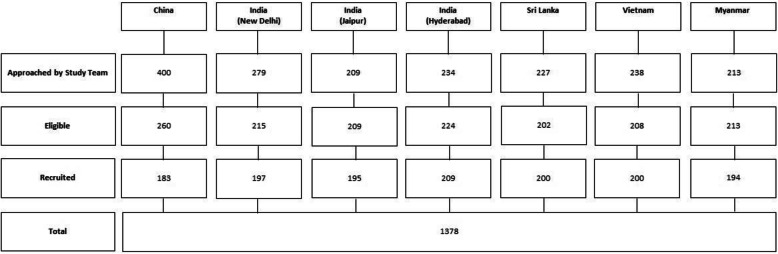
Methods: We used cross-sectional data from surveys of stage IV cancer patients (n = 1378) from seven hospitals across five countries (China, Sri Lanka, India, Vietnam and Myanmar). We conducted separate multivariable linear regression models for each EOL suffering domain. We also tested interactions between the two SES indicators and between each SES indicator and patient age.
Results: Patients living in low economic status households /with fewer years of education reported greater suffering in several domains. We also found significant interaction effects between economic status of the household and years of education for all EOL suffering outcomes. Age significantly moderated the association between economic status of the household and social suffering and between years of education and psychological, social, and spiritual suffering (p < 0.05 for all).
Conclusion: Results highlight that SES inequalities in EOL suffering vary depending on the suffering domain, the SES indicator assessed, and by patient age. Greater palliative care resources for patients with low SES may help reduce these inequalities.
Keywords: Economic status; End of life; Inequalities; Metastasis.
Conflict of interest statement
The authors declare that they have no competing interests.
Figures


References
-
- Committee IMU. Sloan FA GH, editor. Cancer Control Opportunities in Low- and Middle-Income Countries. Washington (DC): The National Academies Press (U.S.); 2007. The Cancer Burden in Low- and Middle-Income Countries and How It Is Measured. - PubMed
-
- Krikorian A, Limonero JT, Maté J. Suffering and distress at the end-of-life. Psycho-Oncology. 2012;21(8):799–808. - PubMed
-
- Wilson KG, Chochinov HM, McPherson CJ, LeMay K, Allard P, Chary S, et al. Suffering with advanced cancer. J Clin Oncol. 2007;25(13):1691–1697. - PubMed
-
- Knaul FM, Farmer PE, Krakauer EL, De Lima L, Bhadelia A, Kwete XJ, et al. Alleviating the access abyss in palliative care and pain relief—an imperative of universal health coverage: the lancet commission report. Lancet. 2018;391(10128):1391–1454. - PubMed
Publication types
MeSH terms
LinkOut - more resources
Full Text Sources
Medical
