Maternal Anxiety and Depression during Late Pregnancy and Newborn Brain White Matter Development
- PMID: 32912873
- PMCID: PMC7661088
- DOI: 10.3174/ajnr.A6759
Maternal Anxiety and Depression during Late Pregnancy and Newborn Brain White Matter Development
Abstract
Background and purpose: Anxiety and depression during pregnancy have been associated with an increased risk of adverse neurodevelopmental outcomes in offspring. We aimed to study the in utero effects of maternal anxiety and depression on early brain development.
Materials and methods: Pregnant women were recruited at ∼36 weeks of gestation for this prospective study. They were assessed for anxiety symptoms by the State-Trait Anxiety Inventory and for depression symptoms by the Beck Depression Inventory, 2nd Edition. After delivery, infant underwent an MR imaging examination of the brain without sedation, including DTI, for evaluation of white matter (WM) development. Infant fractional anisotropy values, a putative marker of WM integrity, were correlated with the mothers' State-Trait Anxiety Inventory and Beck Depression Inventory scores by using both tract-based spatial statistics and ROI methods.
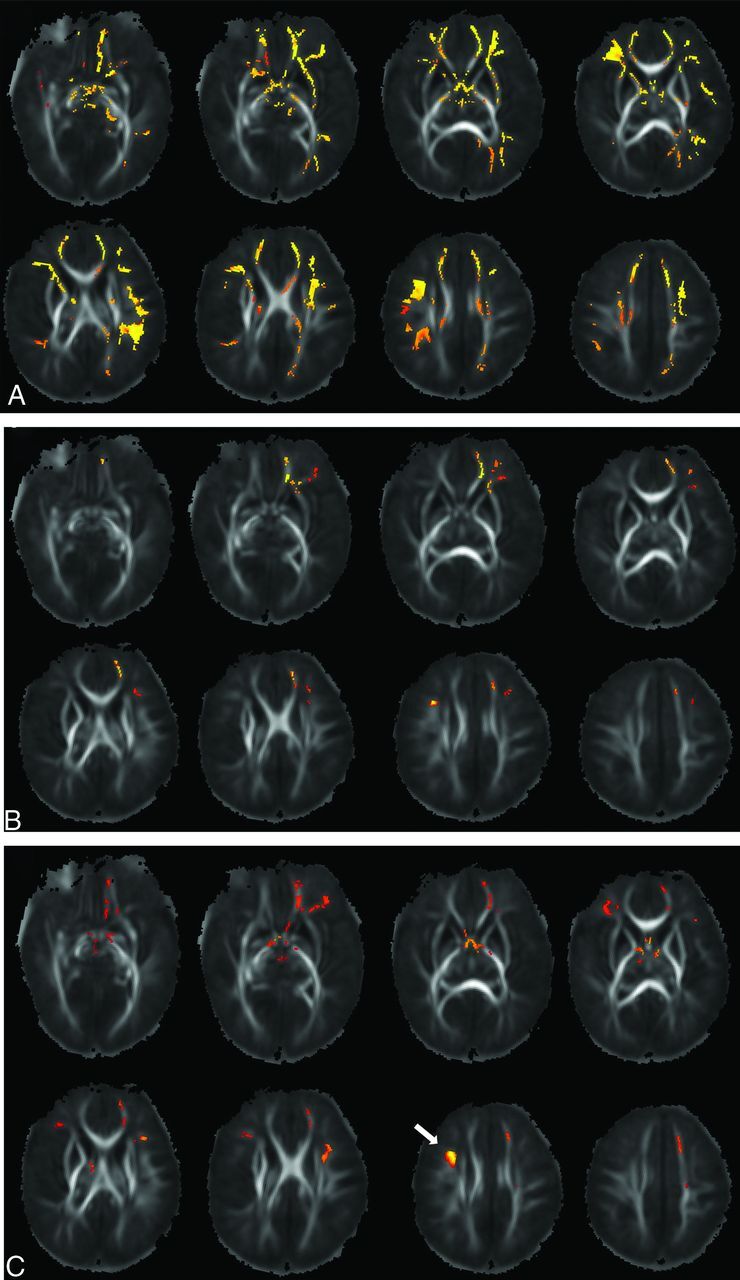
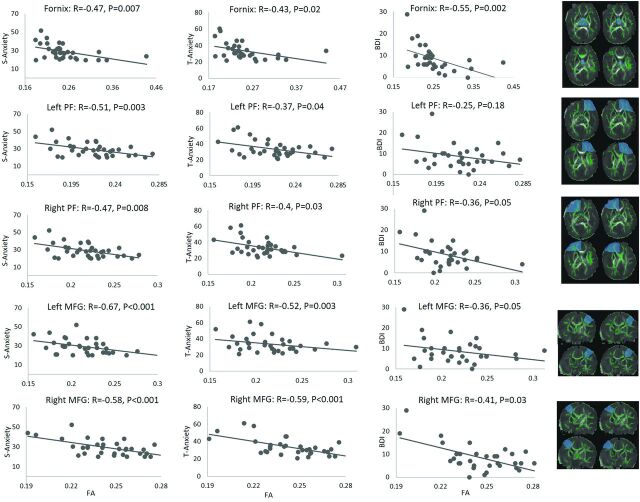
Results: Thirty-four infants were included in this study. Both maternal State-Anxiety and Trait-Anxiety scores negatively correlated (P < .05, corrected) with fractional anisotropy values in widespread brain WM regions; Beck Depression Inventory scores also negatively correlated (P < .05) with fractional anisotropy values in one cluster in the brain. Further ROI analyses confirmed significant negative correlations between average fractional anisotropy values in ROIs including left and right prefrontal WM, left and right middle frontal gyrus WM, and the fornix, and State-Anxiety (R values, -0.47 to -0.67; P values, .008 to <.001), Trait-Anxiety (R, -0.37 to -0.59; P, .04 to <.001), and Beck Depression Inventory (R values, -0.36 to -0.55; P, .05 to .002) scores.
Conclusions: Higher maternal anxiety and depression symptom scores during late pregnancy were associated with lower estimated infant brain WM development, which indicated in utero influences of maternal mental health during pregnancy on the developing brain.
© 2020 by American Journal of Neuroradiology.
Figures